Here we are, Friday morning, and I’ve just finished in the gym.
It’s brightening up now. Blue sky, sun out. Quite different from last night, which was all howling wind, rain, thunder and lightning.
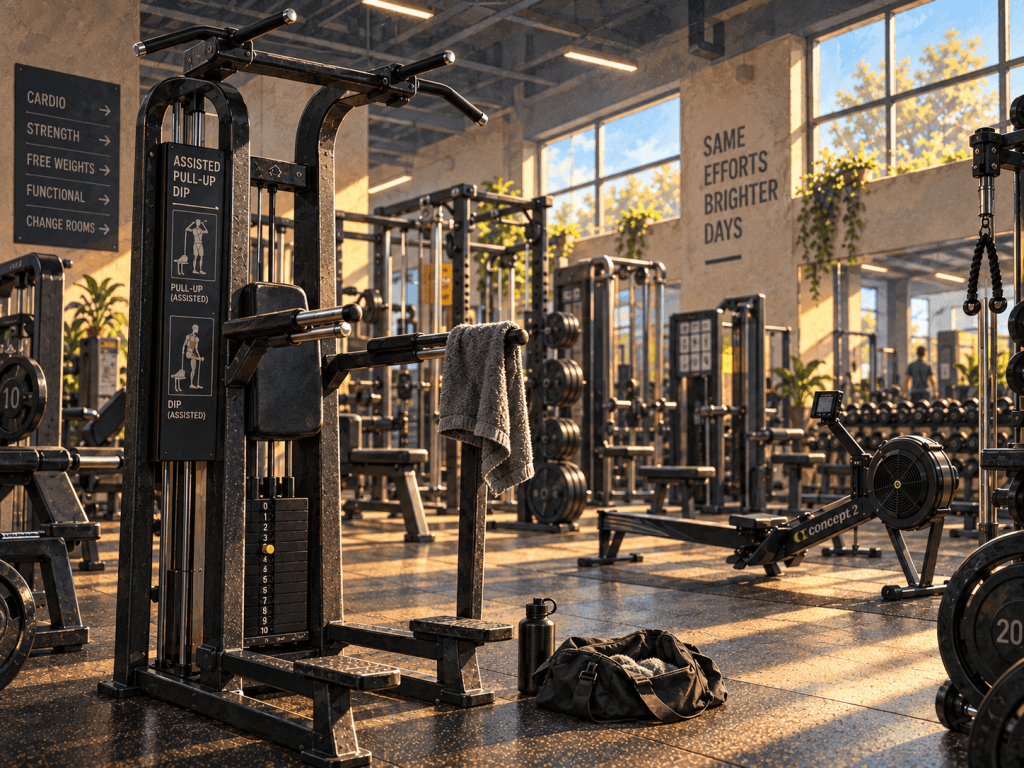
As for the gym, I woke up this morning feeling oddly apprehensive about going. They’ve refurbished it, and I realised I felt a bit like I did back at the start of this whole experiment: slightly intimidated and a bit overwhelmed.
They’ve been posting photos of the refurbishment on Instagram, and I couldn’t see a rowing machine anywhere. That bothered me more than I expected, because the rower has always been my safe zone in any gym. I know how to use it, I know what I’m doing on it, and after all this time I can hold a decent pace without feeling like an amateur.
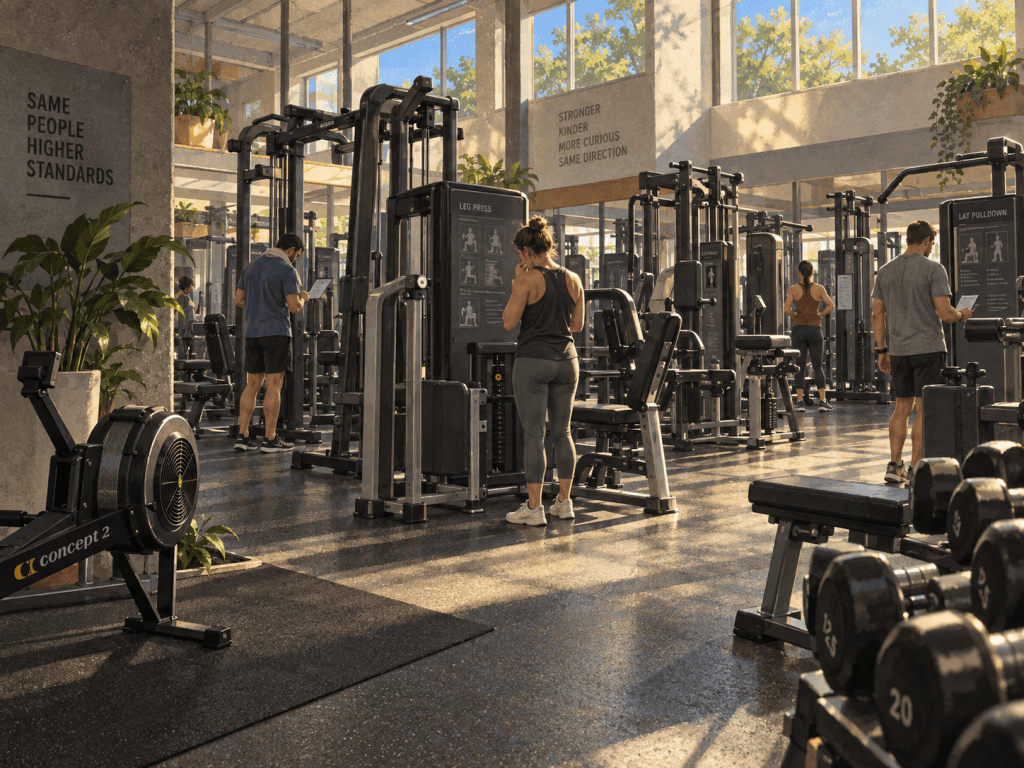
So it was a relief to find they do have one, and not just any rower either. A lovely new Concept2. Tucked away, as gym rowers often are, but that’s fine. I know where it is now. It’s smooth and buttery, a lot like mine in the shed.
They’ve done a really good job with the refurbishment. There’s loads of new equipment and a few new machines to discover and have a go on. I tried a couple of them and all in all I’m quite happy with it.
That said, it is still a bit overwhelming in there.
There were a couple of moments where I found myself just standing there, looking around at this forest of strange-looking scaffolding, plates, handles, pads and seats, thinking: what exactly am I supposed to do here?
So I did what made sense. I found a machine I recognised, did a few bits on that, and then gradually started looking at the others.
The interesting thing, though, was this: because the gym only reopened on Saturday and this was only Wednesday, even the well-fit gym goers, the muscular and honed ones, were also wandering around looking at the new machines, reading the instructions, and scratching their heads a bit.
That made me think.
Maybe I’ve been seeing myself as the outsider in this gym community, when actually I’m just another person in the room figuring things out. Maybe the next step is not just learning the machines, but saying hello to people rather than skulking around in my headphones.
Early days. We’ll see.
For now, I’m pleased with the workout, pleased with the new gym, and glad I went.
After the long, hot, dry summer we’ve had, this weekend has been properly rainy. I was hoping to get out on the bike, especially with the Dingle Peninsula trip coming up in two weekends’ time. It’s only 120km, but I wanted to get a bit of practice in this weekend, maybe 60km or so, just to keep the legs used to longer rides.
That didn’t happen.
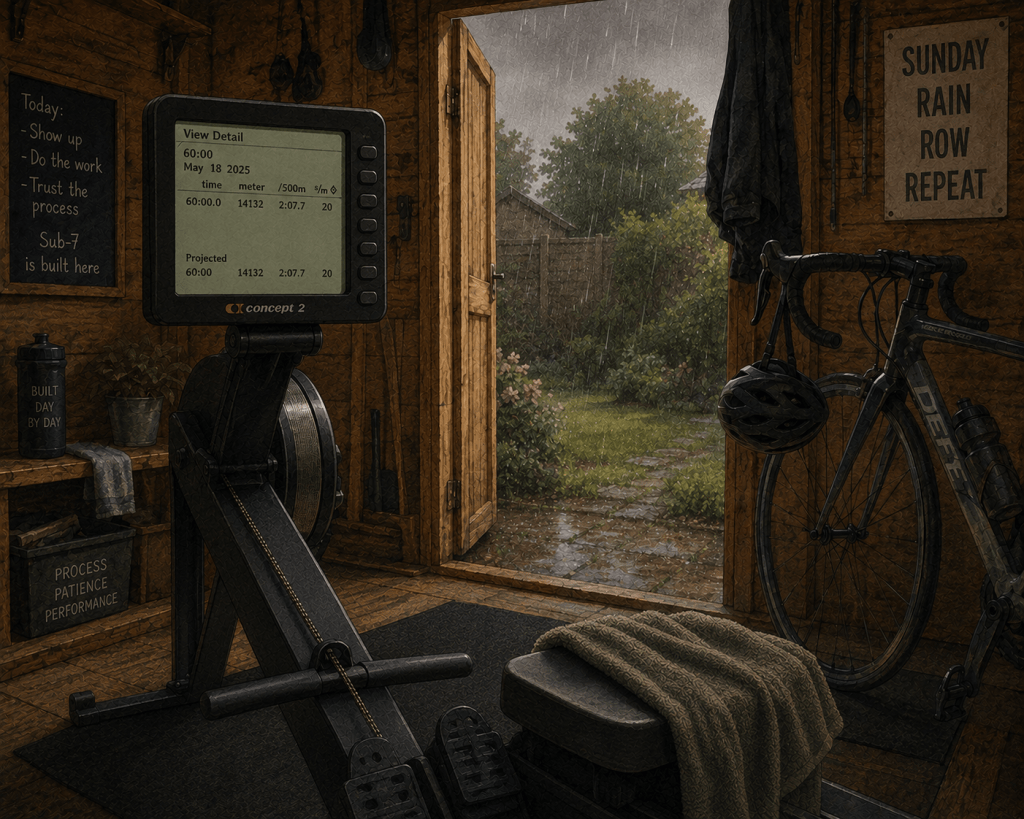
Instead, I’ve just come off the rower. Actually, I’m still sitting on it as I write this, recovering.
The session was three 20-minute blocks, giving me an hour in total. Gradual progression, getting faster as it went on. Nothing frantic, just steady work.
The thing that amazes me is that I did the full 60 minutes, just over 14km, at an average pace of 2:09/500m.
Thinking about it, that’s pretty mind-blowing. There was a time when I could only sustain that pace for short bursts. Not 30 minutes. Not even close. More like 30 seconds.
And here I am now, averaging it for a whole hour.
So yes, there is definitely progress happening. Sometimes it’s hard to see when you’re in the middle of it, but numbers like that make it pretty clear. The aerobic base is there. The cruising speed is improving. The work is paying off.
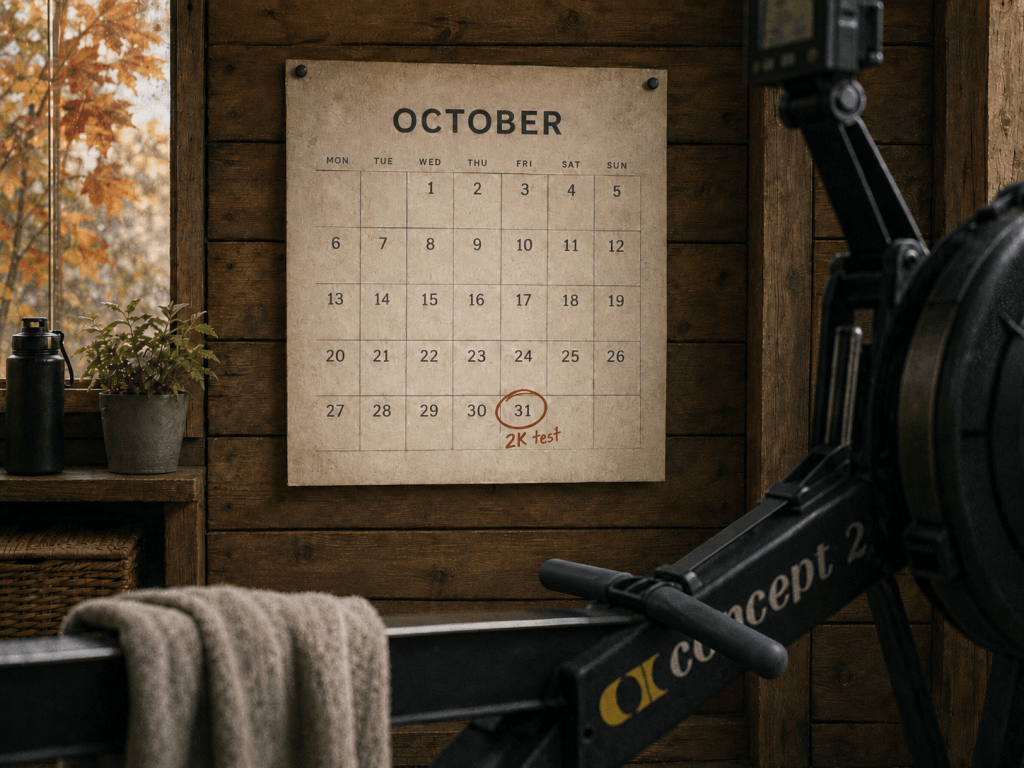
Cycling around Dingle is coming in a couple of weeks. The 2K test is still the target for the end of October.
I mentioned recently that ChatGPT seems to remember what it wants to remember, and that sometimes you have to specifically tell it what to forget.
It turns out you probably have to specifically tell it what to remember too.
So that is what I did.
I told Coach ChatGPT to remember this: we are aiming for a sub-7-minute 2,000m row. I also told it that I want to aim for a 2K test at the end of October, and to adjust the training plans accordingly.
And I have to admit, the last three sessions suggest that it has listened.
The workouts are getting progressively harder. They feel more focused, more purposeful, and more aligned with the actual goal. That is what we need.
I don’t know if I’ll be ready for the full sub-7 attempt by the end of October. That might still be too soon. But if I can beat my previous best of 7:20, I’ll be happy with that. That would be real progress and a proper marker for where I am.
Today was a good one.
I did a 6 × 500m interval set, getting faster and faster as the session went on. Every rep was under 1:57/500m, and the last one was around 1:49.
Controlled. Powerful. Technique felt good.
That is the bit that matters most. Not just the pace, but the fact that it felt managed. No mad thrashing around. No hanging on for dear life. Just proper work, done properly.
Not because nothing has been going on, but because the things to write have largely been the same:
“Nice workout. Got the job done. Nothing much to report.”
And it has all been a bit samey.
That has got me asking questions. Why does it feel the same? Where is the push coming from? Am I still properly engaged in the Sub-7 Experiment?
So I’ve been trying to make sense of it, and here are a few thoughts that might explain it.
Firstly, let’s look at the process.
For ages, the process has been the same. Take screenshots from WHOOP, put them into ChatGPT, ask for a workout, ChatGPT gives me the workout, I do it, then I report back.
That process worked for a while, but I’ve decided to ditch WHOOP.
I have cancelled my WHOOP subscription and no longer wear the device. It has done its job, and I am grateful for it. It gave me the impetus I needed when I started training three years ago, and it helped me get back into the idea of looking after myself. At that point, it was the best tool for the job.
When I started focusing on the rowing, I would set the app going to record the session and then work until I hit the suggested strain in the app itself. That suggested strain feature was brilliant because it stopped me bursting myself every time I got on the machine, wildly going for it until I collapsed.
No pain, no gain, right?
Well, not strictly true.
Too much pain becomes “give up and never go back,” at least that’s what my head was telling me. But with the WHOOP strain monitor giving me a suggested amount of work to aim for, it gave me structure without stupidity. Brilliant.
But now there is so much data in there that I have become swamped by it, and I’m not really using most of it. Yes, I would check recovery and sleep, but to be honest I am well used to my body showing signs of fatigue after a workout now. I don’t need an app to tell me every morning.
Recovery is also quite subjective, based on WHOOP’s algorithms. Sleep quality is the same. I was there. I know how the sleep went.
As for the rest of it, there is so much data now that I don’t know what to do with it, other than remove it from my life and make things simpler.
So no more checking WHOOP first thing in the morning. No more screenshots of WHOOP, ErgData and Strava into ChatGPT after every workout just to capture all the details.
I’ve gone back to using my old Polar chest strap and heart rate monitor, connecting that directly to the Concept2 rowing monitor and letting ErgData capture the session and feed it into Strava. When I’m in the gym, the same strap sends heart rate directly into my phone and the Strava app.
I am still asking ChatGPT to give me the workout each time, and I am still uploading the results from ErgData afterwards. Occasionally I’ll upload Strava too if ChatGPT asks for it. So the coaching process is still there, but the data sources are simpler and there is a lot less noise around it.
Good.
Data sources simplified. App integrations simplified.
Let’s go.
Except nothing really happened.
The workouts were fine, but they were also a bit easy.
So I had a chat with ChatGPT itself.
One of the things about ChatGPT is that it has a memory feature. Depending on the subscription you have, it can remember things from your conversations across different chats. That can be a good thing, but it turns out it can also be a bit of a problem.
It’s good because, as a user, you don’t have to keep reminding it about everything that has happened. I have a persistent conversation inside ChatGPT that is all about Sub-7 coaching, along with many other subjects.
I had some surgery on my leg last October, and at the time I asked ChatGPT, within the Sub-7 coaching conversation, for a recovery plan to get me back up to speed. It remembered that.
I also tweaked my back in the gym a short while ago, using bad form to lift some plates off a machine I was using. Again, I told ChatGPT about it and asked for recovery steps. It remembered that too.
So when I asked it to remind me what the Sub-7 Experiment was about, it told me the long-term plan: to build a training programme that will enable me to row 2,000 metres in under 7 minutes.
That was the right answer.
But then I challenged it. I asked why I felt as though there was no real progress at the moment and why everything felt very samey. It came back and said I was still recovering from the tweaked back and the leg surgery.
And immediately, there it was.
It had remembered that I’d had those issues, but it had not properly remembered that I had also told it I was back in one piece and able to continue with the full-on progress towards Sub-7.
It seems the memory function in ChatGPT remembers what it thinks is important, not necessarily what the user thinks is important, unless the user specifically says: “Remember this.”
So I told it to remember that I am back on form and back into the full Sub-7 programme, and that it should stop treating me like a piece of glass.
And since then, starting last Sunday, the workouts have been much more on plan.
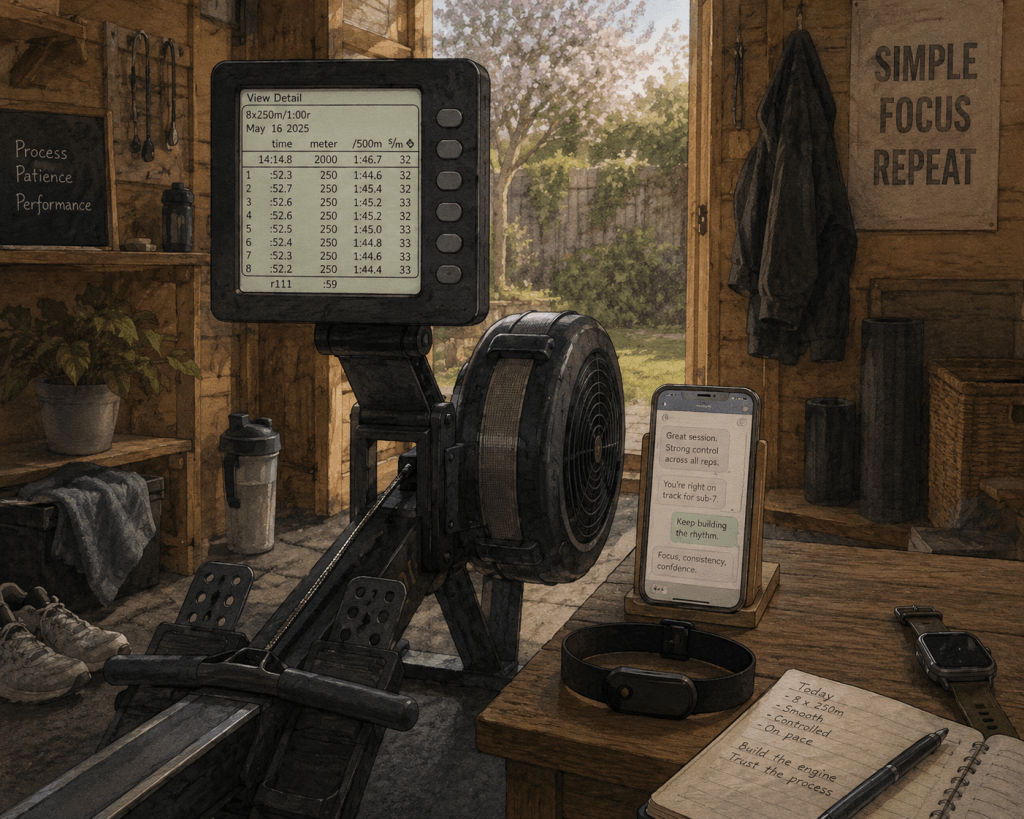
Sunday’s workout was a 10-minute warm-up, then 8 × 250m sprints with 90 seconds rest between each one, designed to simulate 2,000 metres at or around Sub-7 pace.
And my goodness, it was a strong session.
Properly controlled pacing. Good technique. No mad thrashing around. And most importantly, there were signs of real progress.
Yes, there were rest periods between each 250m sprint, but if I add up the actual times of those 250m sections, it comes out as a 7 minute 7 second 2,000m.
All I need to do now is join those 250m sections together.
That is definitely going to need extra strength work in the gym and more power runs on the rower, but I am making progress.
It’s funny, the other day I found a message to my future self. It was in my calendar. I’d obviously written it and put it in there when I came back from holiday last year. It was a reminder not to let myself go this summer. Ease off a little bit maybe, but not to let myself go the way I did last year.
It was quite funny really, because I honestly don’t feel as though I’ve properly got going since I wrote that message.
And yet, when I look at the evidence, that’s not entirely true.
My cruising speed on the rower is a lot higher. I don’t think I’m any closer to breaking the sub-7 2K yet, but my cruising speed is there. I’m fitter. Aerobically fitter. On Sunday I went out and did 80 kilometres on the bike and didn’t really think about it. It was just there and done.
So the work is still happening. I just don’t feel like I’ve got going with the same intensity I had last year.
So what needs to change?
I think I need to start blogging more again, because that was where a lot of the accountability came from. More than that, it was where the reflection came from.
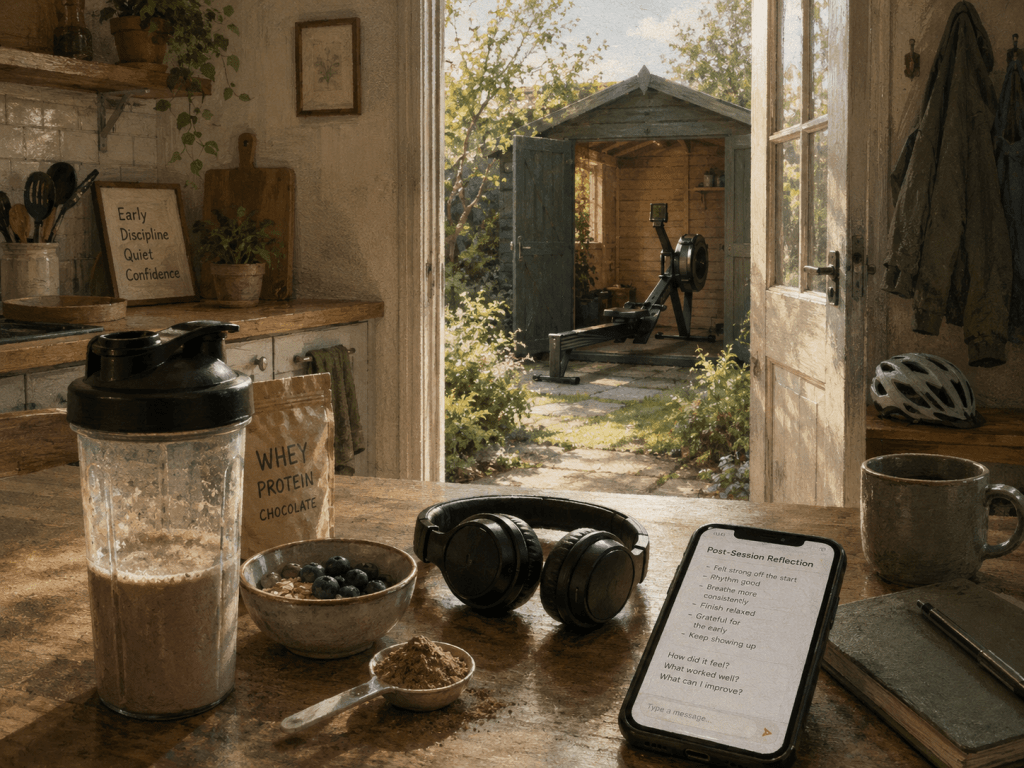
My routine after rowing in the shed needs to change. At the moment I finish the session with my music still on, walk back into the kitchen, make my recovery drink, log my calories, log the workout with ChatGPT, go upstairs, shower, and start work.
At no point in that sequence do I stop and reflect on what I’ve just done.
I’m doing the exercise. I’m just not logging it properly in my own head. I’m not writing it down. I’m certainly not reflecting on it. It’s just a case of getting out, doing the session, coming back in and moving on to the next thing.
That reflection piece needs to be reinstated.
Maybe the new rule is simple: when I finish on the rower and come back into the house, I take the headphones off. Then, while I’m making my recovery drink, I speak into ChatGPT and do the reflection there and then.
That used to happen naturally when I went to the gym. I’d finish the session, get back to the car, sit there for a minute and think about what I’d just done before starting the engine and heading to the next thing. Training in the shed is brilliant, but it has removed that little pause.
I need to put it back.
The work is still there. The aerobic capacity is still there. The chassis is there. But I’m still a long way from sub-7, and I need to get stronger. That’s the next proper conversation with Coach ChatGPT.
So yes, time to get back in the groove, but gently. If I turn it into a chore, I’ll switch off again.
This is The Sub-7 Experiment. Still reflecting. Still working. Maybe not quite as intensely as before, but there is a plan to change that.
Today I’m back rowing, and what a lovely thing it is.
After the big ride on Sunday (104km), I took it easy for a couple of days, just walking. Then today, thursday, I got back on the rower and it felt good.
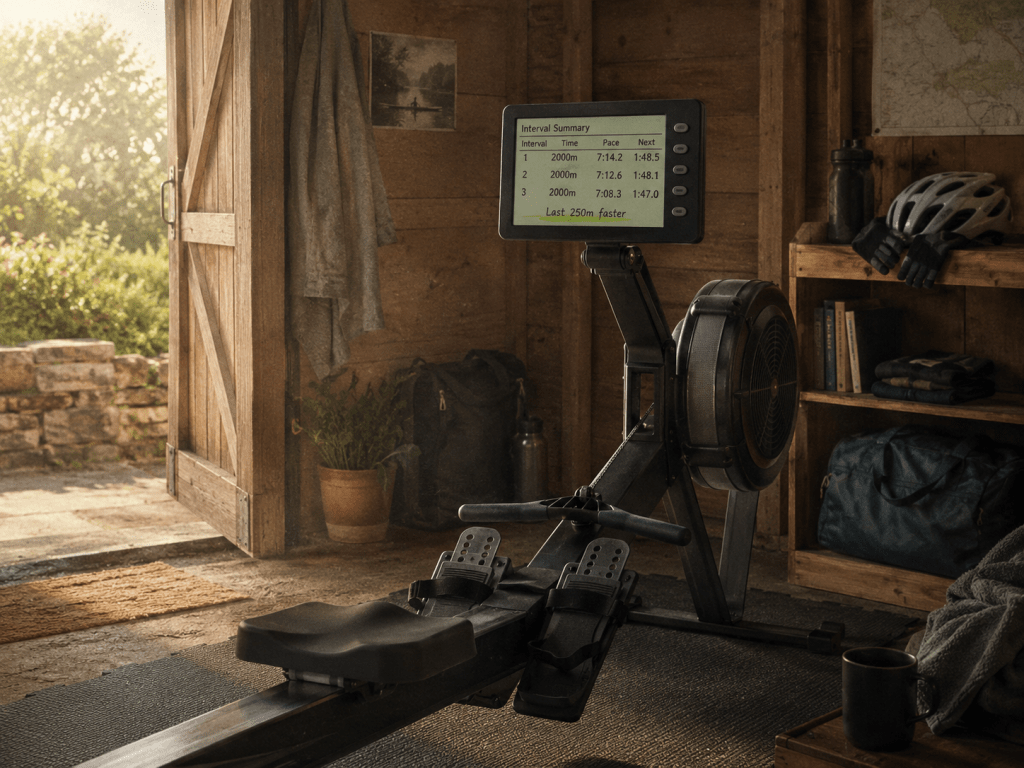
The session was simple. Ten-minute warm-up, then three 2,000-metre intervals. Nothing overly hectic, but what’s interesting is the pace. Looking back at older sessions, I’m now cruising at speeds that used to feel unattainable.
It all felt in control. Smooth. The kind of rowing where you’re working, but you’re not fighting it.
I sped up for the last 250 metres on the final rep just to see if I could. I could. And it felt great.
The “new” rower in the shed is not so new now. It has been there for six months, and the new routine of rowing, then heading straight back into the house to start work or whatever the day brings, has meant I haven’t been giving myself any time to reflect on the workout afterwards. No reflection has meant nothing to post.
Rowing is still important to me, and so is the wider exercise regime as a whole. But I think I’ve been missing that reflection piece. I also wrote in a previous article that I’ve missed the gym visits too. So it feels like time to reassess what matters.
Exercise matters. Having an exercise goal matters. Reflection matters too. And so does being around like-minded people. My gym membership has lapsed, and I think it is time to renew it.
In other news, I’ve been cycling a bit more.
This Sunday I’m riding the Tour de South Coast, a 100km sportive that covers some roads I’ve used before in training. I don’t know anyone else who is doing it, but there will be a couple of hundred cyclists out on the day, and I’m looking forward to it.
I’ve also been back to see Bike Fit Barry, who has once again sprinkled a bit of magic over the setup on the Triban. On top of that, I’ve decided to make it even more comfortable. I’ve taken the mudguards off completely and fitted some big 35mm tyres, which means I can run lower pressures and take a lot of the buzz out of the road surface.
A quick 15km test ride yesterday showed they are doing exactly what I hoped.
I spent a lot of last year tweaking the Giant to try to get more comfort out of it, but the truth is that the early carbon technology makes it so stiff that it just takes too much out of me over longer distances. I’m keen to see how the newly fettled, balloon-tyre-equipped Triban gets on over the 100km on Sunday.
In Coach ChatGPT news, I’m still consulting with it and still completing the workouts it gives me after I upload my daily WHOOP scores. I’m getting stronger and faster on the rower, and my technique is getting better too. I can really feel the progress.
The aim is still to get to a sub-7-minute 2,000m row.
It’s been almost exactly a week since I did anything strenuous. But it was a lovely week with the family. Getting outside, looking at things, doing normal life, and just being together.
Back at it today. Not in the gym, but out in the shed on the rower.
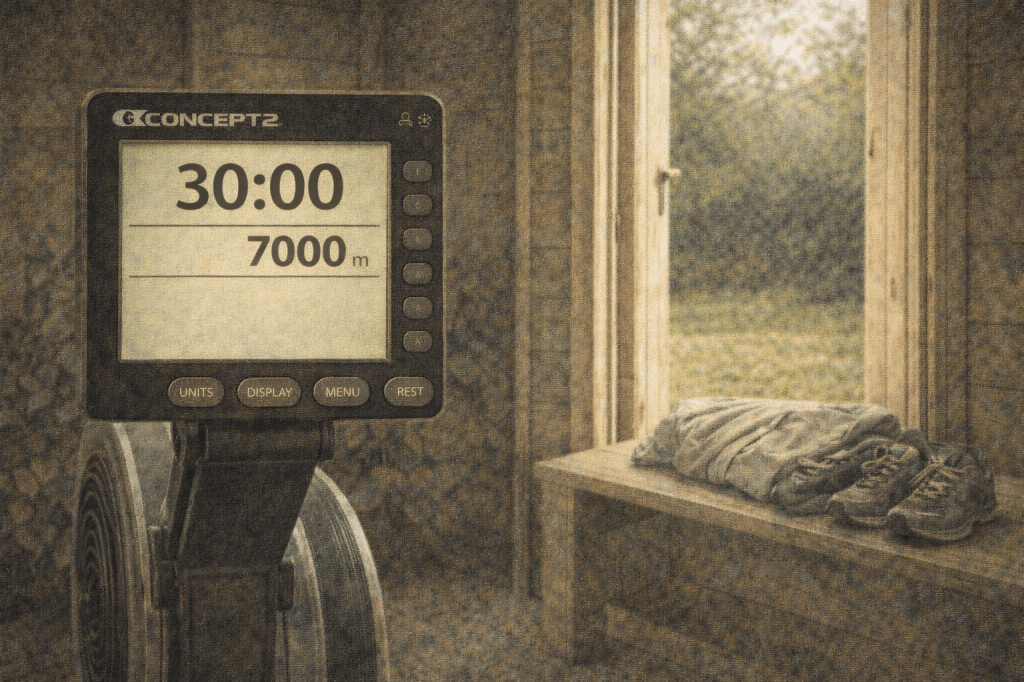
Nothing hectic. Just a fairly cruisy 7,000 metres in 30 minutes.
It’s funny how I’m now calling that “cruisy,” because it used to be the max. That’s probably the simplest sign that progress is happening. I’ve come a long way, and I’ve still got further to go, but I’m pleased with it.
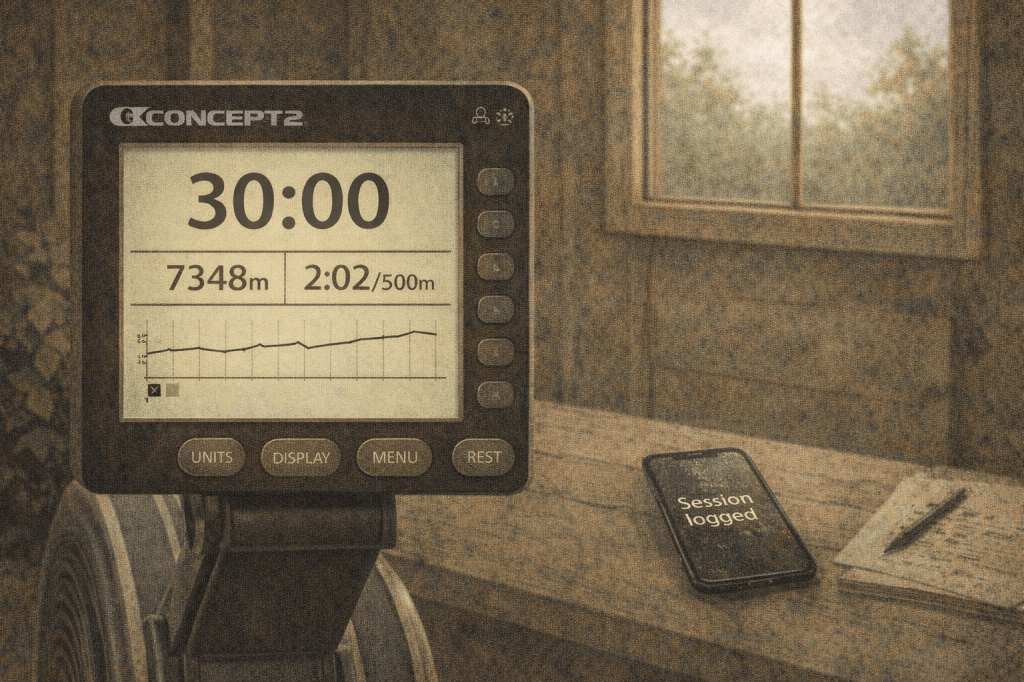
It’s Tuesday and I’ve just finished another 30-minute row.
Nothing major to report, and that’s kind of the point. The pace is there, and it’s growing. The strength is growing too. It all feels like it’s moving in the right direction.
The big thing I’m noticing is controlled power. When I need to turn it on, it’s there, and it doesn’t feel messy.
The pacing was there or thereabouts where Coach GPT asked me to be. I had a little focus wobble around the 15-minute mark, but I pulled it back in and finished stronger.
Quiet progress. Controlled effort. Another good session.