Just out of the gym. It’s Wednesday, and that was a cracking session.
I’m delighted with myself.
You might remember the big scary assisted dip and chin machine from Monday. The one I was nearly brave enough to try, but not quite.
Well, today I had a go.
I did a few sets, worked out roughly where my starting point is and set myself a baseline. That’s good. It is no longer the big mysterious machine in the corner. Now it is just a machine I have used.
While I was feeling brave, I also had a go on the preacher curl machine.
That was another one I had looked at before and quietly avoided. Not because it is particularly complicated, as it turns out. It is actually very simple. But it normally seems to be inhabited by rather large gentlemen who look like they know exactly what they are doing.
Today it was free, so I climbed aboard.
And then, just for good measure, I finally did a Pallof press.
That is another exercise I have been meaning to try for ages and have been putting off, and putting off, and putting off. Again, not complicated once you actually do it.
Funny how often that is the case.
There was plenty of familiar stuff too. Ten minutes on the bike to warm up, two ten-minute sets on the rower, and a spin around the weights.
Nothing heroic.
But three things that had been sitting in the “I’ll try that another day” category have now moved into the “I know how to do that” category.
That feels like progress.
I came out of the gym genuinely delighted with myself. Really, really pleased.
The refurbished gym is already starting to feel a little less new.
Not because nothing has been going on, but because the things to write have largely been the same:
“Nice workout. Got the job done. Nothing much to report.”
And it has all been a bit samey.
That has got me asking questions. Why does it feel the same? Where is the push coming from? Am I still properly engaged in the Sub-7 Experiment?
So I’ve been trying to make sense of it, and here are a few thoughts that might explain it.
Firstly, let’s look at the process.
For ages, the process has been the same. Take screenshots from WHOOP, put them into ChatGPT, ask for a workout, ChatGPT gives me the workout, I do it, then I report back.
That process worked for a while, but I’ve decided to ditch WHOOP.
I have cancelled my WHOOP subscription and no longer wear the device. It has done its job, and I am grateful for it. It gave me the impetus I needed when I started training three years ago, and it helped me get back into the idea of looking after myself. At that point, it was the best tool for the job.
When I started focusing on the rowing, I would set the app going to record the session and then work until I hit the suggested strain in the app itself. That suggested strain feature was brilliant because it stopped me bursting myself every time I got on the machine, wildly going for it until I collapsed.
No pain, no gain, right?
Well, not strictly true.
Too much pain becomes “give up and never go back,” at least that’s what my head was telling me. But with the WHOOP strain monitor giving me a suggested amount of work to aim for, it gave me structure without stupidity. Brilliant.
But now there is so much data in there that I have become swamped by it, and I’m not really using most of it. Yes, I would check recovery and sleep, but to be honest I am well used to my body showing signs of fatigue after a workout now. I don’t need an app to tell me every morning.
Recovery is also quite subjective, based on WHOOP’s algorithms. Sleep quality is the same. I was there. I know how the sleep went.
As for the rest of it, there is so much data now that I don’t know what to do with it, other than remove it from my life and make things simpler.
So no more checking WHOOP first thing in the morning. No more screenshots of WHOOP, ErgData and Strava into ChatGPT after every workout just to capture all the details.
I’ve gone back to using my old Polar chest strap and heart rate monitor, connecting that directly to the Concept2 rowing monitor and letting ErgData capture the session and feed it into Strava. When I’m in the gym, the same strap sends heart rate directly into my phone and the Strava app.
I am still asking ChatGPT to give me the workout each time, and I am still uploading the results from ErgData afterwards. Occasionally I’ll upload Strava too if ChatGPT asks for it. So the coaching process is still there, but the data sources are simpler and there is a lot less noise around it.
Good.
Data sources simplified. App integrations simplified.
Let’s go.
Except nothing really happened.
The workouts were fine, but they were also a bit easy.
So I had a chat with ChatGPT itself.
One of the things about ChatGPT is that it has a memory feature. Depending on the subscription you have, it can remember things from your conversations across different chats. That can be a good thing, but it turns out it can also be a bit of a problem.
It’s good because, as a user, you don’t have to keep reminding it about everything that has happened. I have a persistent conversation inside ChatGPT that is all about Sub-7 coaching, along with many other subjects.
I had some surgery on my leg last October, and at the time I asked ChatGPT, within the Sub-7 coaching conversation, for a recovery plan to get me back up to speed. It remembered that.
I also tweaked my back in the gym a short while ago, using bad form to lift some plates off a machine I was using. Again, I told ChatGPT about it and asked for recovery steps. It remembered that too.
So when I asked it to remind me what the Sub-7 Experiment was about, it told me the long-term plan: to build a training programme that will enable me to row 2,000 metres in under 7 minutes.
That was the right answer.
But then I challenged it. I asked why I felt as though there was no real progress at the moment and why everything felt very samey. It came back and said I was still recovering from the tweaked back and the leg surgery.
And immediately, there it was.
It had remembered that I’d had those issues, but it had not properly remembered that I had also told it I was back in one piece and able to continue with the full-on progress towards Sub-7.
It seems the memory function in ChatGPT remembers what it thinks is important, not necessarily what the user thinks is important, unless the user specifically says: “Remember this.”
So I told it to remember that I am back on form and back into the full Sub-7 programme, and that it should stop treating me like a piece of glass.
And since then, starting last Sunday, the workouts have been much more on plan.
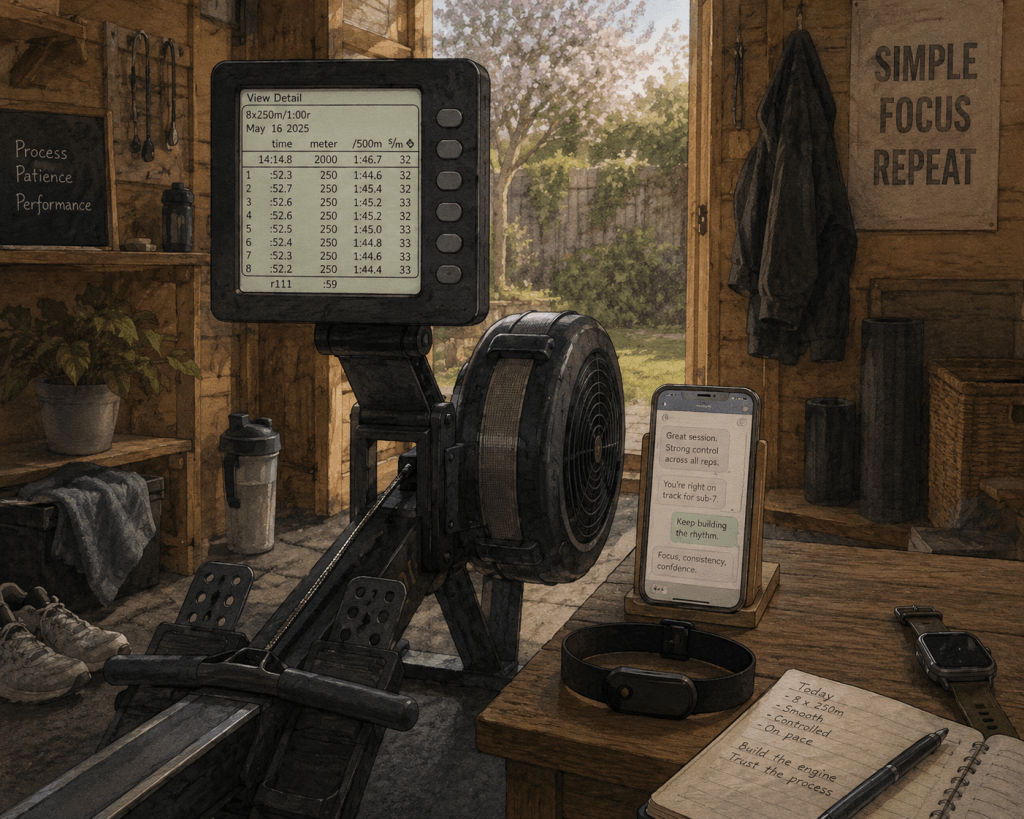
Sunday’s workout was a 10-minute warm-up, then 8 × 250m sprints with 90 seconds rest between each one, designed to simulate 2,000 metres at or around Sub-7 pace.
And my goodness, it was a strong session.
Properly controlled pacing. Good technique. No mad thrashing around. And most importantly, there were signs of real progress.
Yes, there were rest periods between each 250m sprint, but if I add up the actual times of those 250m sections, it comes out as a 7 minute 7 second 2,000m.
All I need to do now is join those 250m sections together.
That is definitely going to need extra strength work in the gym and more power runs on the rower, but I am making progress.
It’s funny, the other day I found a message to my future self. It was in my calendar. I’d obviously written it and put it in there when I came back from holiday last year. It was a reminder not to let myself go this summer. Ease off a little bit maybe, but not to let myself go the way I did last year.
It was quite funny really, because I honestly don’t feel as though I’ve properly got going since I wrote that message.
And yet, when I look at the evidence, that’s not entirely true.
My cruising speed on the rower is a lot higher. I don’t think I’m any closer to breaking the sub-7 2K yet, but my cruising speed is there. I’m fitter. Aerobically fitter. On Sunday I went out and did 80 kilometres on the bike and didn’t really think about it. It was just there and done.
So the work is still happening. I just don’t feel like I’ve got going with the same intensity I had last year.
So what needs to change?
I think I need to start blogging more again, because that was where a lot of the accountability came from. More than that, it was where the reflection came from.
My routine after rowing in the shed needs to change. At the moment I finish the session with my music still on, walk back into the kitchen, make my recovery drink, log my calories, log the workout with ChatGPT, go upstairs, shower, and start work.
At no point in that sequence do I stop and reflect on what I’ve just done.
I’m doing the exercise. I’m just not logging it properly in my own head. I’m not writing it down. I’m certainly not reflecting on it. It’s just a case of getting out, doing the session, coming back in and moving on to the next thing.
That reflection piece needs to be reinstated.
Maybe the new rule is simple: when I finish on the rower and come back into the house, I take the headphones off. Then, while I’m making my recovery drink, I speak into ChatGPT and do the reflection there and then.
That used to happen naturally when I went to the gym. I’d finish the session, get back to the car, sit there for a minute and think about what I’d just done before starting the engine and heading to the next thing. Training in the shed is brilliant, but it has removed that little pause.
I need to put it back.
The work is still there. The aerobic capacity is still there. The chassis is there. But I’m still a long way from sub-7, and I need to get stronger. That’s the next proper conversation with Coach ChatGPT.
So yes, time to get back in the groove, but gently. If I turn it into a chore, I’ll switch off again.
This is The Sub-7 Experiment. Still reflecting. Still working. Maybe not quite as intensely as before, but there is a plan to change that.
11 years ago this weekend I rode 100km in one day on my bike.
It was the furthest I’d ever ridden and it was the first organised ride I’d ever completed. My mate Rich and I set out to do it together and it was a great day out.
One thing that has stuck with me since that day was cycling next to an old boy who, to my untrained eye, could have been 70 years old. He looked like he’d stacked up a lot of experience in his time, and he was riding a Pinarello Dogma. For the uninitiated, that’s basically a superbike. Think Koenigsegg or McLaren. Probably the finest bike money could buy at the time.
This old boy was cruising along. Not in a hurry, not even looking like he was breaking a sweat. Me and Rich were keeping up with him fine. There was a decent-sized group and we were all moving along the flat at around the same pace.
Then we came to a hill.
There was lots of downshifting and lots of effort as we started to climb… except for the old boy. He seemed to put in the exact same effort as he had on the flat and just glided away up the hill like it didn’t exist.
Rich and I still talk about that. And that older gentleman is my inspiration for what I’m doing now. I want to be 75 and still riding my bike up hills like they’re not there. I still want to be able to sit on a rowing machine and go well for 60 minutes at a time. And I’d like to be doing it with my mate Rich.
This weekend I had a little moment of my own.
We were away as a family in a hotel in Kilkenny and I decided to go to the gym for a row. We’d already used the pool earlier in the day and I thought a spin on the rower would be a good way to finish off a day of walking around town.
The row was great, although the machine was a bit old and graunchy. It really made me appreciate how lucky I am to have my own Concept2 in the shed.
There was a group of younger lads in there, twenty-somethings, and I could see them clocking me. I was cruising along, 22 spm, controlled. They kept looking over and I could tell I’d become a bit of a “thing” for them.
Then one of them strutted up to the rower next to me, made a big show of sitting down and strapping in, while his mates watched… and he went for it.
Like a demon. Straight into 35 spm, out of control. On those big Technogym screens you can see everything, and I did just enough to stay ahead of him on speed and watts while keeping it at 22 spm.
He tried and tried but couldn’t get in front.
After a while he got more serious, tried to find a rhythm, started increasing his overall speed… and at that point I dropped my stroke rate to 19 spm and just pulled harder. The display showed 220 watts sustained for about three minutes at around 1:55 pace and he still couldn’t get near me.
When he hit 1000 metres he stopped, got off, and went back to his mates shaking his head.
And I loved it…!!!
Hollow victory? Maybe. Should I know better? Definitely.
But the moral of the story is this: watch out for the old dudes on the rower. They are quite likely to kick your ass.
I genuinely didn’t know where my head was at today. It was all over the place. I wasn’t feeling the gym. I wasn’t feeling the rower. I wasn’t feeling anything.
I did that thing where you’re not doing anything, but you’re also not resting. Up and down the stairs. Round and round the house. Looking out the window. Rain. Wind. Sit in front of the TV for a bit. Make a cup of tea. Walk again. Another cup of tea. More pacing.
I even told Coach GPT I wasn’t going to train today, that I’d just go for a walk, but I was talking myself out of that as well. The truth is, I knew I needed to do something.
And then the voices started. The men in my head.
“What’s the point?” “What’s the point of any of this exercise stuff?” “You’re not getting anywhere.” “Just go back and watch TV.”
I battled it and battled it. Right up to the point where I was pulling my gear out of the wardrobe. Shorts on — still fighting it. T-shirt on — still fighting it. Shoes on — still fighting it.
Then I went out to the shed, sat on the rower, and started.
I did 15 minutes, and every five minutes I got faster. By the last five I was holding sub-1:57 pace.
Then I stopped and did two 250m sprints , pretty much flat out, but controlled. Controlled frustration release. Controlled anger release. The kind where you’re emptying the pressure without blowing up.
It didn’t solve everything. I still feel like there’s a lot going on and a lot to do. But it released the valve.
And I am genuinely grateful I have a rower in the shed, because if I’d had to get in the car and drive to the gym this morning, I don’t think it would have happened at all.
This is The Sub-7 Experiment — as much for mental health as physical health.
Choose to be happy. Choose to be sad. Choose to feel sorry for yourself. Choose to eat your own bodyweight in cheese and crisps and crackers. Choose to turn up. Choose to be a good dad. Choose to go to the gym and come out feeling brilliant, like I did today.
Today was the first time I’ve chosen to go to the gym in a long time. I haven’t been at all this year.
Instead, I’ve been blaming other people. Blaming the New Year’s resolution crowd for “clogging up” the gym. Why am I so anti-them? They’re trying to make a change. I’ve been in their shoes, and not that long ago either. Twelve months ago, twenty-four months ago, I was them.
If anything, I should be in there alongside them. As someone who has been where they are, I could help if they needed it. Instead, I chose to use them as my excuse not to go.
I also chose to decide to be sad because of the time of year. It’s winter, Christmas is gone, the sun barely shows up, so I leaned into it. Chose the slump. Chose to sit on my hands.
What a choice, when there’s only one go at this life.
At some point you have to choose to live it. Choose to get off your arse and do something about it.
Today, I chose to go to the gym.
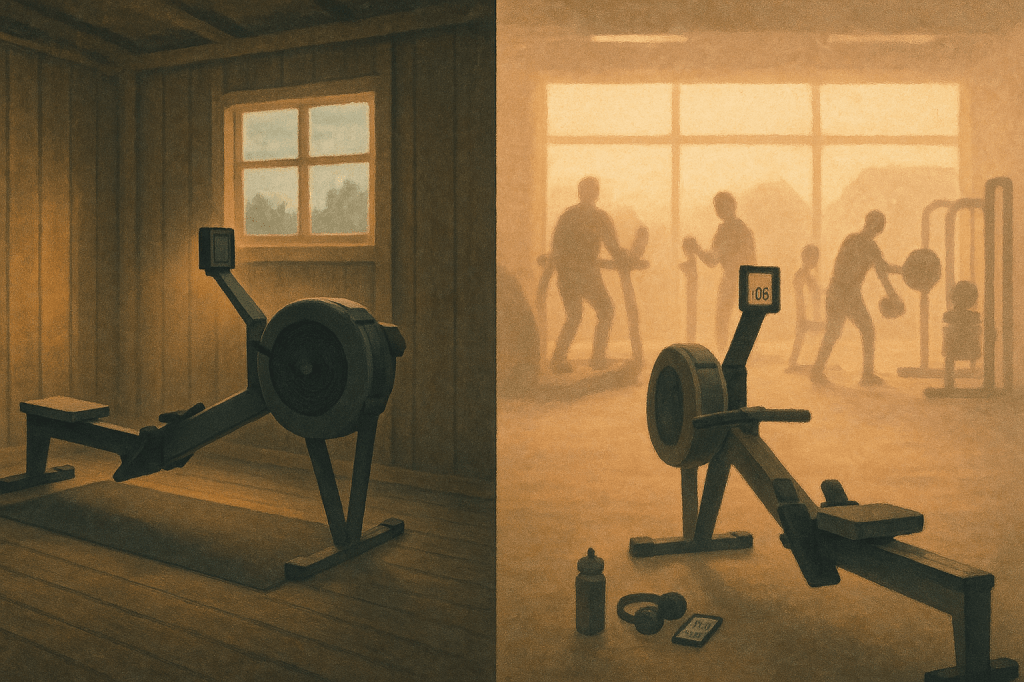
I’ve been rowing in the shed on my new rower, and I’m still delighted I’ve got it. But I’ve missed the contact with people. I’ve missed being in a place that’s full of like-minded folk, all there to put some effort in and feel better for it. The buzz. The energy.
So today I choose differently.
I choose to live. I choose to be the best version of me that I can be. And I choose to start doing that again today.
It’s been tough. Most of December, all of January, and the first bit of February I’ve been coming up here “looking for my mojo.” I’m not even sure I ever had a mojo in the first place, but it became the story in my head: I’ve lost it.
It hasn’t helped that it feels like it has rained every day this year where I live. The sun barely shows up. I also think I put too much stock in the idea that once I had a rowing machine in the shed, everything would click and I’d train every day.
On top of that, the new process I built in December – WHOOP scores into ChatGPT, get a tailored session – hasn’t been working the way I hoped. Not because the logic is bad, but because of how I react to it.
When ChatGPT looks at my WHOOP recovery and sleep and says, “easy day today,” I treat that as a full stop. “Right, that’s it, we’re done.” No movement. No walk. Nothing. It’s basically become an easy out, and I’ll always find an easy out if you give me one.
The “mojo hunt” has turned into the same thing. If I tell myself I’m looking for my mojo and I can’t find it, then I have an excuse to sit on the back foot and do nothing.
I still want to row. I still want a sub-7 2,000 metres. That goal hasn’t changed. What I’ve lost sight of is that exercise, for me, is about far more than chasing a single number on the monitor.
The rowing – and the moving in general – is primarily about my mental health.
Case in point: earlier this week I was heading into a potentially confrontational meeting. I knew the people in the room probably weren’t going to like what I had to tell them. The old me would have carried that anxiety all day.
Instead, I went into the shed.
I told ChatGPT about the meeting and asked for a workout that would help channel the adrenaline and set me up properly. It came back with a plan that turned out to be perfect. By the time I’d finished the row, the energy was controlled, not chaotic.
I hadn’t even called the meeting – someone else had – but when it started I decided I was going to drive it. I would control the narrative. Everyone would get their say, everyone’s points would be noted, but at the end of the day there were only two options on the table. They could go one way or the other. That’s it.
I went in with that calm, directed energy from the row and nailed it.
Fast forward two days. I’ve just come out of the shed after another row and another thinking session, and the penny has finally dropped:
I never had “mojo” in the first place. What I had was movement. When I move, I look after myself. When I stop, everything starts to fog over.
My mental health depends on exercise. Full stop.
And so what if I’ve put on a few pounds lately. That does not define me. What defines me is the state of my head and my ability to deal with things calmly and rationally – whether that’s work stuff, dad stuff, husband stuff or just being a decent friend. That is what counts.
The next step isn’t hunting for some mystical spark. It’s much simpler and much more boring:
Go outside, even when it’s raining.
Get back to walking.
Go to the gym.
See people, even if it’s just a nod to the receptionist or a quick hello to the regulars.
I need the physical work and a bit of human contact. If I keep those two things in the mix, everything else won’t magically fall into place, but it will get clearer again. And clarity is what I need: for my mental health, my physical health, to be a decent dad and husband, and to be kinder to myself.
I’d lost sight of that.
This is The Sub-7 Experiment: not just chasing 2,000 metres, but remembering to look after myself.
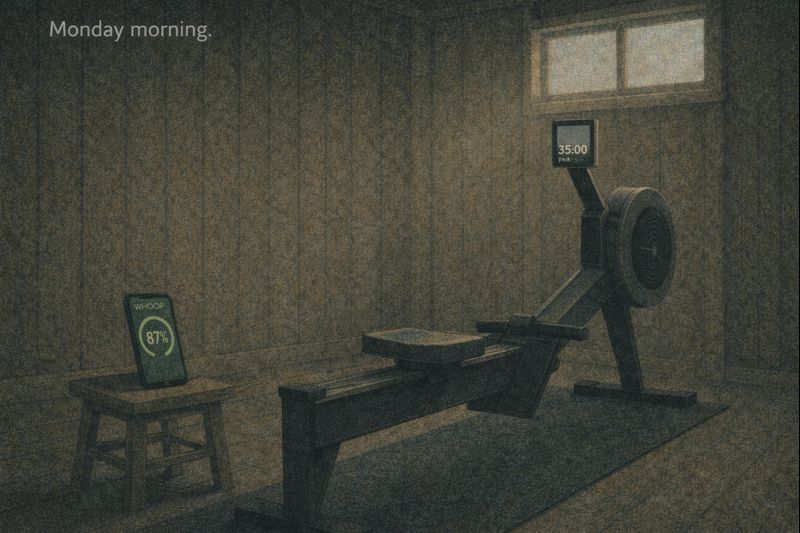
WHOOP was green when I woke up, and green means go. So I went.
I did a short warm-up, then 35 minutes on the rower at an average pace of about 2:04/500m, which worked out to roughly 8,500 metres. With the warm-up and cool-down, it comes in around 11k for the day.
Nothing dramatic, no heroics. Just a solid, steady session and another brick in the wall.
When I finish my sessions, I take screenshots of the WHOOP data and the ErgData app and feed them back into Coach ChatGPT. Today I noticed something new. It didn’t just say “good job.” It started to ask for specific changes in the data.
My pace was where it had asked for it, if not a little quicker. What it picked up on was my stroke rate. It pointed out that I was moving a bit fast and that it would like to see the same pace but with a lower stroke rate.
That probably doesn’t make much sense unless you are used to the action of rowing.
Inside the rower is a flywheel that gives you the resistance on each stroke. On the recovery part of the stroke, that flywheel slows down, and how much it slows depends on the damper setting. The higher the damper, the more the flywheel slows, and the harder you have to work on each stroke to get it spinning again. To keep a 2:04 pace at a higher stroke rate, say 26–28 strokes per minute, you can “get away with” less power per stroke. To hold the same 2:04 at 22–24 strokes per minute, each stroke has to do more work.
In simple terms, CoachGPT is asking me to slow the stroke rate down and put more power into each stroke. Get stronger, not just spin faster.
I hadn’t really seen it nudge me like that before. That is good. It means the coach is starting to care about how I make the split, not just the number on the screen.
I have just walked back in from the shed after a good session on the rower.
I am really starting to like this new version of ChatGPT. It feels like it remembers more of the coaching conversation as we go, which makes the whole thing feel more joined up. Today it had me doing 5 minute intervals, and it was a proper session. Enough to feel it, not so much that it wiped me out.
What has surprised me is what I am starting to miss.
I thought that once I had the rower in the shed, that would be it. Training at home, no commute, no waiting for machines, no distractions. And a lot of that is true. But I have realised I miss the people at the gym more than I expected.
I am not a big talker there. It is usually just a quick hello to the staff on the desk, a nod to the regulars, and then everyone gets on with their own programme. Headphones in, sets to do, not much conversation. But there is still a sense of other humans being around you, all doing their thing. I did not think I would miss that, and yet I do.
It is a small thing, but the nods and the “alright?” moments matter more than I gave them credit for.
Rowing will always be the main thread. The shed is perfect for that. But I think I will still go to the gym now and then for strength work and, if I am honest, for that tiny bit of human connection. A different kind of fuel.
Today’s row kept the body ticking over, but it also taught me something: I need both the quiet of the shed and the presence of other people now and then.
This is The Sub-7 Experiment, and we are still learning.
It feels like I have a new coach. You might remember that I’ve been asking ChatGPT to prepare workouts and coaching advice to help me row 2,000 metres in under seven minutes. That is the whole point of The Sub-7 Experiment. Can I use AI to help me achieve a fitness goal.
When I first tried this, the model available to me was GPT 4.0 and it was good. I set up the role, gave it the context, kept the conversation alive, and each day I told it how I was feeling. It responded with the workout for that day. That simple rhythm worked well.
Then 4.1 came along. The improvements were small but noticeable. It held context better, got confused less often, and could handle my slightly lazy and vague questions more easily. As with most tech, each release pushed things forward.
Earlier this year GPT 5.0 arrived with a huge amount of hype. It was supposed to push ChatGPT into a whole new league. PhD-level reasoning. Better accuracy. A genuine step up.
The reality was mixed. Yes, it produced better code for a different project I was working on. Yes, it had more “thinking” capacity and could reason more deeply without me having to explicitly tell it to think. That part was a massive improvement.
But as a conversationalist it was a step backwards. It forgot things. It lost context. It got confused about tasks. The backlash was so strong that OpenAI reinstated version 4.1 as a choice because so many people preferred to keep using it. It felt like my coach had left the building.
I worked around it with careful prompting, but it was frustrating. The Sub-7 Experiment relies on continuity and rhythm, and something was always slipping.
Which is why it now feels like I have a new coach. GPT 5.1 has arrived and it feels different in a very good way. The tone is consistent. The help it offers is actually useful. It anticipates the next step instead of fumbling it. It feels like an upgrade in the true sense of the word.
Let me explain why this matters.
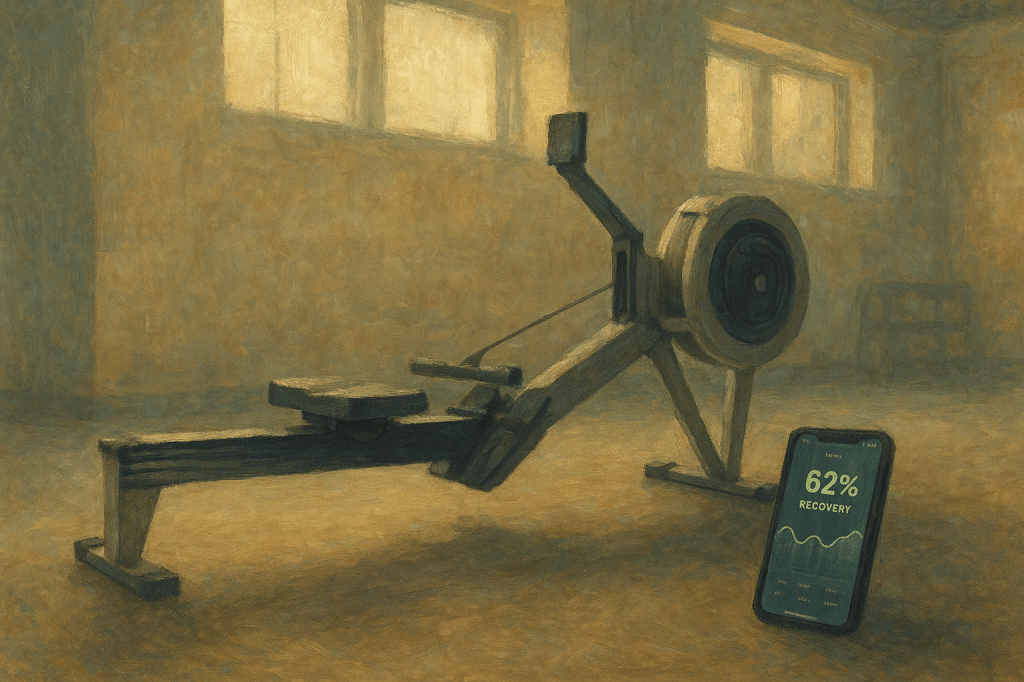
I have a WHOOP device and I’ve used it for almost two years. Before ChatGPT became part of my training, WHOOP was my only guide. It sits on my wrist and picks up all sorts of measurements: heart rate, skin temperature, strain, sleep quality and plenty more. Every morning the app shows three dials. Yesterday’s strain, today’s recovery level, and last night’s sleep. When you start a workout you tell WHOOP what you’re doing and it gives you a target strain. When you hit it, the band vibrates and tells you to stop. Simple. Clever. And it worked well.
But in the last few months I’ve been questioning the value. The subscription model has changed. The promise of free device upgrades for active subscribers has been replaced by an “uplift fee”. My renewal is in February and it will cost a lot more to keep going into my third year. And that makes me ask what I actually need it for.
Most of the data WHOOP collects I don’t really use. I know how well I slept because I was there. What I actually value is recovery guidance and strain targets. And there are other devices out there that do similar things for a simple one-off cost. Polar Loop is one I’m looking at seriously.
So I turned to ChatGPT 5.1 for help. Reviews. Recommendations. Thoughts based on my training. And one of the threads pointed out something obvious: I have not been using most of WHOOP’s data anyway. Not deeply. And the only thing that truly matters is the workout planning, which comes from CoachGPT.
I asked if there was any way for ChatGPT to access WHOOP data directly. It said no, the APIs are not available yet. But then it made the suggestion that genuinely impressed me.
It told me exactly which two screens in the WHOOP app to screenshot each morning. It told me to upload them, and it would analyse everything it needed: recovery, sleep, strain, HRV, and readiness. It would then produce a fully tailored workout for that day. And if it thinks I need a rest day, it will tell me that too.
I have used this new process for the last few days and it is genuinely brilliant. Two screenshots. Upload. Instant plan. Clear reasoning. Exactly what it expects from me. Exactly what to avoid. Exactly how hard to push.
And it works. The coaching is better. The structure is better. The whole system feels like something new.
Well done, ChatGPT 5.1. This is The Sub-7 Experiment. Recovering using structured data.