Tag: Sub-7 Experiment

  • Before You Buy the Bike

    In a previous post, Comfort is Speed, I talked about the process of bike fitting and some of the advantages and gains. But there is one particular gain that needed its own post.

    When bike manufacturers build bikes, they have to cater for people of all shapes and sizes. They have to decide on average component and frame sizes that will work for the largest number of people, while also keeping design and manufacturing costs under control.

    They are in business after all. They are there to make money.

    So bikes are sold, mainly, by frame size. Small, medium, large. 50cm, 52cm, 58cm and so on.

    Those frames come with a stem length and crank length that have been chosen by the design team based on their experience. When you buy a bike off the shelf, that is what you have to work with.

    Bike manufacturers also publish the frame geometry. That means the length of the various tubes on the frame, the angles at the junctions, and the measurements that give you a general idea of what the bike will be like to ride.

    Sizing charts are published too.

    To cater for the masses.

    When I bought my Giant and my Triban, I bought them both based on my height, inside leg measurement, and the sizing chart the manufacturer had published.

    We talked about rules of thumb in the previous article, and one of those rules when buying a new bike says that if you are halfway between two frame sizes, you should go for the smaller one. The logic is that it is easier to extend components than it is to shrink the frame once it is in your shed or garage.

    I was between sizes on the Triban, so I bought the large frame, not the XL.

    It turns out that for my height, I have fairly average length legs but great big long monkey arms and torso.

    And so it transpires that the frames of the bikes I own are too small for me. Yes, they are okay for leg length, but they are too short for my upper body. To get anywhere near the level of comfort I need, the stems have to be extended.

    After a few years of ownership, that is not a huge issue. You find it out, spend some money on a new stem after a bike fit, and move on.

    But what if the bike was brand new?

    What if you had just spent a considerable amount of cash on a new bike, only to find out straight away that it needed a new stem, different cranks, different pedals, or maybe even that you had bought the wrong size frame?

    I, for one, would feel a bit miffed.

    Cue the second type of bike fitting: the pre-purchase bike fit.

    I am in the very lucky position of being in the process of buying a new bike. A lot of research has gone into this purchase. I want something I can ride all day. Something I can ride fast if I want to. Maybe even something I can take away from the main road and down quieter tracks and trails.

    Most of all, I want it to be comfortable and able to deal with the poor surfaces on the roads near where I live and ride most often.

    My recent experience has shown me that most of the comfort comes from fit and dimensions. It has also shown me that I am not an average shape.

    So I booked another session with Bike Fit Barry. No sponsorship, no arrangement, just a very happy customer.

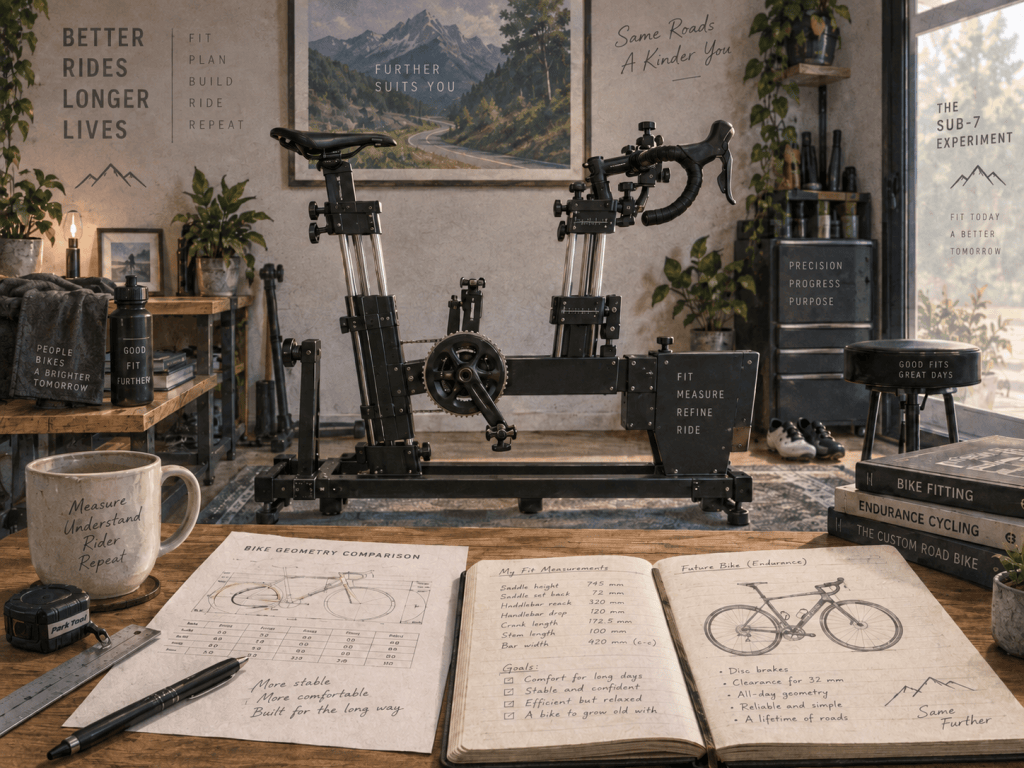
    For the new bike fitting session, Barry used a fitting jig. It mimics a bike, with handlebars, saddle, pedals and all the adjustable contact points. He had it set up when I arrived using the same dimensions from my Giant, based on the previous fitting session. That was the starting point.

    This time Barry also measured me properly, not just my height and inside leg. He measured hip to knee, knee to ankle, shoulder width, shoulder to elbow, and elbow to wrist. In other words, he was not just fitting a bike to “someone about my height.” He was building a picture of how I am actually put together.

    I had already narrowed the new bike decision down to one of two Mason bikes: the Bokeh and the Definition. I had been in touch with Mason and had booked a test ride on both bikes, each on a 58cm frame, because that is what the sizing chart suggested I needed.

    Barry had the geometry and frame details of the Mason Bokeh in his computer, and we went through the process of getting me set up in a comfortable position.

    Seat height. Stem length. Handlebar height and width. Crank length. Each change was documented until we found a comfortable fit.

    Barry even asked if I was going to buy new pedals for the bike. I said I hadn’t considered it. He told me about some Shimano pedals with a 4mm longer axle and said I should try them.

    He went outside to his own bike, took them off, and put them onto the fitting rig.

    The change was small but significant. It released pressure I had been feeling in my hips and lower back. These micro-adjustments can make a massive difference to the whole setup and feel.

    There were three big “oh wow” moments for me in this session.

    The first was the extra axle width on the pedals making such a difference to how my hips and back felt.

    The second was the shorter cranks. Normally, on a large or XL frame, the cranks will come from the factory at 170mm or maybe 172.5mm. For me, for the new bike and the way I am built, 165mm cranks are the way to go.

    The third “oh wow” moment was the big one.

    It turns out that the 60cm Mason Bokeh frame is the one I should go for.

    Because it is longer and taller than the 58cm frame the sizing chart pointed me towards, it accepts my long monkey arms and torso without me having to concertina myself into the available space between saddle and handlebars.

    This is huge.

    This new bike is my own personal indulgence for something I really love to do, and I can only imagine how disappointed I would have been if I had bought the wrong sized frame.

    Again.

    I am still going to ride the bike before I place the order, and that will happen in the next couple of weeks. But because of the bike fitting, I now know the exact measurements of the components I need.

    The beauty of the Mason model is that I can take everything we learned in the fitting session and pass it on to them, so they can build the bike specifically for me.

    It’s like going to Savile Row and having a bespoke suit made.

    If you are thinking of buying a new bike, and if you are going to spend your hard-earned cash, find a way to budget for a pre-purchase bike fit. Make sure you buy the right size frame, or even the right brand and model bike for what you actually want to use it for.

    Many bike fitters offer a follow-up session for when the new bike arrives, just to get it set up properly. Barry does, and I will be seeing him again in a couple of months when my new bike arrives.

    This is The Sub-7 Experiment.
  • Spent but Elated

    What a weekend.

    I went to Dingle with my two cycling buddies, the two who normally drag me around these events and make sure I complete them. Both great lads, and I really love these trips away with them.

    We have done a cycling adventure every year for the last few years, and they are great. Hire an Airbnb, go out for pizza the night before the event, cycle the event, go back out for a meal in the evening, and head home the following day.

    Brilliant. Great rides, great company.

    This year was a bit different. Our usual organised sportive didn’t take place, so the three of us decided to ride the Dingle Peninsula instead. One of our group had completed the Ride Dingle sportive a few years ago and was very impressed with the route, so we decided to do it ourselves this year.

    We rented an Airbnb right on the route. Ordinarily, with a sportive, we have to drive to the event, find parking, do the ride, and then drive back to our accommodation. This year, the start and finish point was right on the driveway of the house, and that was fantastic.

    The weather forecast was pretty hectic, with a yellow wind and rain warning in place for the day of the ride.

    At about 9:00pm the night before, the wind started picking up and the rain started falling. By the time we all turned in for the night, the rain was hammering against the roof and windows. I don’t think any of us got much sleep, such was the noise of the tempest battering the house outside.

    We had originally planned to set out at 9:00am, but given the weather, we pushed it to 10:00am. That was the right call. The wind started to die down and the rain was showery at most. By the time we rolled out, the rain had pretty much stopped.

    We had also looked at the route and found alternatives and bail-out points where we could shorten the ride if the weather was too intense.

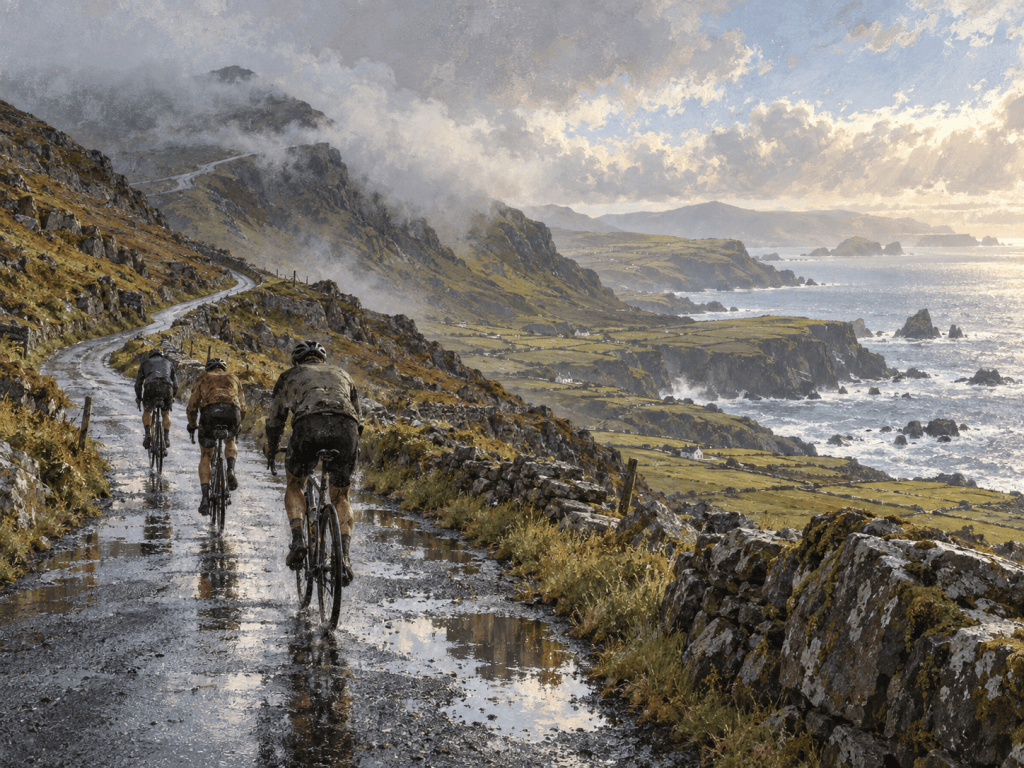
    The first section was 20km from where we were staying into Dingle itself, over the Conor Pass. The main pull was just over 5km at an average of 9%, and by the time we reached the top we were in the clouds, unable to see much of the fantastic view that is normally available from there.

    A quick leg stretch at the top, and then we dropped down into Dingle. Halfway down we were out of the clouds, and soon enough we were outside the first coffee stop of the day.

    20km completed, and we were feeling good.

    The decision was made to go for the next section of the ride, which looped out around the peninsula itself, past Slea Head, and back into Dingle.

    It was still windy, but the sky brightened up and it remained dry for the rest of the day. It is such a spectacular part of the world, with rugged coastline, beautiful views, and interesting, technical roads. These are still public roads, open to two-way traffic, so care needs to be taken. But that being said, they are very rewarding roads to ride.

    Back into Dingle for a late lunch, and that was 80km of the 120km completed.

    The last section to get back to the house was mainly main road, so a lot busier traffic-wise, but there were great stretches of segregated cycle path, especially up the hills where bikes are so much slower than traffic. They were smooth and largely clear of the usual broken glass, sharp rocks, and overgrown foliage that normally seem to be strewn across cycle paths in this country.

    There were 15 major climbs on the day, and when we got to the top of the 15th it was literally all downhill from there. The views from that last vantage point were magnificent, and we could practically see the house where we were staying from the top.

    We clipped in and cycled back to the house. The last 7km or so were straight back into the headwind. The lads are always generous with their energy and I often find myself at the back of the line, tucked into the slipstream and well looked after. They both say they don’t mind, but it still plays on my mind. This year, with a few kilometres left and the wind still in our faces, I went to the front, dug in and emptied the tanks. Hopefully I gave them a bit of respite for the final drag home. We’d been pretty well matched all the way round this year, and by the time we got back we were all well spent.

    But elated.

    The lads hadn’t been doing their normal amount of training this year, for work and home reasons. I hadn’t cycled any more than 60km for a few months, but I had been rowing, and that fitness and mindset kept me in good stead all the way around.

    We had a good meal that evening. The following day we had a good breakfast and spoiled ourselves with a sauna overlooking the rugged coastline, with a saltwater plunge to cool off afterwards.

    What a great weekend.

    Roll on the next one next year.

    This is The Sub-7 Experiment, but this weekend it was mostly cycling.

  • Comfort Is Speed

    There seems to be a lot of discussion at the moment around bike fit.

    It could be that the cookies in my feed are just serving me bike fit content because I’ve been looking into it recently. Or it could be that more people are waking up to the fact that cycling does not have to be all about discomfort and pain. It should be about enjoyment and fun too.

    With that in mind, I thought I’d share a few thoughts of my own.

    There tends to be a thought that if you want to go fast, you slam your handlebars as low as possible to get as “aero” as possible. There is an equation that says you multiply your inside leg by 0.883, known as the LeMond method, and that will give you your saddle height. There is also the old “knee over pedal spindle” rule, where a line dropped from the front of your knee is supposed to line up neatly with the pedal axle.

    All of these things sound useful, and they can be useful as starting points, but they are not bike fit. They are rules of thumb. Bike fit is what happens when those rules meet an actual human body, with actual flexibility, actual history, actual injuries, and actual goals.

    A friend of mine had been championing bike fitting to me for years. I just thought I didn’t really need to spend €250 for someone to tell me how high my saddle needed to be. In typical fashion, I ignored the advice and went on my merry way thinking I knew best.

    I am lucky enough to have two bikes in my shed: a full carbon framed Giant and an aluminium framed Triban. Both great bikes, but both were making me sore across the lower back and shoulders, and I was getting pins and needles in my hands.

    All three are symptoms of a badly fitted bike.

    But in my head I still had the thought that pain and discomfort were just part of cycling, especially on 50km-plus rides. I thought I just needed to suck it up and get on with it.

    So I did some research. I found the inside leg equation and the knee-over-pedal-spindle advice and started changing things on both bikes to see how it went. I also bought some cushy handlebar tape and silicone inserts to try to stop the numb hands.

    The saddle height worked okay. The knee-over-spindle bit was harder to achieve by myself. That involved putting the bike on the trainer, making a plumb bob out of string and some washers I found in the shed, putting masking tape on my shoes, and drawing on the tape where I thought the pedal spindle was in relation to everything else.

    It wasn’t exactly scientific, but I managed to make some changes.

    Then I tried to make my handlebars as high as possible. I bought a headset extension and a comedy high-rise stem, specifically for the Triban. My thinking was simple: my lower back is sore because I’m leaning forward, so if I sit more upright it should ease the pressure on my back.

    It did.

    But it made my shoulders worse. And it made my back worse when I went any real distance.

    I even downloaded an app, stuck little white dots on my elbows, shoulders, hips and knees, set my phone up on my bike workshop stand and followed the instructions to see if I could get it any better.

    I didn’t.

    More frustration.

    More thinking: “Yeah, but this is cycling and cycling is uncomfortable.”

    Eventually, I booked an appointment with a bike fitter.

    Bike Fit Barry.

    I found him online and he would do both bikes in one session, so I loaded up the car and went to see what it was all about.

    The session started with a discussion about what symptoms I was experiencing, any medical history, and what I wanted to achieve. Was it comfort? Was it power? Was it speed?

    The answer was pretty much a combination of all three, but erring on the side of comfort. Yes, I like going fast, but I’m not racing from lamp post to lamp post any more. I want to be able to ride all day and enjoy it.

    After the discussion, Barry asked me to walk up and down without my shoes on so he could see my gait. Then he started asking about my medical history again. There was something he couldn’t quite put his finger on. Something he couldn’t suss out.

    Then I remembered.

    I had broken my left leg just above the ankle once, a long time ago.

    And that was it. That was why he couldn’t quite place why I was walking strangely. It didn’t feel strange to me, but it was enough to make a difference.

    Next step, literally, was to look at my cycling shoes. He quickly discovered they were too narrow for me. When he pointed it out, I said that was what cycling shoes were all about. Or so I thought. You cram your foot into a shoe, tighten it as much as possible, and that gives you proper power transfer to the pedals.

    No.

    He measured my feet, including width, and pulled out a pair of new wide-fitting cycling shoes. I put them on.

    So comfortable.

    The next phase was proper cleat alignment. The cleats are the physical connection between the shoes and the pedals. They can be positioned to move the foot forward or back in relation to the pedal spindle, slightly side to side, and also change the angle of the foot in relation to the direction of travel. All of that affects the position of the entire mechanical framework of the skeleton.

    I’ve only mentioned it briefly here, but the cleat placement and foot alignment took most of the time in the session and its quite possibly the most important part of the session and the overall fit.

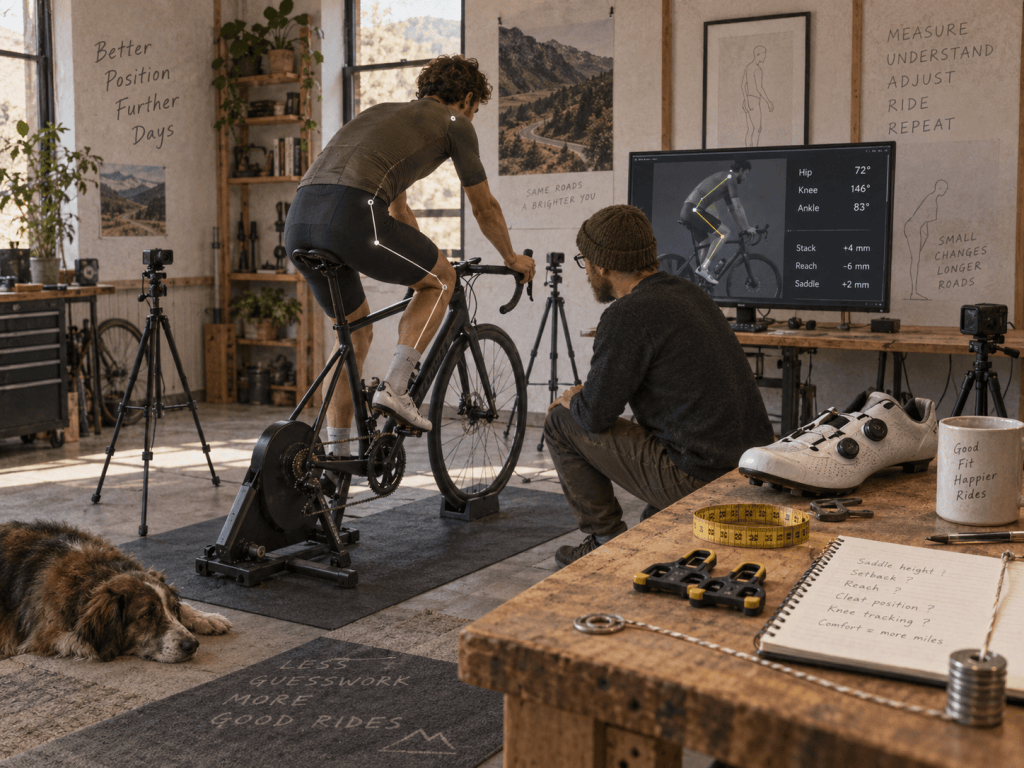
    Next, the bike was mounted onto the training setup in his studio and I started pedalling. Cameras at the front, rear and side recorded me riding. Snapshots of angles such as hip angle, knee angle at the top and bottom of the pedal stroke, elbow angle and shoulder angle were displayed on a screen. That gave Barry an idea of where I was in relation to the usual guidelines.

    Then, using his experience, his know-how and the conversation with me, he went about changing all the things that could be changed: seat height, saddle position fore and aft, saddle angle and handlebar height.

    This was by far the strangest thing and went against everything I had previously thought.

    He lowered the handlebars.

    It turns out I am quite supple and can bend at the waist fairly well. Because I had the handlebars up so high, I was holding myself up and pushing my shoulders up to fit my arms in, while my body was trying to bend lower.

    Sounds odd, but I was actually cycling hunched over. That was causing the sore shoulders, and I was putting so much pressure on my hands that the pins and needles were there all the time.

    By lowering the bars, the pressure was released.

    And the changes only need to be small. We are talking millimetres. Millimetres can make a big difference.

    We also talked about saddles. It was decided that my saddle was probably the wrong shape and I should investigate something else. Barry has a pressure pad he can place on the saddle to see where the weight quite literally sits. It showed more pressure on one side, which we put down to my twisted pelvis, but a new saddle looked like it might improve the comfort.

    After a while, we had one bike set up and it was time for the second one.

    This was the Triban with the comedy stem and riser. I hadn’t been able to find the original stem that came with the bike, so Barry tried to get the bars as low as possible. This bike didn’t need to be set up quite the same way as the Giant because it had different duties. I quite often put flat pedals on it and cycle with my son, so it didn’t need to be set up purely for distance.

    I took the bikes home and started riding the Giant far more than I had previously. It was easier to ride, more comfortable, and I started researching new saddles.

    After a while, I moved the stem down another couple of millimetres and that eased my shoulders even more. It was great. I found another saddle and booked a follow-up session with Barry to get it fitted properly.

    The bike had come alive.

    I rode it often, basically ignoring the Triban.

    A few months later, I thought I would try the Triban on a spin again, and it was uncomfortable. I had become used to riding the Giant with the lower handlebars, and I decided I should book in with Bike Fit Barry again.

    When I was there getting the new saddle fitted, I noticed that he had stems of different lengths on the wall in his studio. I asked if I could bring the Triban in and try different length stems. He said yes.

    That fitting took place, and now that bike is also comfortable to ride.

    So what is the outcome?

    I am absolutely now a proponent of having a proper bike fit with an experienced person, because it is way more nuanced than a few rules of thumb. Everyone is different, so everyone will have a different fit.

    People may think it is too expensive, but cyclists will happily spend hundreds of euro on new components to save a few grams here and a few grams there.

    The reality is that comfort is speed.

    If you can push power through your pedals without having to permanently brace yourself because of discomfort, you are going to get bigger gains than a few grams of weight will ever give you.

    And that leads into the next part of the story, because there is another kind of bike fit that I wish I had understood sooner.

    This is The Sub-7 Experiment.

  • From 30 Seconds to 60 Minutes

    Sunday, end of August.

    After the long, hot, dry summer we’ve had, this weekend has been properly rainy. I was hoping to get out on the bike, especially with the Dingle Peninsula trip coming up in two weekends’ time. It’s only 120km, but I wanted to get a bit of practice in this weekend, maybe 60km or so, just to keep the legs used to longer rides.

    That didn’t happen.

    Instead, I’ve just come off the rower. Actually, I’m still sitting on it as I write this, recovering.

    The session was three 20-minute blocks, giving me an hour in total. Gradual progression, getting faster as it went on. Nothing frantic, just steady work.

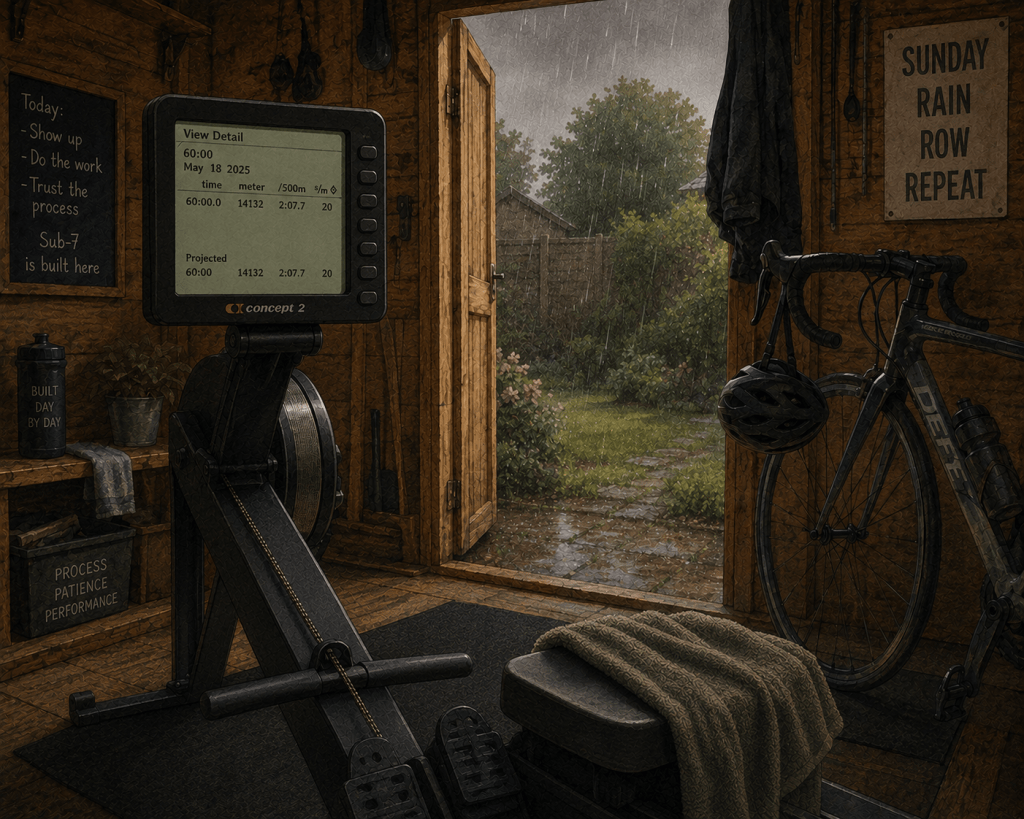
    The thing that amazes me is that I did the full 60 minutes, just over 14km, at an average pace of 2:09/500m.

    Thinking about it, that’s pretty mind-blowing. There was a time when I could only sustain that pace for short bursts. Not 30 minutes. Not even close. More like 30 seconds.

    And here I am now, averaging it for a whole hour.

    So yes, there is definitely progress happening. Sometimes it’s hard to see when you’re in the middle of it, but numbers like that make it pretty clear. The aerobic base is there. The cruising speed is improving. The work is paying off.

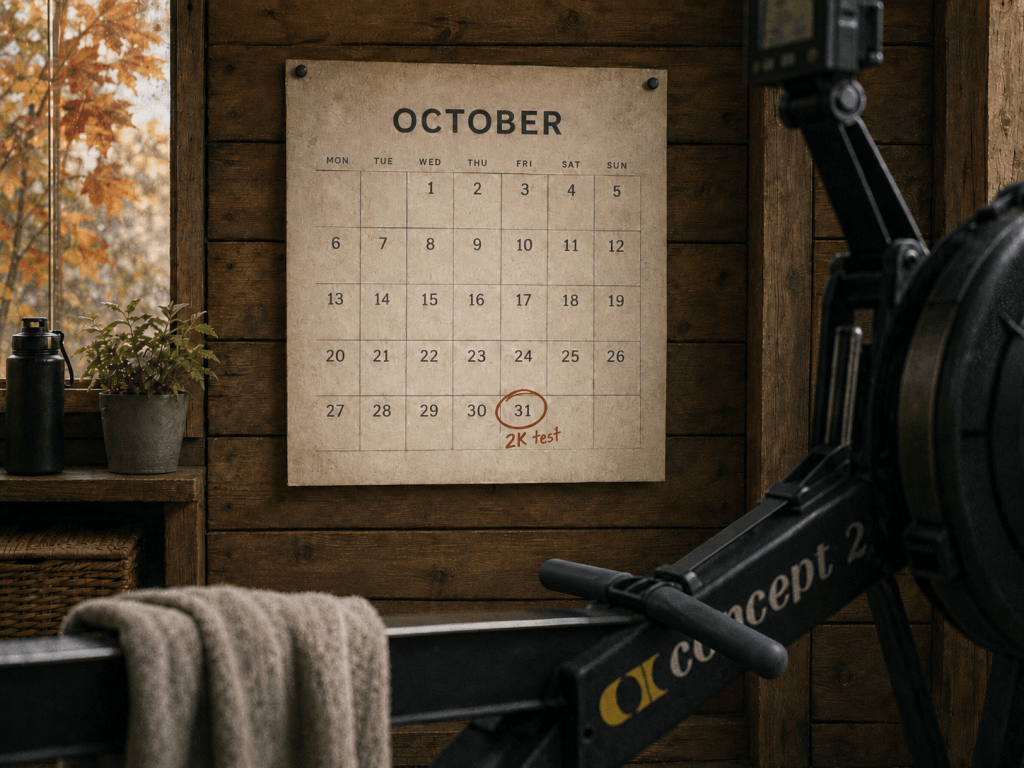
    Cycling around Dingle is coming in a couple of weeks. The 2K test is still the target for the end of October.

    Let’s see how it goes.

    This is The Sub-7 Experiment.

  • Training Again

    I mentioned recently that ChatGPT seems to remember what it wants to remember, and that sometimes you have to specifically tell it what to forget.

    It turns out you probably have to specifically tell it what to remember too.

    So that is what I did.

    I told Coach ChatGPT to remember this: we are aiming for a sub-7-minute 2,000m row. I also told it that I want to aim for a 2K test at the end of October, and to adjust the training plans accordingly.

    And I have to admit, the last three sessions suggest that it has listened.

    The workouts are getting progressively harder. They feel more focused, more purposeful, and more aligned with the actual goal. That is what we need.

    I don’t know if I’ll be ready for the full sub-7 attempt by the end of October. That might still be too soon. But if I can beat my previous best of 7:20, I’ll be happy with that. That would be real progress and a proper marker for where I am.

    Today was a good one.

    I did a 6 × 500m interval set, getting faster and faster as the session went on. Every rep was under 1:57/500m, and the last one was around 1:49.

    Controlled. Powerful. Technique felt good.

    That is the bit that matters most. Not just the pace, but the fact that it felt managed. No mad thrashing around. No hanging on for dear life. Just proper work, done properly.

    So here we go.

    This is The Sub-7 Experiment.
  • Stop Treating Me Like Glass

    It’s been a while since I’ve written anything.

    Not because nothing has been going on, but because the things to write have largely been the same:

    “Nice workout. Got the job done. Nothing much to report.”

    And it has all been a bit samey.

    That has got me asking questions. Why does it feel the same? Where is the push coming from? Am I still properly engaged in the Sub-7 Experiment?

    So I’ve been trying to make sense of it, and here are a few thoughts that might explain it.

    Firstly, let’s look at the process.

    For ages, the process has been the same. Take screenshots from WHOOP, put them into ChatGPT, ask for a workout, ChatGPT gives me the workout, I do it, then I report back.

    That process worked for a while, but I’ve decided to ditch WHOOP.

    I have cancelled my WHOOP subscription and no longer wear the device. It has done its job, and I am grateful for it. It gave me the impetus I needed when I started training three years ago, and it helped me get back into the idea of looking after myself. At that point, it was the best tool for the job.

    When I started focusing on the rowing, I would set the app going to record the session and then work until I hit the suggested strain in the app itself. That suggested strain feature was brilliant because it stopped me bursting myself every time I got on the machine, wildly going for it until I collapsed.

    No pain, no gain, right?

    Well, not strictly true.

    Too much pain becomes “give up and never go back,” at least that’s what my head was telling me. But with the WHOOP strain monitor giving me a suggested amount of work to aim for, it gave me structure without stupidity. Brilliant.

    But now there is so much data in there that I have become swamped by it, and I’m not really using most of it. Yes, I would check recovery and sleep, but to be honest I am well used to my body showing signs of fatigue after a workout now. I don’t need an app to tell me every morning.

    Recovery is also quite subjective, based on WHOOP’s algorithms. Sleep quality is the same. I was there. I know how the sleep went.

    As for the rest of it, there is so much data now that I don’t know what to do with it, other than remove it from my life and make things simpler.

    So no more checking WHOOP first thing in the morning. No more screenshots of WHOOP, ErgData and Strava into ChatGPT after every workout just to capture all the details.

    I’ve gone back to using my old Polar chest strap and heart rate monitor, connecting that directly to the Concept2 rowing monitor and letting ErgData capture the session and feed it into Strava. When I’m in the gym, the same strap sends heart rate directly into my phone and the Strava app.

    I am still asking ChatGPT to give me the workout each time, and I am still uploading the results from ErgData afterwards. Occasionally I’ll upload Strava too if ChatGPT asks for it. So the coaching process is still there, but the data sources are simpler and there is a lot less noise around it.

    Good.

    Data sources simplified. App integrations simplified.

    Let’s go.

    Except nothing really happened.

    The workouts were fine, but they were also a bit easy.

    So I had a chat with ChatGPT itself.

    One of the things about ChatGPT is that it has a memory feature. Depending on the subscription you have, it can remember things from your conversations across different chats. That can be a good thing, but it turns out it can also be a bit of a problem.

    It’s good because, as a user, you don’t have to keep reminding it about everything that has happened. I have a persistent conversation inside ChatGPT that is all about Sub-7 coaching, along with many other subjects.

    I had some surgery on my leg last October, and at the time I asked ChatGPT, within the Sub-7 coaching conversation, for a recovery plan to get me back up to speed. It remembered that.

    I also tweaked my back in the gym a short while ago, using bad form to lift some plates off a machine I was using. Again, I told ChatGPT about it and asked for recovery steps. It remembered that too.

    So when I asked it to remind me what the Sub-7 Experiment was about, it told me the long-term plan: to build a training programme that will enable me to row 2,000 metres in under 7 minutes.

    That was the right answer.

    But then I challenged it. I asked why I felt as though there was no real progress at the moment and why everything felt very samey. It came back and said I was still recovering from the tweaked back and the leg surgery.

    And immediately, there it was.

    It had remembered that I’d had those issues, but it had not properly remembered that I had also told it I was back in one piece and able to continue with the full-on progress towards Sub-7.

    It seems the memory function in ChatGPT remembers what it thinks is important, not necessarily what the user thinks is important, unless the user specifically says: “Remember this.”

    So I told it to remember that I am back on form and back into the full Sub-7 programme, and that it should stop treating me like a piece of glass.

    And since then, starting last Sunday, the workouts have been much more on plan.

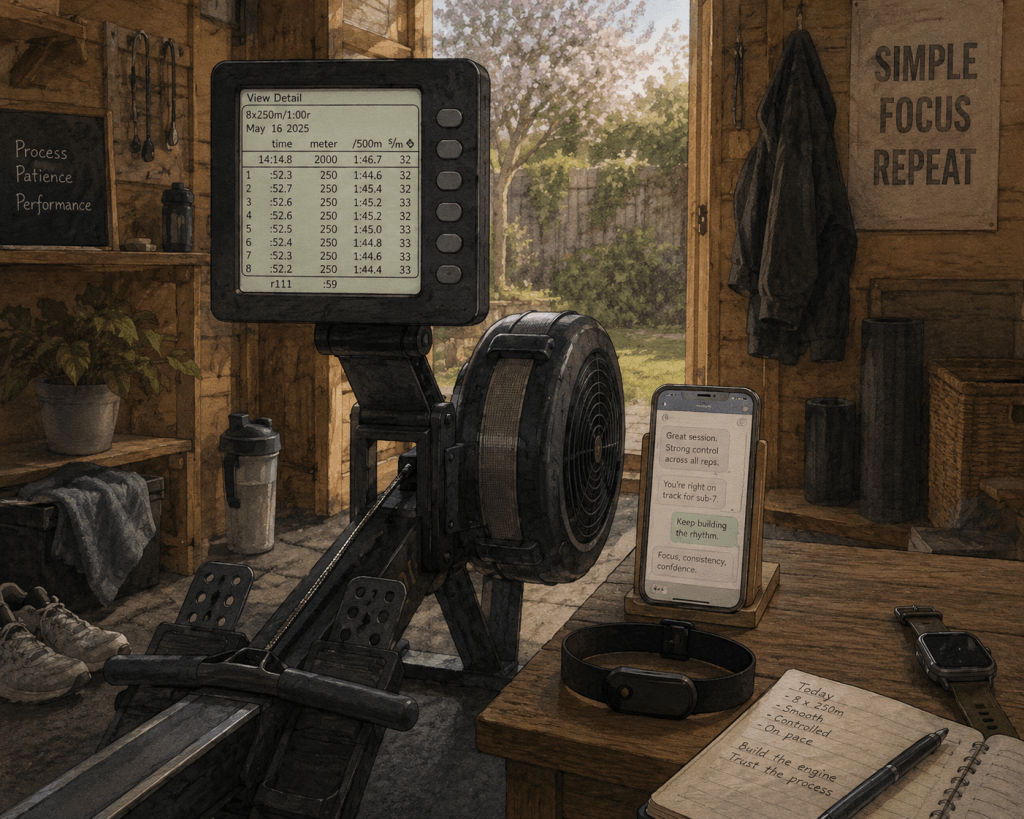
    Sunday’s workout was a 10-minute warm-up, then 8 × 250m sprints with 90 seconds rest between each one, designed to simulate 2,000 metres at or around Sub-7 pace.

    And my goodness, it was a strong session.

    Properly controlled pacing. Good technique. No mad thrashing around. And most importantly, there were signs of real progress.

    Yes, there were rest periods between each 250m sprint, but if I add up the actual times of those 250m sections, it comes out as a 7 minute 7 second 2,000m.

    All I need to do now is join those 250m sections together.

    That is definitely going to need extra strength work in the gym and more power runs on the rower, but I am making progress.

    And it feels great.

    This is The Sub-7 Experiment.

  • Back in the Groove

    Friday, and another gym day.

    It’s beautiful outside. The weather is still warm, and that definitely helps. But the main thing is that I got myself into the gym again and did the session.

    Nothing dramatic to report. Just rebuilding the momentum, rebuilding the strength, and getting back into the groove.

    And I thoroughly enjoyed it.

    Short and sweet today. That’s it. Just good.

    This is The Sub-7 Experiment.

  • Still Bendy Enough

    It’s Tuesday, and I’ve just finished a workout in the gym.

    It’s the first time I’ve been in for weights and strength work for a while, and I did feel a bit weak and underpowered. I don’t know if that’s because I’m expecting too much, or because I’m simply out of practice. Probably a bit of both.

    But anyway, it was nice to be out.

    It’s a lovely sunny day. Warm too. About 22°C and it’s not even 10 o’clock yet. That always helps.

    I really enjoyed being back in the gym and doing a couple of different things. Things that were not rowing. I love the rower in the shed, but I do need this bit too. The lifting, the moving, the using different muscles, and just being somewhere else for a while.

    So yes, all good. Not my strongest session ever, but a useful one. A reminder that strength needs consistency, not occasional heroic appearances.

    Then, to finish things off, I had to do a bit of gymnastics getting back into the car. Somebody had parked so close to my driver’s door that I couldn’t get in, so I had to climb in through the passenger side and shuffle across.

    I’m glad I’m not an old fella yet. Or at least I’m glad I’m still supple enough to make that work.

    This is The Sub-7 Experiment. Still rowing, still lifting, still trying to stay bendy enough to get into my own car.

  • The Chassis Is There

    I haven’t done one of these posts for a while.

    It’s funny, the other day I found a message to my future self. It was in my calendar. I’d obviously written it and put it in there when I came back from holiday last year. It was a reminder not to let myself go this summer. Ease off a little bit maybe, but not to let myself go the way I did last year.

    It was quite funny really, because I honestly don’t feel as though I’ve properly got going since I wrote that message.

    And yet, when I look at the evidence, that’s not entirely true.

    My cruising speed on the rower is a lot higher. I don’t think I’m any closer to breaking the sub-7 2K yet, but my cruising speed is there. I’m fitter. Aerobically fitter. On Sunday I went out and did 80 kilometres on the bike and didn’t really think about it. It was just there and done.

    So the work is still happening. I just don’t feel like I’ve got going with the same intensity I had last year.

    So what needs to change?

    I think I need to start blogging more again, because that was where a lot of the accountability came from. More than that, it was where the reflection came from.

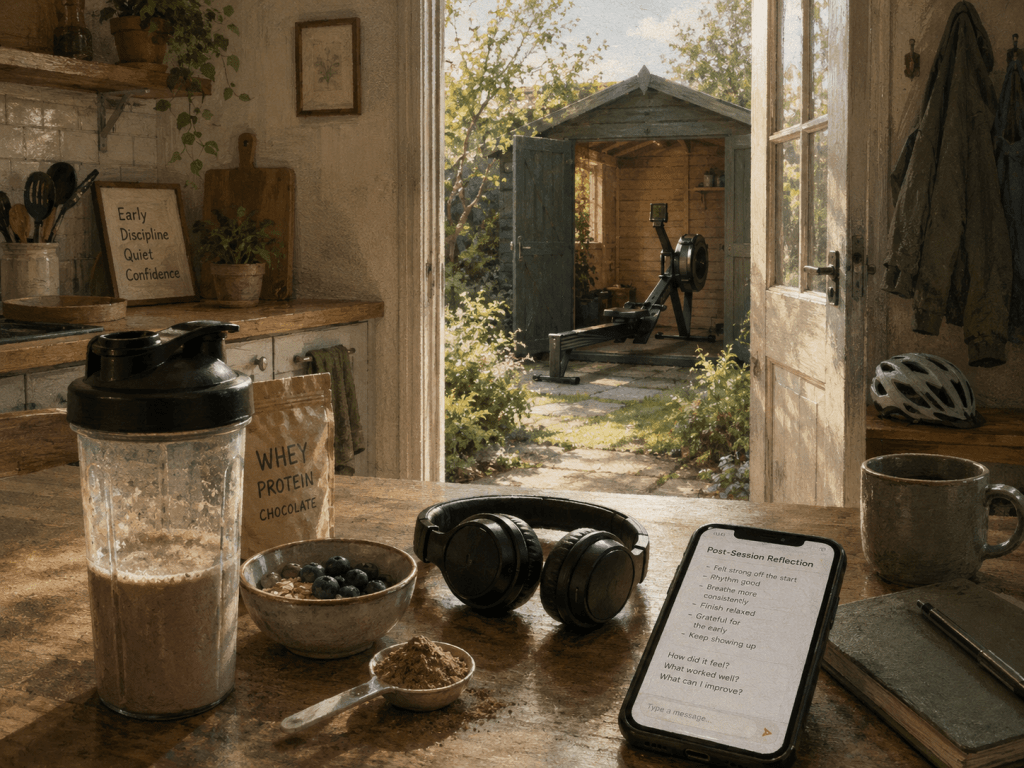
    My routine after rowing in the shed needs to change. At the moment I finish the session with my music still on, walk back into the kitchen, make my recovery drink, log my calories, log the workout with ChatGPT, go upstairs, shower, and start work.

    At no point in that sequence do I stop and reflect on what I’ve just done.

    I’m doing the exercise. I’m just not logging it properly in my own head. I’m not writing it down. I’m certainly not reflecting on it. It’s just a case of getting out, doing the session, coming back in and moving on to the next thing.

    That reflection piece needs to be reinstated.

    Maybe the new rule is simple: when I finish on the rower and come back into the house, I take the headphones off. Then, while I’m making my recovery drink, I speak into ChatGPT and do the reflection there and then.

    That used to happen naturally when I went to the gym. I’d finish the session, get back to the car, sit there for a minute and think about what I’d just done before starting the engine and heading to the next thing. Training in the shed is brilliant, but it has removed that little pause.

    I need to put it back.

    The work is still there. The aerobic capacity is still there. The chassis is there. But I’m still a long way from sub-7, and I need to get stronger. That’s the next proper conversation with Coach ChatGPT.

    So yes, time to get back in the groove, but gently. If I turn it into a chore, I’ll switch off again.

    This is The Sub-7 Experiment. Still reflecting. Still working. Maybe not quite as intensely as before, but there is a plan to change that.

  • Never Race a Stranger in a Hotel Gym

    11 years ago this weekend I rode 100km in one day on my bike.

    It was the furthest I’d ever ridden and it was the first organised ride I’d ever completed. My mate Rich and I set out to do it together and it was a great day out.

    One thing that has stuck with me since that day was cycling next to an old boy who, to my untrained eye, could have been 70 years old. He looked like he’d stacked up a lot of experience in his time, and he was riding a Pinarello Dogma. For the uninitiated, that’s basically a superbike. Think Koenigsegg or McLaren. Probably the finest bike money could buy at the time.

    This old boy was cruising along. Not in a hurry, not even looking like he was breaking a sweat. Me and Rich were keeping up with him fine. There was a decent-sized group and we were all moving along the flat at around the same pace.

    Then we came to a hill.

    There was lots of downshifting and lots of effort as we started to climb… except for the old boy. He seemed to put in the exact same effort as he had on the flat and just glided away up the hill like it didn’t exist.

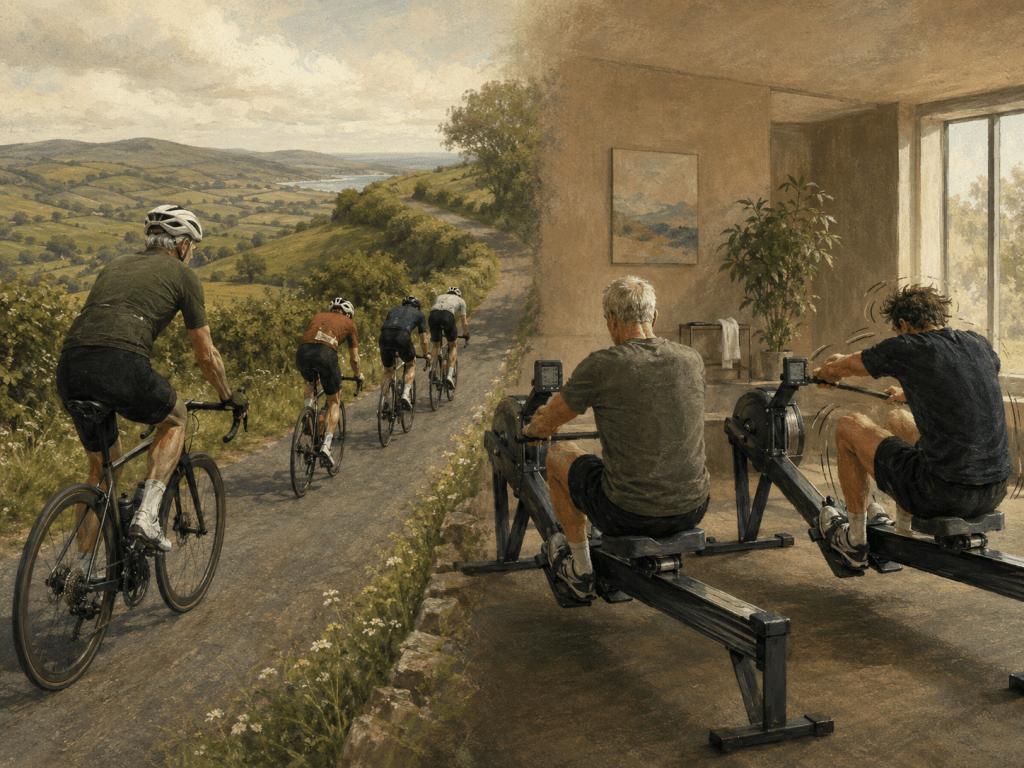
    Rich and I still talk about that. And that older gentleman is my inspiration for what I’m doing now. I want to be 75 and still riding my bike up hills like they’re not there. I still want to be able to sit on a rowing machine and go well for 60 minutes at a time. And I’d like to be doing it with my mate Rich.

    This weekend I had a little moment of my own.

    We were away as a family in a hotel in Kilkenny and I decided to go to the gym for a row. We’d already used the pool earlier in the day and I thought a spin on the rower would be a good way to finish off a day of walking around town.

    The row was great, although the machine was a bit old and graunchy. It really made me appreciate how lucky I am to have my own Concept2 in the shed.

    There was a group of younger lads in there, twenty-somethings, and I could see them clocking me. I was cruising along, 22 spm, controlled. They kept looking over and I could tell I’d become a bit of a “thing” for them.

    Then one of them strutted up to the rower next to me, made a big show of sitting down and strapping in, while his mates watched… and he went for it.

    Like a demon. Straight into 35 spm, out of control. On those big Technogym screens you can see everything, and I did just enough to stay ahead of him on speed and watts while keeping it at 22 spm.

    He tried and tried but couldn’t get in front.

    After a while he got more serious, tried to find a rhythm, started increasing his overall speed… and at that point I dropped my stroke rate to 19 spm and just pulled harder. The display showed 220 watts sustained for about three minutes at around 1:55 pace and he still couldn’t get near me.

    When he hit 1000 metres he stopped, got off, and went back to his mates shaking his head.

    And I loved it…!!!

    Hollow victory? Maybe. Should I know better? Definitely.

    But the moral of the story is this: watch out for the old dudes on the rower. They are quite likely to kick your ass.

    This is The Sub-7 Experiment.