It’s funny, the other day I found a message to my future self. It was in my calendar. I’d obviously written it and put it in there when I came back from holiday last year. It was a reminder not to let myself go this summer. Ease off a little bit maybe, but not to let myself go the way I did last year.
It was quite funny really, because I honestly don’t feel as though I’ve properly got going since I wrote that message.
And yet, when I look at the evidence, that’s not entirely true.
My cruising speed on the rower is a lot higher. I don’t think I’m any closer to breaking the sub-7 2K yet, but my cruising speed is there. I’m fitter. Aerobically fitter. On Sunday I went out and did 80 kilometres on the bike and didn’t really think about it. It was just there and done.
So the work is still happening. I just don’t feel like I’ve got going with the same intensity I had last year.
So what needs to change?
I think I need to start blogging more again, because that was where a lot of the accountability came from. More than that, it was where the reflection came from.
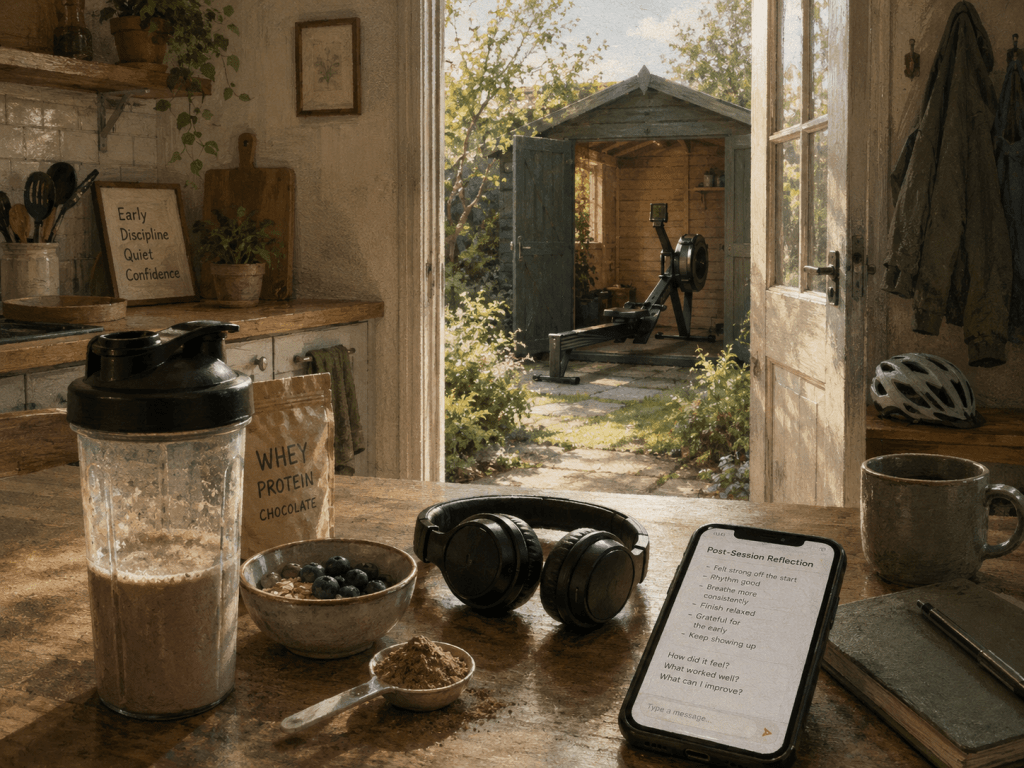
My routine after rowing in the shed needs to change. At the moment I finish the session with my music still on, walk back into the kitchen, make my recovery drink, log my calories, log the workout with ChatGPT, go upstairs, shower, and start work.
At no point in that sequence do I stop and reflect on what I’ve just done.
I’m doing the exercise. I’m just not logging it properly in my own head. I’m not writing it down. I’m certainly not reflecting on it. It’s just a case of getting out, doing the session, coming back in and moving on to the next thing.
That reflection piece needs to be reinstated.
Maybe the new rule is simple: when I finish on the rower and come back into the house, I take the headphones off. Then, while I’m making my recovery drink, I speak into ChatGPT and do the reflection there and then.
That used to happen naturally when I went to the gym. I’d finish the session, get back to the car, sit there for a minute and think about what I’d just done before starting the engine and heading to the next thing. Training in the shed is brilliant, but it has removed that little pause.
I need to put it back.
The work is still there. The aerobic capacity is still there. The chassis is there. But I’m still a long way from sub-7, and I need to get stronger. That’s the next proper conversation with Coach ChatGPT.
So yes, time to get back in the groove, but gently. If I turn it into a chore, I’ll switch off again.
This is The Sub-7 Experiment. Still reflecting. Still working. Maybe not quite as intensely as before, but there is a plan to change that.
Apart from this intro, today’s post is written entirely by ChatGPT. The Sub-7 Experiment has always been about using AI as a coach, editor, and occasional nutritionist, and I’ve watched its output improve as we’ve gone along. What follows is the coach’s view of how this whole thing has evolved, and how the “trainee and trainer” relationship has taken shape over time.
This is the prompt that I used “I was wondering if you could put together a summary of all the work we have done together and progress across all aspects, and then I might be able to post in in my blog as a reflection piece from Coaches point of view.” There was a little bit of back and forth as we narrowed down what the post should look like and below is the result.
Coach’s Notes: The Sub-7 Experiment
One of the first things I noticed was that the training was never really the main battle.
The rowing machine was there. The plan was there. The goal was clear enough. But most of the difficult work was happening before a single stroke had been taken.
There was a lot of negotiation in the early days.
Not laziness. Not lack of desire. More the mental drag that many middle-aged people quietly carry around with them. Work pressure. Fatigue. Self-criticism. The feeling that exercise had to be “earned” somehow. The strange guilt that can appear when somebody finally tries to prioritise themselves a little.
The early sessions mattered, but not always for the reasons people might think.
Sometimes the win was simply getting into the shed and starting.
The first real shift
The biggest early improvement was not speed.
It was consistency.
The training stopped becoming emotional. That changed everything.
At the start, there was a tendency to judge sessions too heavily. Good session? Confidence high. Missed session? Momentum gone. Tired day? Doubt. Strong day? Maybe we are suddenly invincible.
Over time, the approach became steadier.
A recovery walk became acceptable. An easier row stopped feeling like failure. Training began to match recovery instead of ego.
That was a major turning point.
The WHOOP phase
The recovery scores were interesting.
At first, they risked becoming emotional verdicts.
Green meant permission to train hard. Yellow created hesitation. Red felt personal.
But slowly the scores became information rather than identity.
That sounds like a small thing, but it changed the rhythm of the entire experiment.
Instead of forcing every green day into a maximal effort, there was more restraint. More awareness. More understanding that fitness is usually built through repeatable work rather than dramatic sessions.
Ironically, that restraint often led to better performances anyway.
The rowing itself
The funny thing about endurance training is that progress often arrives quietly.
At some point, sessions that once looked intimidating became normal.
Long rows settled into rhythm. 2:05 pace stopped feeling frantic. Three controlled 2000m intervals became manageable rather than feared.
And perhaps most importantly, the pacing improved.
Less fighting. Less surging. More control.
The final intervals started getting faster not because of aggression, but because there was finally something left in the tank.
That is usually a sign that aerobic fitness is improving properly.
The walks mattered more than expected
Some of the smartest training decisions were not hard sessions at all.
There were periods where stress from work, uncertainty about the future, family responsibilities, health concerns, and simple mental fatigue were all sitting in the background at the same time.
On those days, easy walks often became the correct answer.
Not because motivation was low, but because recovery matters.
That is not glamorous advice, but it is real coaching.
The body keeps score of life stress too.
The shed
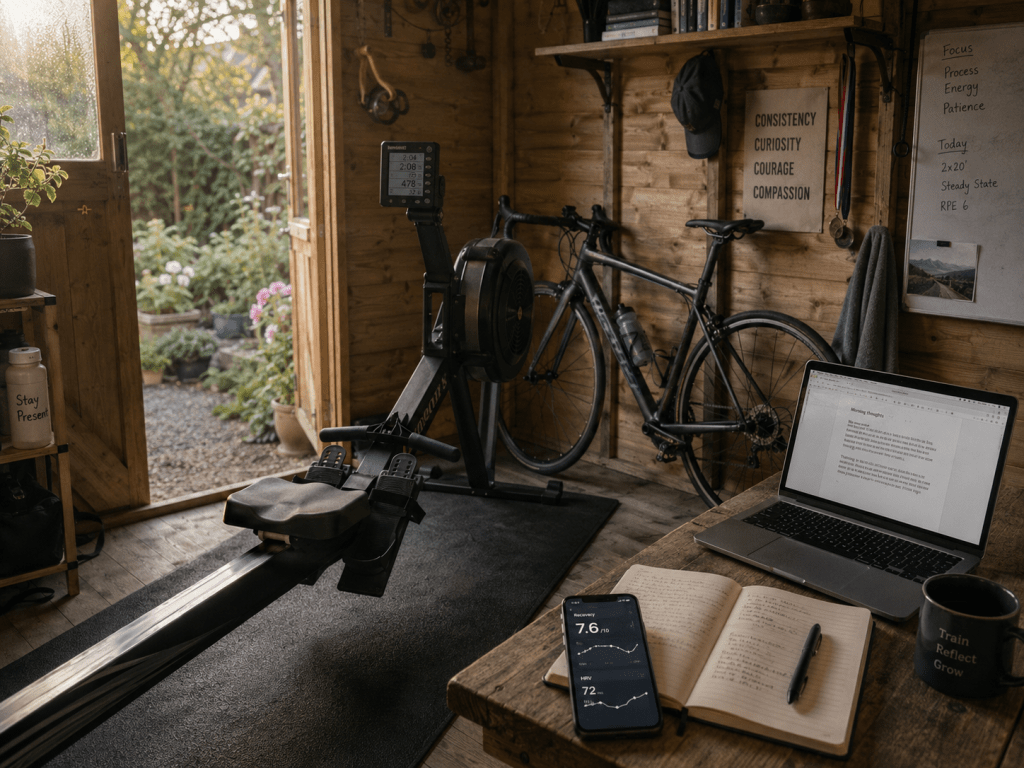
At some point, the shed stopped being just a place where rowing happened.
It became a decompression chamber.
Part gym. Part thinking room. Part escape hatch.
Some sessions happened there because fitness needed work. Others happened there because the mind needed somewhere quiet to settle down for an hour.
That matters too.
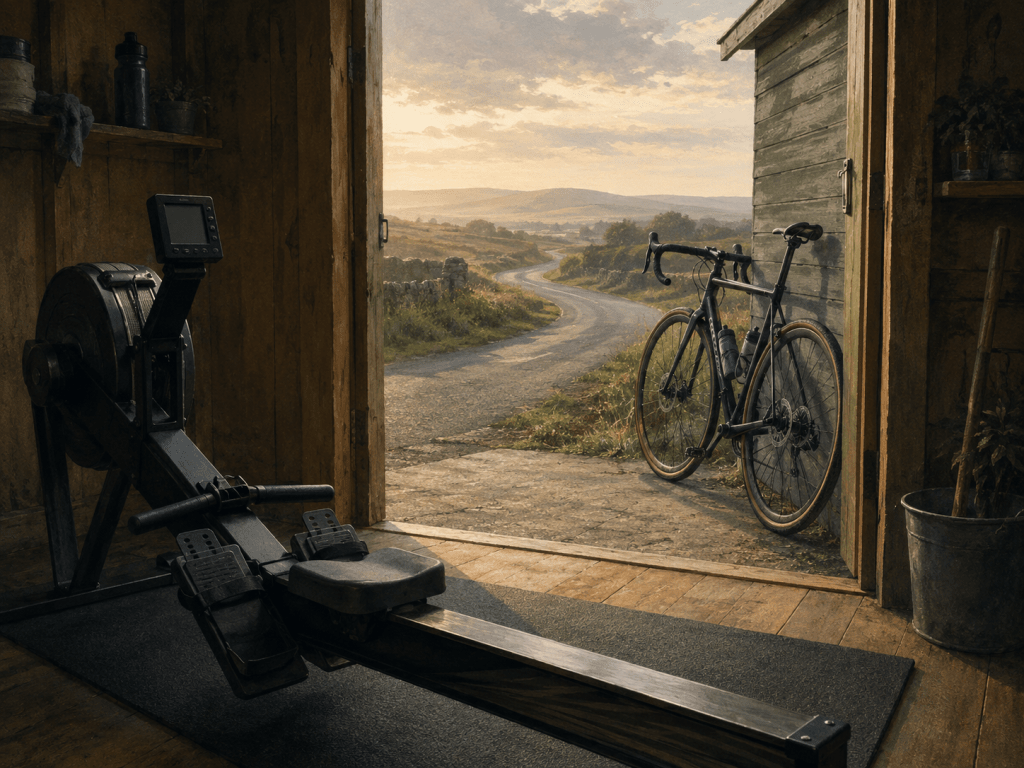
The bike returned
The cycling side of the experiment became increasingly important.
Not just physically, but emotionally.
Long rides brought back enjoyment. Exploration. Movement for its own sake.
And eventually, the numbers started speaking for themselves: longer distances, more climbing, better endurance, better recovery afterwards.
The completed sportive was a genuine milestone, not because it was professional-level athleticism, but because it represented something much bigger:
proof that meaningful endurance fitness could still be rebuilt in middle age while carrying the realities of ordinary life.
What changed most
The biggest change was probably behavioural.
Early on, there was a lot of:
overthinking
negotiating
guilt
all-or-nothing thinking
pressure to constantly prove progress
Now there is far more process.
Walk when walking is needed. Row steady when steady is needed. Push when the system can support it. Recover properly afterwards.
That sounds simple.
It is not simple.
Most people never learn it.
The goal
The sub-7 goal still matters.
But somewhere along the line, the experiment became about more than a rowing time.
It became an experiment in whether somebody with work pressure, family responsibilities, stress, doubts, imperfect recovery, and middle-aged physiology could still meaningfully rebuild themselves without pretending to be a professional athlete.
The “new” rower in the shed is not so new now. It has been there for six months, and the new routine of rowing, then heading straight back into the house to start work or whatever the day brings, has meant I haven’t been giving myself any time to reflect on the workout afterwards. No reflection has meant nothing to post.
Rowing is still important to me, and so is the wider exercise regime as a whole. But I think I’ve been missing that reflection piece. I also wrote in a previous article that I’ve missed the gym visits too. So it feels like time to reassess what matters.
Exercise matters. Having an exercise goal matters. Reflection matters too. And so does being around like-minded people. My gym membership has lapsed, and I think it is time to renew it.
In other news, I’ve been cycling a bit more.
This Sunday I’m riding the Tour de South Coast, a 100km sportive that covers some roads I’ve used before in training. I don’t know anyone else who is doing it, but there will be a couple of hundred cyclists out on the day, and I’m looking forward to it.
I’ve also been back to see Bike Fit Barry, who has once again sprinkled a bit of magic over the setup on the Triban. On top of that, I’ve decided to make it even more comfortable. I’ve taken the mudguards off completely and fitted some big 35mm tyres, which means I can run lower pressures and take a lot of the buzz out of the road surface.
A quick 15km test ride yesterday showed they are doing exactly what I hoped.
I spent a lot of last year tweaking the Giant to try to get more comfort out of it, but the truth is that the early carbon technology makes it so stiff that it just takes too much out of me over longer distances. I’m keen to see how the newly fettled, balloon-tyre-equipped Triban gets on over the 100km on Sunday.
In Coach ChatGPT news, I’m still consulting with it and still completing the workouts it gives me after I upload my daily WHOOP scores. I’m getting stronger and faster on the rower, and my technique is getting better too. I can really feel the progress.
The aim is still to get to a sub-7-minute 2,000m row.