I haven’t written for a while.
It’s been tough. Most of December, all of January, and the first bit of February I’ve been coming up here “looking for my mojo.” I’m not even sure I ever had a mojo in the first place, but it became the story in my head: I’ve lost it.
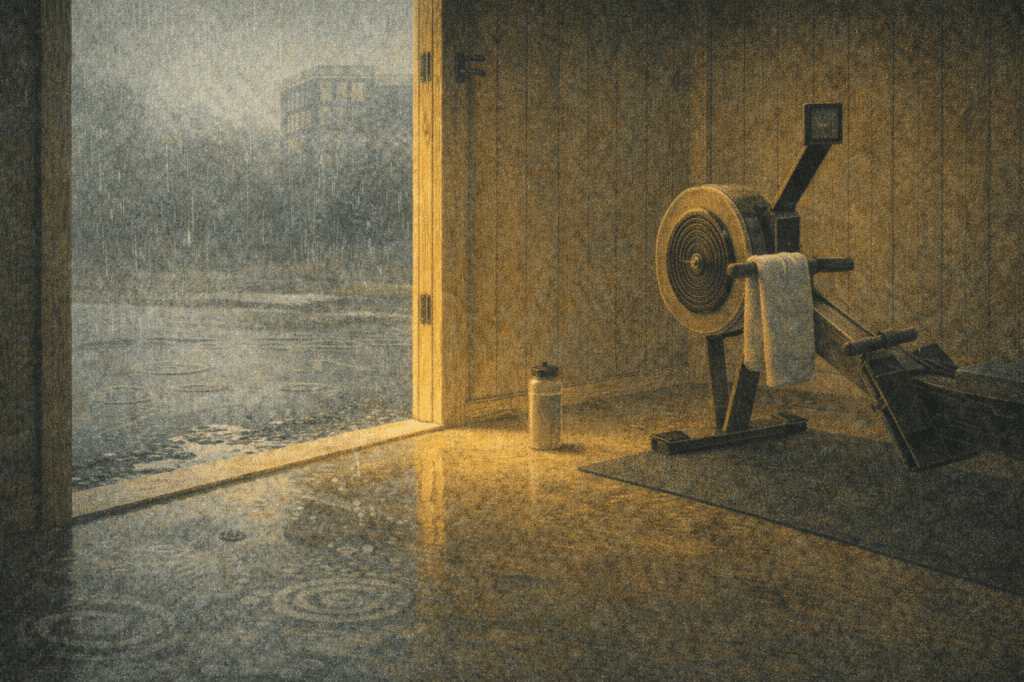
It hasn’t helped that it feels like it has rained every day this year where I live. The sun barely shows up. I also think I put too much stock in the idea that once I had a rowing machine in the shed, everything would click and I’d train every day.
On top of that, the new process I built in December – WHOOP scores into ChatGPT, get a tailored session – hasn’t been working the way I hoped. Not because the logic is bad, but because of how I react to it.
When ChatGPT looks at my WHOOP recovery and sleep and says, “easy day today,” I treat that as a full stop. “Right, that’s it, we’re done.” No movement. No walk. Nothing. It’s basically become an easy out, and I’ll always find an easy out if you give me one.
The “mojo hunt” has turned into the same thing. If I tell myself I’m looking for my mojo and I can’t find it, then I have an excuse to sit on the back foot and do nothing.
I still want to row. I still want a sub-7 2,000 metres. That goal hasn’t changed. What I’ve lost sight of is that exercise, for me, is about far more than chasing a single number on the monitor.
The rowing – and the moving in general – is primarily about my mental health.
Case in point: earlier this week I was heading into a potentially confrontational meeting. I knew the people in the room probably weren’t going to like what I had to tell them. The old me would have carried that anxiety all day.
Instead, I went into the shed.
I told ChatGPT about the meeting and asked for a workout that would help channel the adrenaline and set me up properly. It came back with a plan that turned out to be perfect. By the time I’d finished the row, the energy was controlled, not chaotic.
I hadn’t even called the meeting – someone else had – but when it started I decided I was going to drive it. I would control the narrative. Everyone would get their say, everyone’s points would be noted, but at the end of the day there were only two options on the table. They could go one way or the other. That’s it.
I went in with that calm, directed energy from the row and nailed it.
Fast forward two days. I’ve just come out of the shed after another row and another thinking session, and the penny has finally dropped:
I never had “mojo” in the first place. What I had was movement. When I move, I look after myself. When I stop, everything starts to fog over.
My mental health depends on exercise. Full stop.
And so what if I’ve put on a few pounds lately. That does not define me. What defines me is the state of my head and my ability to deal with things calmly and rationally – whether that’s work stuff, dad stuff, husband stuff or just being a decent friend. That is what counts.
The next step isn’t hunting for some mystical spark. It’s much simpler and much more boring:
- Go outside, even when it’s raining.
- Get back to walking.
- Go to the gym.
- See people, even if it’s just a nod to the receptionist or a quick hello to the regulars.
I need the physical work and a bit of human contact. If I keep those two things in the mix, everything else won’t magically fall into place, but it will get clearer again. And clarity is what I need: for my mental health, my physical health, to be a decent dad and husband, and to be kinder to myself.
I’d lost sight of that.
This is The Sub-7 Experiment: not just chasing 2,000 metres, but remembering to look after myself.

 The Sub-7 Experiment