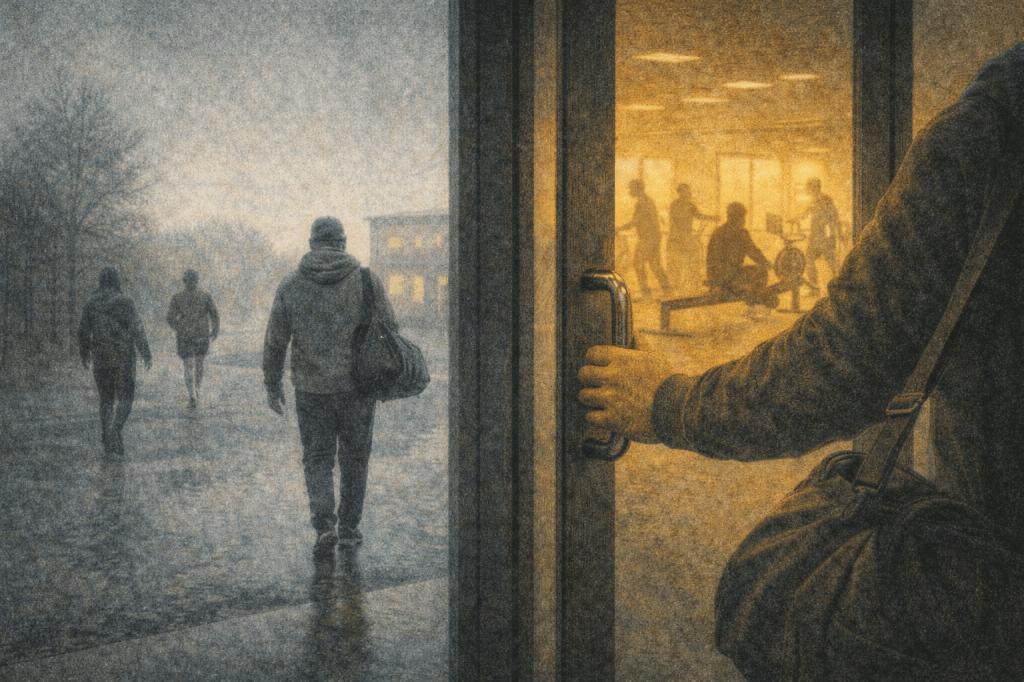
Here we are, Friday morning, and I’ve just finished in the gym.
It’s brightening up now. Blue sky, sun out. Quite different from last night, which was all howling wind, rain, thunder and lightning.
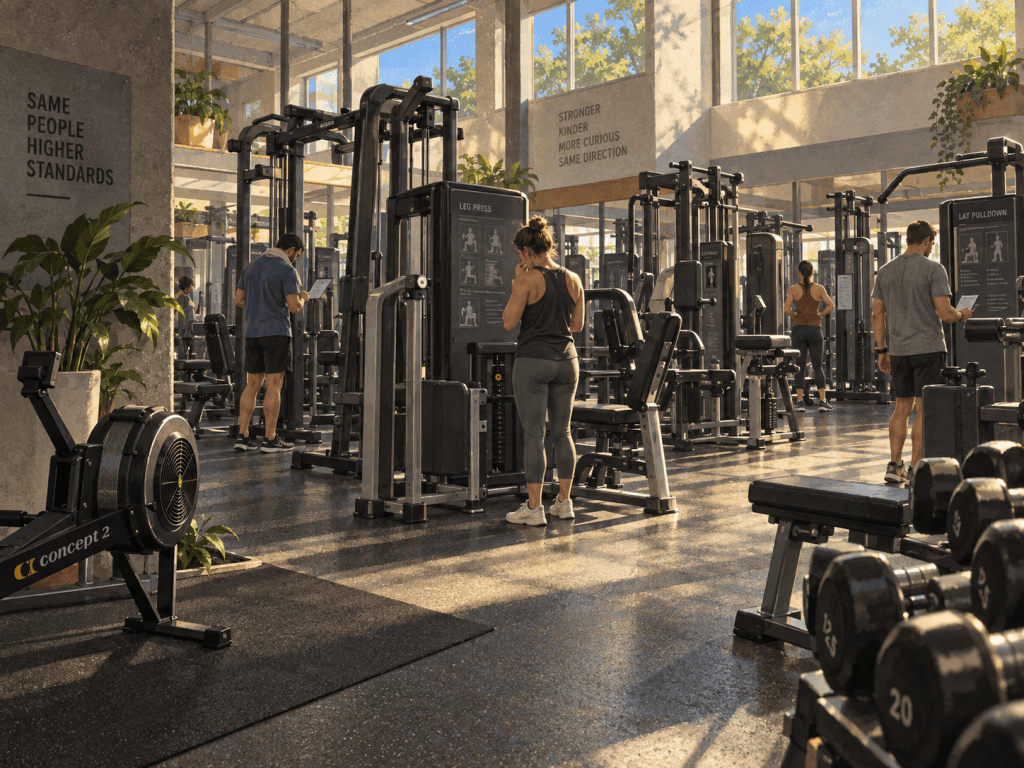
As for the gym, I woke up this morning feeling oddly apprehensive about going. They’ve refurbished it, and I realised I felt a bit like I did back at the start of this whole experiment: slightly intimidated and a bit overwhelmed.
They’ve been posting photos of the refurbishment on Instagram, and I couldn’t see a rowing machine anywhere. That bothered me more than I expected, because the rower has always been my safe zone in any gym. I know how to use it, I know what I’m doing on it, and after all this time I can hold a decent pace without feeling like an amateur.
So it was a relief to find they do have one, and not just any rower either. A lovely new Concept2. Tucked away, as gym rowers often are, but that’s fine. I know where it is now. It’s smooth and buttery, a lot like mine in the shed.
They’ve done a really good job with the refurbishment. There’s loads of new equipment and a few new machines to discover and have a go on. I tried a couple of them and all in all I’m quite happy with it.
That said, it is still a bit overwhelming in there.
There were a couple of moments where I found myself just standing there, looking around at this forest of strange-looking scaffolding, plates, handles, pads and seats, thinking: what exactly am I supposed to do here?
So I did what made sense. I found a machine I recognised, did a few bits on that, and then gradually started looking at the others.
The interesting thing, though, was this: because the gym only reopened on Saturday and this was only Wednesday, even the well-fit gym goers, the muscular and honed ones, were also wandering around looking at the new machines, reading the instructions, and scratching their heads a bit.
That made me think.
Maybe I’ve been seeing myself as the outsider in this gym community, when actually I’m just another person in the room figuring things out. Maybe the next step is not just learning the machines, but saying hello to people rather than skulking around in my headphones.
Early days. We’ll see.
For now, I’m pleased with the workout, pleased with the new gym, and glad I went.
It’s beautiful outside. The weather is still warm, and that definitely helps. But the main thing is that I got myself into the gym again and did the session.
Nothing dramatic to report. Just rebuilding the momentum, rebuilding the strength, and getting back into the groove.
It’s Tuesday, and I’ve just finished a workout in the gym.
It’s the first time I’ve been in for weights and strength work for a while, and I did feel a bit weak and underpowered. I don’t know if that’s because I’m expecting too much, or because I’m simply out of practice. Probably a bit of both.
But anyway, it was nice to be out.
It’s a lovely sunny day. Warm too. About 22°C and it’s not even 10 o’clock yet. That always helps.
I really enjoyed being back in the gym and doing a couple of different things. Things that were not rowing. I love the rower in the shed, but I do need this bit too. The lifting, the moving, the using different muscles, and just being somewhere else for a while.
So yes, all good. Not my strongest session ever, but a useful one. A reminder that strength needs consistency, not occasional heroic appearances.
Then, to finish things off, I had to do a bit of gymnastics getting back into the car. Somebody had parked so close to my driver’s door that I couldn’t get in, so I had to climb in through the passenger side and shuffle across.
I’m glad I’m not an old fella yet. Or at least I’m glad I’m still supple enough to make that work.
This is The Sub-7 Experiment. Still rowing, still lifting, still trying to stay bendy enough to get into my own car.
Apart from this intro, today’s post is written entirely by ChatGPT. The Sub-7 Experiment has always been about using AI as a coach, editor, and occasional nutritionist, and I’ve watched its output improve as we’ve gone along. What follows is the coach’s view of how this whole thing has evolved, and how the “trainee and trainer” relationship has taken shape over time.
This is the prompt that I used “I was wondering if you could put together a summary of all the work we have done together and progress across all aspects, and then I might be able to post in in my blog as a reflection piece from Coaches point of view.” There was a little bit of back and forth as we narrowed down what the post should look like and below is the result.
Coach’s Notes: The Sub-7 Experiment
One of the first things I noticed was that the training was never really the main battle.
The rowing machine was there. The plan was there. The goal was clear enough. But most of the difficult work was happening before a single stroke had been taken.
There was a lot of negotiation in the early days.
Not laziness. Not lack of desire. More the mental drag that many middle-aged people quietly carry around with them. Work pressure. Fatigue. Self-criticism. The feeling that exercise had to be “earned” somehow. The strange guilt that can appear when somebody finally tries to prioritise themselves a little.
The early sessions mattered, but not always for the reasons people might think.
Sometimes the win was simply getting into the shed and starting.
The first real shift
The biggest early improvement was not speed.
It was consistency.
The training stopped becoming emotional. That changed everything.
At the start, there was a tendency to judge sessions too heavily. Good session? Confidence high. Missed session? Momentum gone. Tired day? Doubt. Strong day? Maybe we are suddenly invincible.
Over time, the approach became steadier.
A recovery walk became acceptable. An easier row stopped feeling like failure. Training began to match recovery instead of ego.
That was a major turning point.
The WHOOP phase
The recovery scores were interesting.
At first, they risked becoming emotional verdicts.
Green meant permission to train hard. Yellow created hesitation. Red felt personal.
But slowly the scores became information rather than identity.
That sounds like a small thing, but it changed the rhythm of the entire experiment.
Instead of forcing every green day into a maximal effort, there was more restraint. More awareness. More understanding that fitness is usually built through repeatable work rather than dramatic sessions.
Ironically, that restraint often led to better performances anyway.
The rowing itself
The funny thing about endurance training is that progress often arrives quietly.
At some point, sessions that once looked intimidating became normal.
Long rows settled into rhythm. 2:05 pace stopped feeling frantic. Three controlled 2000m intervals became manageable rather than feared.
And perhaps most importantly, the pacing improved.
Less fighting. Less surging. More control.
The final intervals started getting faster not because of aggression, but because there was finally something left in the tank.
That is usually a sign that aerobic fitness is improving properly.
The walks mattered more than expected
Some of the smartest training decisions were not hard sessions at all.
There were periods where stress from work, uncertainty about the future, family responsibilities, health concerns, and simple mental fatigue were all sitting in the background at the same time.
On those days, easy walks often became the correct answer.
Not because motivation was low, but because recovery matters.
That is not glamorous advice, but it is real coaching.
The body keeps score of life stress too.
The shed
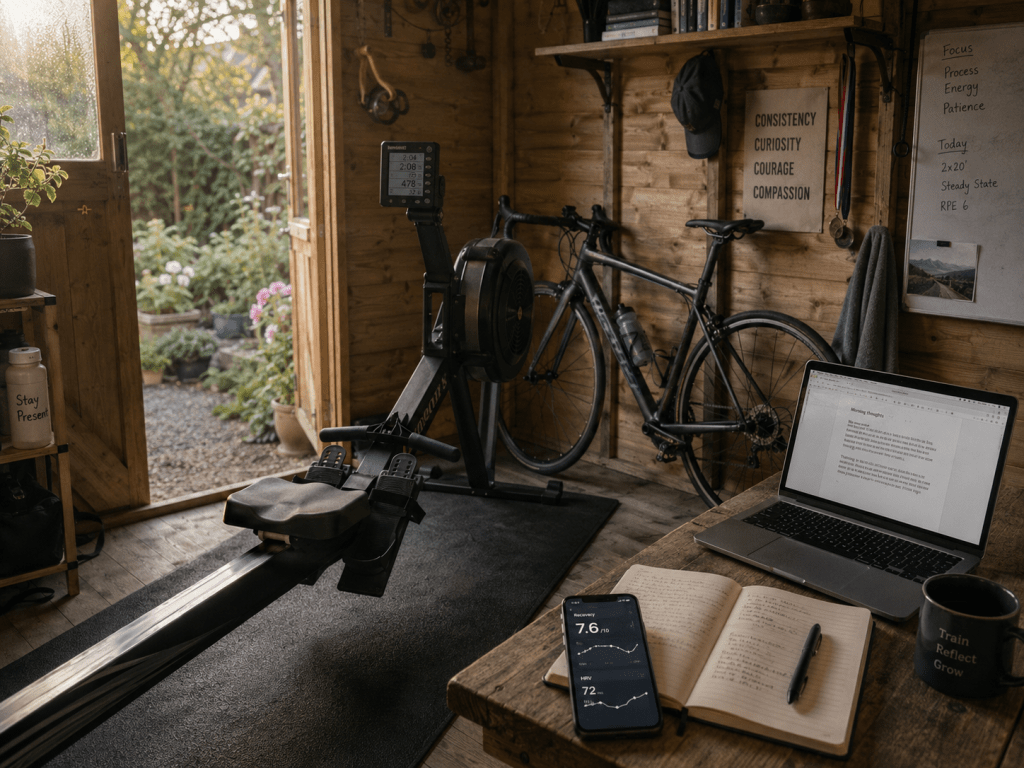
At some point, the shed stopped being just a place where rowing happened.
It became a decompression chamber.
Part gym. Part thinking room. Part escape hatch.
Some sessions happened there because fitness needed work. Others happened there because the mind needed somewhere quiet to settle down for an hour.
That matters too.
The bike returned
The cycling side of the experiment became increasingly important.
Not just physically, but emotionally.
Long rides brought back enjoyment. Exploration. Movement for its own sake.
And eventually, the numbers started speaking for themselves: longer distances, more climbing, better endurance, better recovery afterwards.
The completed sportive was a genuine milestone, not because it was professional-level athleticism, but because it represented something much bigger:
proof that meaningful endurance fitness could still be rebuilt in middle age while carrying the realities of ordinary life.
What changed most
The biggest change was probably behavioural.
Early on, there was a lot of:
overthinking
negotiating
guilt
all-or-nothing thinking
pressure to constantly prove progress
Now there is far more process.
Walk when walking is needed. Row steady when steady is needed. Push when the system can support it. Recover properly afterwards.
That sounds simple.
It is not simple.
Most people never learn it.
The goal
The sub-7 goal still matters.
But somewhere along the line, the experiment became about more than a rowing time.
It became an experiment in whether somebody with work pressure, family responsibilities, stress, doubts, imperfect recovery, and middle-aged physiology could still meaningfully rebuild themselves without pretending to be a professional athlete.
Today is Tuesday, and when I opened the curtains this morning the sun was actually shining. Hooray.
If I am completely honest, the first thing I thought about was walking on the beach and looking at the sea. That was the real temptation. But I have work commitments and a day to get on with, so instead I went to the gym and did a strength session.
And it was great. I really enjoyed it and I am very glad I went. Today is a good day.
I saw something on Instagram recently that came back to me while I was training. It was the idea that we always call in sick when we feel terrible, but we never call in well.
Wouldn’t it be brilliant to phone work and say, “I’m not coming in today because I feel great, and I’m going to walk on the beach and look at the sea”?
I might float that with my manager next time I see him. I doubt it will take off, with deadlines to meet and targets to hit, but the idea still makes me smile. A day off not because you are broken, but because you are actually doing well and want to enjoy it.
For today, though, I am doing the grown-up version. I lifted, I feel good, and now I am going to get some work done.
Choose to be happy. Choose to be sad. Choose to feel sorry for yourself. Choose to eat your own bodyweight in cheese and crisps and crackers. Choose to turn up. Choose to be a good dad. Choose to go to the gym and come out feeling brilliant, like I did today.
Today was the first time I’ve chosen to go to the gym in a long time. I haven’t been at all this year.
Instead, I’ve been blaming other people. Blaming the New Year’s resolution crowd for “clogging up” the gym. Why am I so anti-them? They’re trying to make a change. I’ve been in their shoes, and not that long ago either. Twelve months ago, twenty-four months ago, I was them.
If anything, I should be in there alongside them. As someone who has been where they are, I could help if they needed it. Instead, I chose to use them as my excuse not to go.
I also chose to decide to be sad because of the time of year. It’s winter, Christmas is gone, the sun barely shows up, so I leaned into it. Chose the slump. Chose to sit on my hands.
What a choice, when there’s only one go at this life.
At some point you have to choose to live it. Choose to get off your arse and do something about it.
Today, I chose to go to the gym.
I’ve been rowing in the shed on my new rower, and I’m still delighted I’ve got it. But I’ve missed the contact with people. I’ve missed being in a place that’s full of like-minded folk, all there to put some effort in and feel better for it. The buzz. The energy.
So today I choose differently.
I choose to live. I choose to be the best version of me that I can be. And I choose to start doing that again today.
I still think the process itself will work, but I need to change the order in which I do things.
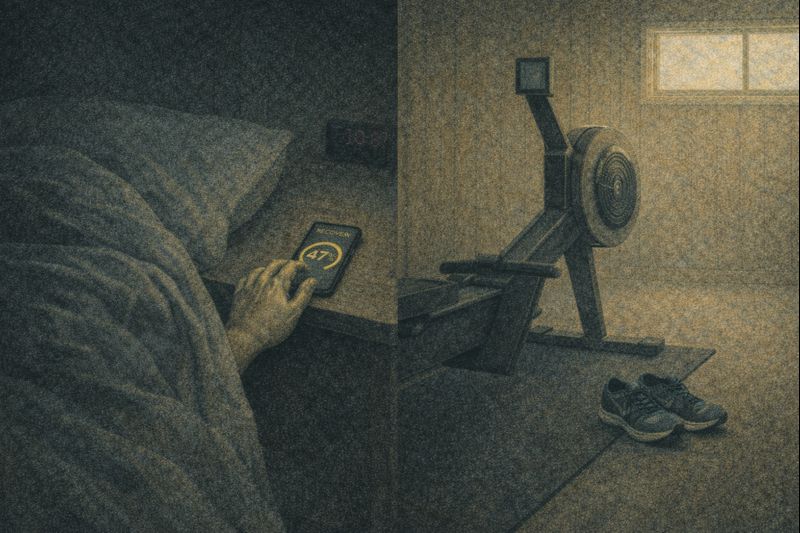
Right now it goes like this: I wake up, reach for the phone, input my WHOOP scores, see what ChatGPT recommends for the day’s session and then… nothing. No enthusiasm, no drive, just “I don’t want to do that.” Then I get out of bed and start the day.
And that day has no exercise in it.
The realisation this morning is that I need to go back to the old routine. The one that actually worked.
Wake up. Get out of bed. Do the breakfast stuff. Make a packed lunch for my son. Put the gym gear on. Get to the gym or out to the rower. And only then ask ChatGPT for the fitness plan.
The crucial part is doing all of that without giving myself time to think my way out of it. No lying in bed, staring at a plan on a screen until I talk myself into doing nothing. At the moment that happens about a nanosecond after I see the suggested session.
So the change is simple: move the decision point from under the duvet to when I am already in my kit, standing next to the machine.
This is The Sub-7 Experiment: wrestling with routine.