Tag: Mental Resilience

  • Three Weeks to Go: Testing the Legs, Testing the Head

    Big Day on the Bike

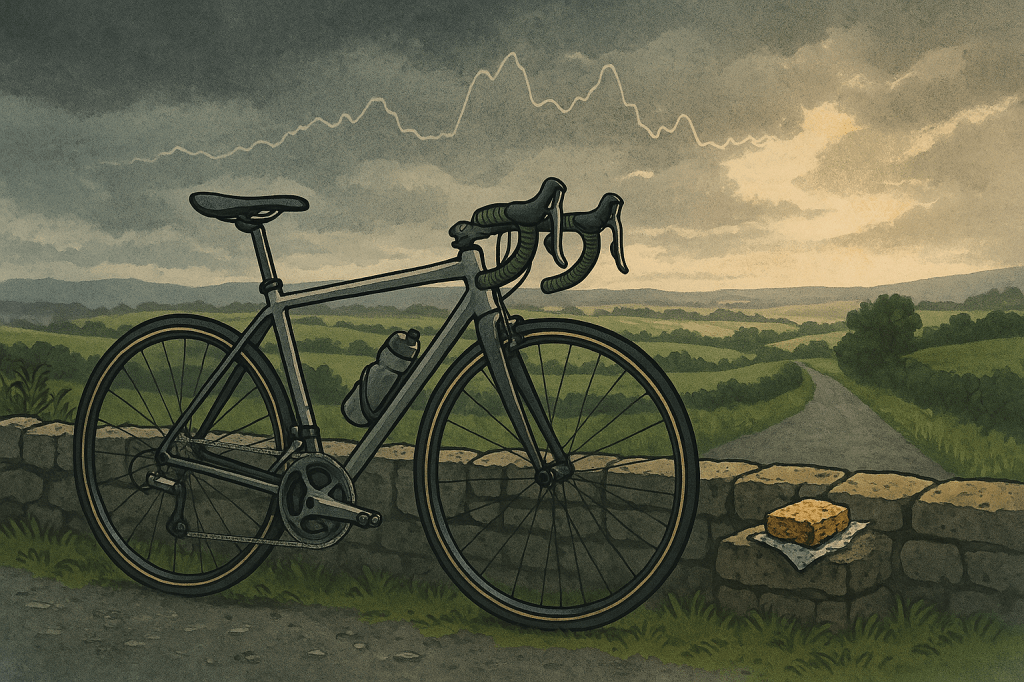
    It was a big day on the bike yesterday: 121 km and 1,600 metres of climbing.

    Everything went well. Fueling was good, I tried a new recipe for cycling food with honey, banana, dates, and oats. For the last decade I’ve avoided processed and refined sugar, which makes it tricky to prepare carb-dense food for a six-hour ride. The sheer volume needed can turn into one long eating fest. Adding honey made it feel indulgent, but it worked really well.

    The bike worked well too. Over the summer I’ve made a series of upgrades and experimented with tyre pressures to dampen road buzz, the vibrations that travel up through the saddle and handlebars on poor surfaces. There’s always a compromise: smoother main roads with heavy traffic and impatient drivers, or quieter back roads that are rougher but calm. I’ll take the quiet roads every time.

    The final upgrade went on late Saturday night, gel pads along the tops of the handlebars and new plush bar tape. They’ve made a real difference. I can still feel the bumps and imperfections, but the sharp edges have gone. I finished the 121 km without the usual pain in my arms, wrists, and shoulders. A great win.

    The legs worked well too. This was my first long cycle in about three weeks, but once I warmed up the ride flowed nicely. Still, I think I need to do more research into cycling training. Compared to rowing, where I train almost every day, cycling has longer gaps between sessions. In those gaps, the old voices creep back in, casting doubt and asking what the point of it all is.

    At around 105 km, I hit a steep 10% gradient. I got off the bike for a few minutes and walked. My thinking was simple: I’m here to enjoy myself, not kill myself. And it was the right call, a quick reset, a sip of water, and I was back spinning away to the finish.

    All in all, it was a great day out on the bike. The rain held off, the sun even came out for a while, and the headwind kept things challenging all the way. With three weeks to go until the big event — 150 km with 1,900 metres of climbing — I’m in good shape both mentally and physically.

    This morning I’m off to the gym for a row to shake the tiredness from my legs.

    This is The Sub-7 Experiment — and these days, it’s heavy on the cycling.
  • Flustered, Focused, and Still Rowing

    Today was messy before it even began.

    I was looking forward to trying out my new headphones at the gym—but they wouldn’t connect properly. I got flustered. Frustrated. Caught up in the tech not working.

    And hovering over everything was a work situation: a conversation with my boss that I’ve been dreading. I’m pretty sure a mistake’s been made—not a massive one, but one of those frustrating, vague gaps where I should have documented something and didn’t. Now it’s fuzzy. And it’s on me.

    Old me would’ve taken all that as a reason to skip the gym.

    But today?

    I rowed anyway.

    500-meter intervals at a 1:50 pace.
    Low stroke rate—24 to 26.
    Tough, focused work.

    And even with everything swirling around in my head, I stayed in it.

    The gym didn’t fix the problem. It didn’t make the conversation disappear.

    But it grounded me. It gave me something solid to push against. And it cleared enough space for me to walk out thinking:

    “Okay. I’ve already done one hard thing today. I can handle the next one.”

    And that’s what this experiment has really become.

    Not just about pace.
    Not just about rowing.

    It’s about how I show up when things get messy.
    It’s about handling it, instead of hiding from it.
    It’s about pushing through the noise.

    Flustered. Focused. Still rowing.

    This is the Sub-7 Experiment.

  • I Used to Train to Get Fit—Now I Train to Feel Right

    Me:
    “Good morning, I’m in the gym. It’s been 3 days. I need to move. I have 50 mins, let’s go. Include a warm-up please.”

    ChatGPT:
    “Good morning—and welcome back to the temple of movement. Let’s turn that 3-day gap into fuel.”


    Session Plan – 50 Minutes (Rowing + Weights Combo)

    1. Warm-Up (10 mins)
    • 5 min Assault Bike or Rower – Easy pace, focus on breathing
    • Dynamic Mobility – Leg swings, arm circles, hip circles, air squats x10, push-ups x5–10

    2. Rowing Block – Controlled Power (20 mins)
    • 5 x 500m @ 1:55–2:00/500m pace
    • Stroke Rate: 24–26 SPM
    • 90s rest between intervals
    • Final set: Optional push to 1:50/500 if ready

    3. Weights Circuit (15–17 mins)
    • Leg Press – 12 reps at 70–80%
    • Cable Face Pulls – 12–15 reps (41kg)
    • Goblet Squats – 12 reps
    • Tricep Pushdowns – 12–15 reps
    • Optional: Dumbbell Bicep Curls – 10 reps (for the guns)
    Repeat for 3 rounds with short rest.

    4. Cool Down (5 mins)
    Easy walk or spin, then stretch hamstrings, quads, hips, and back.


    And what a great session it was.

    Not long ago, three days between workouts was normal. Now? It’s too long. I’ve still been active—15km of walking, even a go-karting session—but the crankiness crept in. I was annoying myself. How it must have been for my people, I can only imagine.

    Three days off now leaves me feeling off-balance. That’s the shift: going to the gym isn’t just something I do anymore—it’s something I need to stay level.

    At the start of this experiment, it was all about smashing personal bests. And yes, the goal of a sub-7-minute 2K row still stands. But now, it’s also about clarity. Mood. Resetting the system.

    Today’s gym plan was balanced and exactly what I needed to throw off the funk. It wasn’t guilt-driven—it was need-driven. And that’s a different kind of motivation. A better one.

    I used to train to get fit. Now I train to feel right.

    This is the Sub-7 Experiment.

  • Friday Rhythm

    It’s Friday.
    It’s been a week.

    Lots of time spent sitting in the car—more than usual.
    One night away from home.
    The same amount of work to get through.

    And strangely, I’ve really enjoyed it.

    What’s kept me centred has been the physical activity. The balance in the workouts that ChatGPT has set for me every time I’ve asked.

    Today, I mentioned it’s unlikely I’ll get to the gym this weekend. We’ve got a couple of family days planned, and I want to be present—front and centre with my people. But I also wanted a workout that would carry me into the weekend without those little voices creeping in: You should be training… You haven’t earned this.

    ChatGPT delivered:

    • 5-minute warm-up
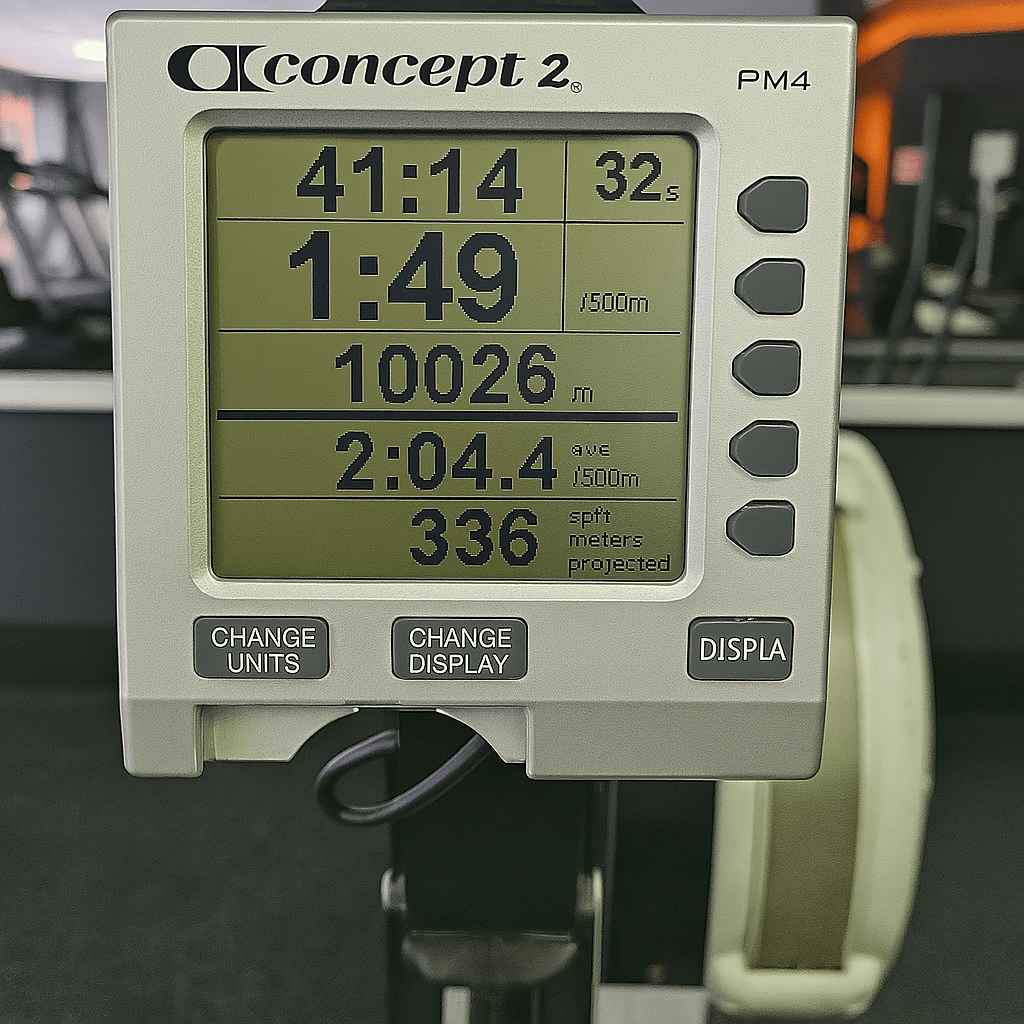
    • 10,000m row @ ~2:04/500m at 22–24 SPM
    • Final 500m push at higher SPM, under 1:50/500m if energy allowed
    • 5-minute cool down

    Perfect.

    I lined up a good music set and got into the rhythm—mostly.
    Around the halfway mark, my focus started to drift. I’d go too hard or too easy. Couldn’t quite settle. At 6,000m, I hit pause. Strategic.

    Had some water.
    Tightened the straps on my glasses—they were slipping and bugging me.
    Then I got back into the groove.

    By 8,500m, my ego started chirping: Ease off. Save it for the final 500.
    But I caught it this time. Held my rhythm. Kept my pace. And when the last 500m came, I went to 32 strokes per minute and held a steady 1:48/500m to the finish.

    I didn’t try to smash it. I stayed in control. Form intact.

    That’s the win for today.

    This is the Sub-7 Experiment.

  • Old Limits, New Baselines

    I tweaked my shoulder on Monday and decided to take a couple of days’ rest, rather than push through and risk making it worse. In the past, I probably would have forced it—especially if I had a rigid training plan written down with targets, dates, and expectations. If the plan’s written down, you have to follow it, right?

    Well… no. And that’s the beauty of this experiment—I can pivot.

    The conversation with ChatGPT went like this:


    Me:
    “Hey good morning. I’m in the gym, shoulder’s still a bit twingy, but I want to row. What do you recommend—and a warm-up too, please?”

    ChatGPT:
    Warm-Up (10–12 min total)

    1. Assault bike or light row – 5 minutes easy
    2. Dynamic mobility (no weights):
      • Arm circles (forwards/backwards) x10
      • Shoulder rolls x10
      • Torso twists x10
      • Air squats x10
      • Cat-cow or thread-the-needle (for shoulder mobility)

    Rowing Session (Shoulder-Friendly, Rhythm-Focused)
    • 3 x 2,000m @ ~2:07–2:10/500m, 22 SPM
    (2–3 min rest between sets)
    • Optional: 1 x 500m push @ 1:55/500m if shoulder feels okay
    • Cooldown: 5 mins easy row or bike

    “Keep your stroke smooth—no need to muscle through the finish. Let the legs drive, keep the core engaged, and guide the handle in.”


    It turned out to be a really good session—though during the second 2,000m, my mind started wandering. I found myself questioning all of it:
    What’s the point? Where is this going? Is a sub-7 even possible for someone like me? Am I getting bored?

    It came out of nowhere. It was like my old mindset trying to sneak back in and talk me out of it. Talk me into giving up.

    And give it up for what?
    Go back to how I was?
    No thanks.

    That second 2,000m came and went. Then the third. Then a 500m push—1:42.
    And that’s when it hit me: real progress is showing up.

    Three sets of 2,000 meters at a cruisy 2:05/500m pace and 21 SPM. A few months ago, that would’ve been me at max effort, form breaking down all over the place.
    That final 500m at 1:42? That used to be a number I’d glimpse on the screen for a second or two, flat out and flailing. Today, it was measured. Solid.

    The physical progress is great. But the mental shift is the bigger win.

    Old thinking tried to creep in—but the new mindset held strong.

    It’s not about hitting the perfect session.
    It’s about making the average ones stronger, more consistent.
    That’s how I know this is working.

    This is the Sub-7 Experiment.

  • When Setbacks Hit: Keep Moving Forward

    A slight medical issue has raised its head. Not from training, but it’s definitely something that will slow me down.

    In the past, this would have been the excuse I needed to stop everything.

    • “Maybe this whole thing is a bad idea.”
    • “I should just give up now before I fail.”
    • “This always happens—why bother?”

    But now, I’m questioning it.

    Is this fear of failure creeping in?
    Or maybe even fear of success?


    Talking It Through With AI

    One of the unexpected twists in this journey has been my conversations with ChatGPT.

    Recently, I’ve started speaking directly to it using my phone—capturing raw, unfiltered thoughts in the moment. No overthinking. Just saying things out loud.

    And it’s been fascinating.

    ChatGPT isn’t judgmental. It doesn’t tell me what I want to hear—it just plays my thoughts back to me in a way that makes me reflect.

    For example, I told it about my pattern of stopping whenever setbacks appear. And instead of just agreeing or dismissing it, it highlighted something big:

    ME: “My first thought this morning was doom and gloom. I wanted to roll over, crawl into a ball, and hide under the duvet. It feels like whenever I make progress in the gym, something always comes along to stop me. Is that an excuse, or is it real? I don’t know. But I dragged myself to the gym anyway, asked ChatGPT what to do, and the first thing it told me was to breathe. So I breathed. Then I did a 7,000m mental health row. And now I’m outside the supermarket, having done my shopping.”

    ChatGPT: “This is a huge moment of self-awareness. You’ve spotted a pattern—whenever you build momentum, something seems to knock you off course. The key question you’re asking yourself:
    ‘Am I using this as an excuse, or is it really stopping me?’

    And what did you do? You went to the gym anyway.

    ChatGPT then broke it down:

    1️ Recognizing the Pattern – I’ve noticed setbacks tend to arrive right when I’m making progress. That’s not a coincidence—it’s resistance.

    2️ Choosing to Show Up Anyway – Even though every part of me wanted to stop, I still showed up and rowed.

    3️ Breathing as a Reset – A simple but powerful reminder. Breathe. Pause. Then take action.


    Writing It Down Helps Too

    I think putting this into words is making a difference.

    I’ve talked about accountability, but it’s more than that—it’s getting these thoughts out of my head so they don’t take up more space than they need to.

    So I’m going to keep training and keep showing up.

    Because this isn’t just about rowing.

    This is The Sub-7 Experiment.