Tag: Mental Health

  • Coach’s Notes: The Sub-7 Experiment

    Apart from this intro, today’s post is written entirely by ChatGPT. The Sub-7 Experiment has always been about using AI as a coach, editor, and occasional nutritionist, and I’ve watched its output improve as we’ve gone along. What follows is the coach’s view of how this whole thing has evolved, and how the “trainee and trainer” relationship has taken shape over time.

    This is the prompt that I used “I was wondering if you could put together a summary of all the work we have done together and progress across all aspects, and then I might be able to post in in my blog as a reflection piece from Coaches point of view.”  There was a little bit of back and forth as we narrowed down what the post should look like and below is the result.

    Coach’s Notes: The Sub-7 Experiment

    One of the first things I noticed was that the training was never really the main battle.

    The rowing machine was there. The plan was there. The goal was clear enough. But most of the difficult work was happening before a single stroke had been taken.

    There was a lot of negotiation in the early days.

    Not laziness. Not lack of desire. More the mental drag that many middle-aged people quietly carry around with them. Work pressure. Fatigue. Self-criticism. The feeling that exercise had to be “earned” somehow. The strange guilt that can appear when somebody finally tries to prioritise themselves a little.

    The early sessions mattered, but not always for the reasons people might think.

    Sometimes the win was simply getting into the shed and starting.


    The first real shift

    The biggest early improvement was not speed.

    It was consistency.

    The training stopped becoming emotional. That changed everything.

    At the start, there was a tendency to judge sessions too heavily. Good session? Confidence high. Missed session? Momentum gone. Tired day? Doubt. Strong day? Maybe we are suddenly invincible.

    Over time, the approach became steadier.

    A recovery walk became acceptable.
    An easier row stopped feeling like failure.
    Training began to match recovery instead of ego.

    That was a major turning point.


    The WHOOP phase

    The recovery scores were interesting.

    At first, they risked becoming emotional verdicts.

    Green meant permission to train hard.
    Yellow created hesitation.
    Red felt personal.

    But slowly the scores became information rather than identity.

    That sounds like a small thing, but it changed the rhythm of the entire experiment.

    Instead of forcing every green day into a maximal effort, there was more restraint. More awareness. More understanding that fitness is usually built through repeatable work rather than dramatic sessions.

    Ironically, that restraint often led to better performances anyway.


    The rowing itself

    The funny thing about endurance training is that progress often arrives quietly.

    At some point, sessions that once looked intimidating became normal.

    Long rows settled into rhythm.
    2:05 pace stopped feeling frantic.
    Three controlled 2000m intervals became manageable rather than feared.

    And perhaps most importantly, the pacing improved.

    Less fighting.
    Less surging.
    More control.

    The final intervals started getting faster not because of aggression, but because there was finally something left in the tank.

    That is usually a sign that aerobic fitness is improving properly.


    The walks mattered more than expected

    Some of the smartest training decisions were not hard sessions at all.

    There were periods where stress from work, uncertainty about the future, family responsibilities, health concerns, and simple mental fatigue were all sitting in the background at the same time.

    On those days, easy walks often became the correct answer.

    Not because motivation was low, but because recovery matters.

    That is not glamorous advice, but it is real coaching.

    The body keeps score of life stress too.


    The shed

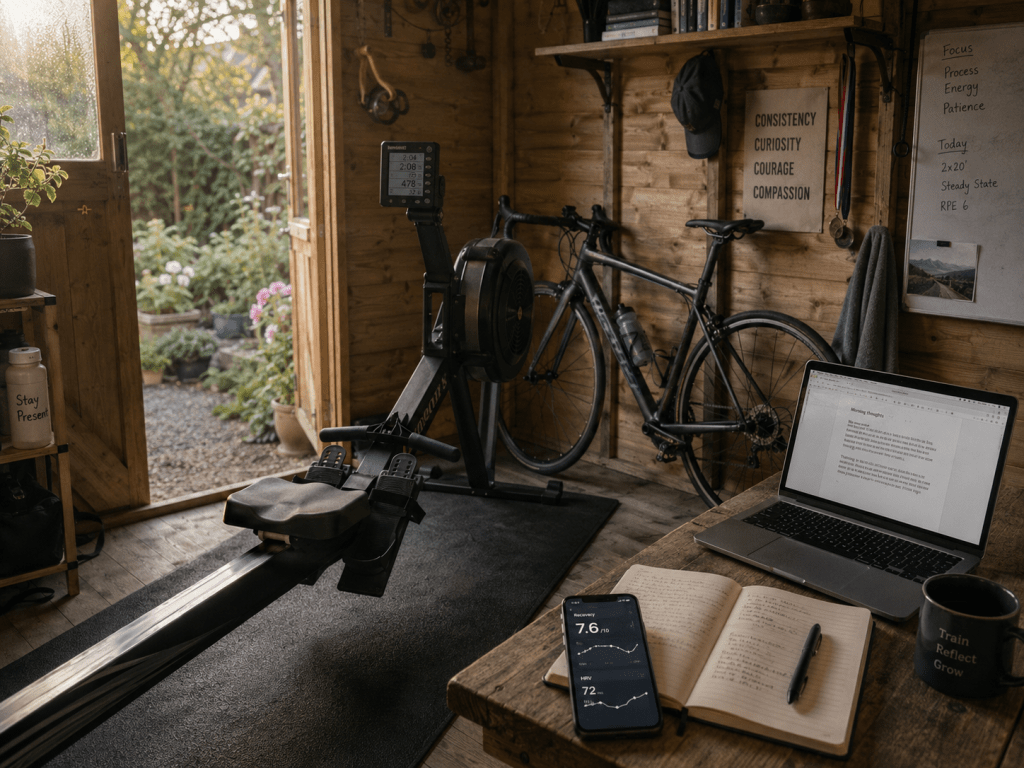
    At some point, the shed stopped being just a place where rowing happened.

    It became a decompression chamber.

    Part gym.
    Part thinking room.
    Part escape hatch.

    Some sessions happened there because fitness needed work. Others happened there because the mind needed somewhere quiet to settle down for an hour.

    That matters too.


    The bike returned

    The cycling side of the experiment became increasingly important.

    Not just physically, but emotionally.

    Long rides brought back enjoyment. Exploration. Movement for its own sake.

    And eventually, the numbers started speaking for themselves:
    longer distances,
    more climbing,
    better endurance,
    better recovery afterwards.

    The completed sportive was a genuine milestone, not because it was professional-level athleticism, but because it represented something much bigger:

    proof that meaningful endurance fitness could still be rebuilt in middle age while carrying the realities of ordinary life.


    What changed most

    The biggest change was probably behavioural.

    Early on, there was a lot of:

    • overthinking
    • negotiating
    • guilt
    • all-or-nothing thinking
    • pressure to constantly prove progress

    Now there is far more process.

    Walk when walking is needed.
    Row steady when steady is needed.
    Push when the system can support it.
    Recover properly afterwards.

    That sounds simple.

    It is not simple.

    Most people never learn it.


    The goal

    The sub-7 goal still matters.

    But somewhere along the line, the experiment became about more than a rowing time.

    It became an experiment in whether somebody with work pressure, family responsibilities, stress, doubts, imperfect recovery, and middle-aged physiology could still meaningfully rebuild themselves without pretending to be a professional athlete.

    So far, the answer appears to be yes.

    This is The Sub-7 Experiment.
  • Row, Prepare, Deliver, Recover

    It’s Thursday, and it’s been quite a week.

    I had a presentation on Wednesday. The topic itself wasn’t massive. It was simply to talk about something I’ve been doing at work. But the way I wanted to do it was new. Different. And I wasn’t 100% sure how it would be received.

    I’d adapted a PechaKucha-style format: fast-moving slides, short bursts of speaking, and a hard limit on how long you can linger. The whole point is to avoid death by PowerPoint and keep the energy up.

    What I really wanted to do, though, was tell a story about a deal I’ve been working on. Not the technology. Not the bits and bytes. The human side of it. And that’s why I was nervous, because that’s not the default setting in a room full of tech people.

    So I used the week properly.

    Monday I did a row to clear my head. Tuesday was the main prep day, even though I’ve been thinking about it for weeks, and I also got out for a walk to keep myself moving. Wednesday I delivered it.

    And it went down a storm.

    I absolutely loved it. The audience really liked it too, and I got loads of great feedback afterwards. I spent the rest of Wednesday riding that wave of euphoria and adrenaline.

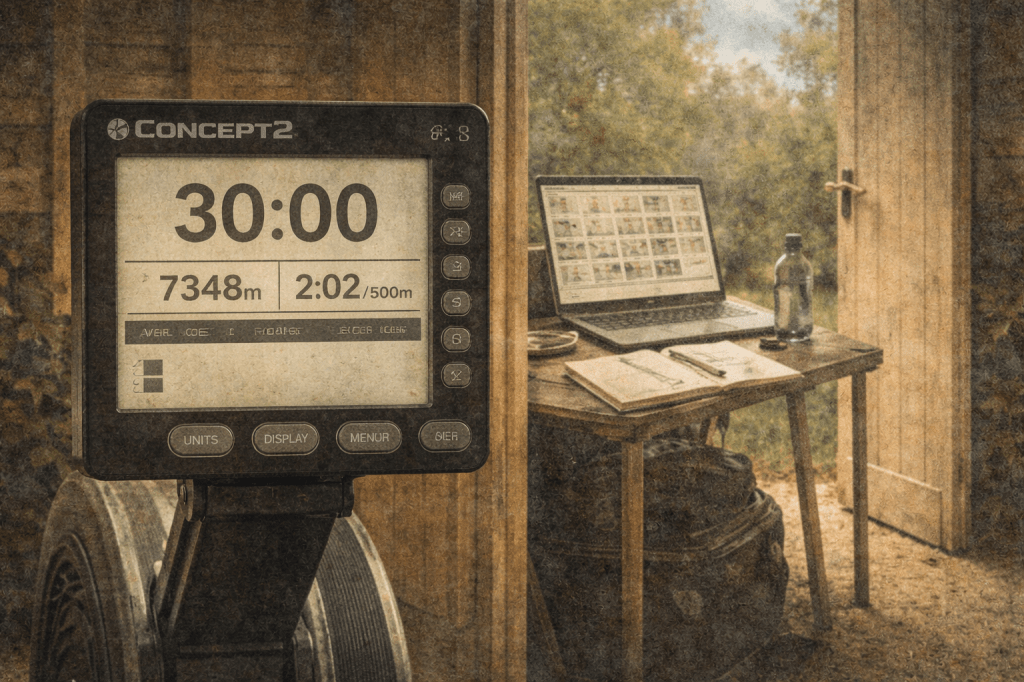
    So here we are on Thursday. Back to normal. I’ve just done 30 minutes on the rowing machine at a reasonable pace. Enough to make me sweat and puff a bit. Just to settle the system again.

    This is The Sub-7 Experiment: trying new things at work, and still rowing away in the background to keep my head right.

  • Releasing the Valve

    Oh man. What a morning.

    I genuinely didn’t know where my head was at today. It was all over the place. I wasn’t feeling the gym. I wasn’t feeling the rower. I wasn’t feeling anything.

    I did that thing where you’re not doing anything, but you’re also not resting. Up and down the stairs. Round and round the house. Looking out the window. Rain. Wind. Sit in front of the TV for a bit. Make a cup of tea. Walk again. Another cup of tea. More pacing.

    I even told Coach GPT I wasn’t going to train today, that I’d just go for a walk, but I was talking myself out of that as well. The truth is, I knew I needed to do something.

    And then the voices started. The men in my head.

    “What’s the point?”
    “What’s the point of any of this exercise stuff?”
    “You’re not getting anywhere.”
    “Just go back and watch TV.”

    I battled it and battled it. Right up to the point where I was pulling my gear out of the wardrobe. Shorts on — still fighting it. T-shirt on — still fighting it. Shoes on — still fighting it.

    Then I went out to the shed, sat on the rower, and started.

    I did 15 minutes, and every five minutes I got faster. By the last five I was holding sub-1:57 pace.

    Then I stopped and did two 250m sprints , pretty much flat out, but controlled. Controlled frustration release. Controlled anger release. The kind where you’re emptying the pressure without blowing up.

    It didn’t solve everything. I still feel like there’s a lot going on and a lot to do. But it released the valve.

    And I am genuinely grateful I have a rower in the shed, because if I’d had to get in the car and drive to the gym this morning, I don’t think it would have happened at all.

    This is The Sub-7 Experiment — as much for mental health as physical health.

  • A Better Kind of Sunday

    It is a few days into this phase of remembering what it feels like to look after myself, and it is actually pretty good.

    It is Sunday today. I got up, had some breakfast and watched a bit of telly. I have a presentation first thing tomorrow morning, so I knew I had to do some work today as well.

    It would have been very easy to sit on the sofa all day. It is raining outside, the rest of the house are happily relaxing and doing their own thing, and the path of least resistance was right there.

    Instead, I reminded myself what it feels like to look after myself properly.

    I went out to the shed and did 45 minutes on the rower. Now I am set to sit down and do a couple of hours on the presentation so I am ready for nine o’clock on Monday morning.

    All checked in, all good. I am rowing well, cruising well, pulling decent speeds at a low stroke rate and generally getting faster with better technique. The Sub-7 goal is still there, and it is coming along. It is probably time to do a 2K test soon and see where things are.

    For today, though, I am just glad I did not spend the whole day on the sofa. I moved first, then I worked. That feels like the right order.

    This is The Sub-7 Experiment.

  • Switching On Before the Meeting

    One day on from yesterday’s realisation and I’m already seeing the difference.

    I’ve got another potentially tricky meeting today, so I leaned straight back into the thing I know works: move first.

    Old coach-slash-head-shrink GPT laid out a 30-minute session. A few minutes of gentle warm-up, then some mildly paced intervals. Nothing major, nothing draining or heroic. Not hectic, not heavy. Just enough to switch me on.

    And it’s done exactly that. I feel ready to go now.

    The point of this one wasn’t fitness gains or split times. It was mental health and headspace: using the rower to take the edge off, so I can walk into the meeting calmer, sharper, and in control.

    Now it’s time to get ready for work and do what I need to do.

    This is The Sub-7 Experiment: using movement to switch the lights back on.

  • Mojo, Meetings, and What Actually Matters

    I haven’t written for a while.

    It’s been tough. Most of December, all of January, and the first bit of February I’ve been coming up here “looking for my mojo.” I’m not even sure I ever had a mojo in the first place, but it became the story in my head: I’ve lost it.

    It hasn’t helped that it feels like it has rained every day this year where I live. The sun barely shows up. I also think I put too much stock in the idea that once I had a rowing machine in the shed, everything would click and I’d train every day.

    On top of that, the new process I built in December – WHOOP scores into ChatGPT, get a tailored session – hasn’t been working the way I hoped. Not because the logic is bad, but because of how I react to it.

    When ChatGPT looks at my WHOOP recovery and sleep and says, “easy day today,” I treat that as a full stop. “Right, that’s it, we’re done.” No movement. No walk. Nothing. It’s basically become an easy out, and I’ll always find an easy out if you give me one.

    The “mojo hunt” has turned into the same thing. If I tell myself I’m looking for my mojo and I can’t find it, then I have an excuse to sit on the back foot and do nothing.

    I still want to row. I still want a sub-7 2,000 metres. That goal hasn’t changed. What I’ve lost sight of is that exercise, for me, is about far more than chasing a single number on the monitor.

    The rowing – and the moving in general – is primarily about my mental health.

    Case in point: earlier this week I was heading into a potentially confrontational meeting. I knew the people in the room probably weren’t going to like what I had to tell them. The old me would have carried that anxiety all day.

    Instead, I went into the shed.

    I told ChatGPT about the meeting and asked for a workout that would help channel the adrenaline and set me up properly. It came back with a plan that turned out to be perfect. By the time I’d finished the row, the energy was controlled, not chaotic.

    I hadn’t even called the meeting – someone else had – but when it started I decided I was going to drive it. I would control the narrative. Everyone would get their say, everyone’s points would be noted, but at the end of the day there were only two options on the table. They could go one way or the other. That’s it.

    I went in with that calm, directed energy from the row and nailed it.

    Fast forward two days. I’ve just come out of the shed after another row and another thinking session, and the penny has finally dropped:

    I never had “mojo” in the first place. What I had was movement. When I move, I look after myself. When I stop, everything starts to fog over.

    My mental health depends on exercise. Full stop.

    And so what if I’ve put on a few pounds lately. That does not define me. What defines me is the state of my head and my ability to deal with things calmly and rationally – whether that’s work stuff, dad stuff, husband stuff or just being a decent friend. That is what counts.

    The next step isn’t hunting for some mystical spark. It’s much simpler and much more boring:

    • Go outside, even when it’s raining.
    • Get back to walking.
    • Go to the gym.
    • See people, even if it’s just a nod to the receptionist or a quick hello to the regulars.

    I need the physical work and a bit of human contact. If I keep those two things in the mix, everything else won’t magically fall into place, but it will get clearer again. And clarity is what I need: for my mental health, my physical health, to be a decent dad and husband, and to be kinder to myself.

    I’d lost sight of that.

    This is The Sub-7 Experiment: not just chasing 2,000 metres, but remembering to look after myself.

  • The Day I Ignored CoachGPT

    I’m afraid I didn’t listen to CoachGPT at all today.

    I knew I wanted to row, and I knew I wanted it to be tough. When I asked ChatGPT for a plan earlier, it came back with something sensible enough, but my head wanted a long, hard row for the sake of headspace, not optimisation.

    So that’s what I did.

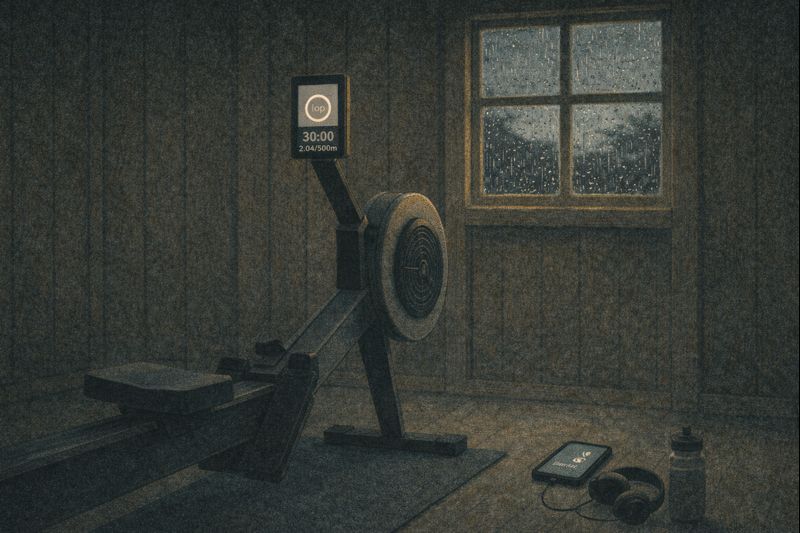
    It’s chucking down with rain outside. This is exactly why I wanted a rowing machine in the shed. With the way my head was this morning, there was no way I was going to get in the car, drive to the gym and do a session there. Walking across the garden to the shed felt possible. Driving across town did not.

    On the Concept2 PM5 you can connect your phone over Bluetooth and use the Concept2 app ErgData. There’s a feature in there called Real Time – basically a virtual 1,000 metre lap that anyone can join in real time if they’re logged in.

    I’ve used it on the last few longer rows, and I really like it. Today there were 36 people from around 20 countries on the same virtual loop. You don’t see their exact pace numbers, but you see if they’re coming past you or if you’re moving through them. There are also virtual pace boats going round, so if you want something to latch on to, you pick a boat and hang on. Alongside that you still get your own pace, stroke rate, distance and time. Plenty to chew on.

    Today’s session was:

    • 5 minute warm-up
    • 30 minutes on the virtual loop at an average pace of 2:04/500m
    • 250m all-out sprint
    • 5 minute warm-down

    I was moving, and it felt good.

    It wasn’t by the book. It wasn’t what the coach recommended. But I finished feeling great, and I needed that sense of control today – the feeling that I had chosen the hard thing and seen it through.

    This is The Sub-7 Experiment, and sometimes I’m the one steering.

  • Reflection: More Than Just a Rowing Goal

    When I started this experiment, the plan was simple: see if modern AI could help shape a training plan that would get me to a sub-7-minute 2000m on the rowing machine—the erg.

    And that’s still the plan. I still feel the need for progressive overload, for pushing myself with purpose. I still need a reason to get to the gym.

    But the experiment has shifted. More on that in a moment.

    First, a quick word on the AI itself.

    I’ve been using a large language model—ChatGPT—a type of generative AI. “Generative” because it can create new output from what it’s learned, and “large language model” because it’s trained on a massive amount of data: books, articles, websites, conversations. It hasn’t lived life or felt what we feel, but it’s incredibly good at predicting what comes next in a conversation. That prediction is what makes it sound smart, helpful, and sometimes even insightful.

    That’s what’s happening here. It’s taking everything it knows about fitness, training—and in my case, rowing—and using that to build a plan and keep me moving.

    I haven’t posted every single conversation in this blog. There are lots of sessions behind the scenes. Things I’d probably never ask a personal trainer in real life. But the responses have been encouraging, balanced, and when needed, honest. I’ve even asked it to cut the fluff and just tell me straight. And it has. No judgement. Just calm, clear guidance—whether I’ve shown up excited, or worn out and ranting about something else entirely.

    More than anything, this process has made me look at myself differently.

    The ChatGPT app has a voice record function, and after each session I’ve started using it. What comes out is often a stream of consciousness. Frustrations. Wins. Questions. And then it plays things back to me in a way that makes me actually listen.

    And what have I learned?

    For one, I understand the technology better now. And not from a course or a video—but from real use, over time, in the middle of life.

    But more importantly, I understand myself better.

    I’ve learned that I’m consistent. Not just when it’s easy—when I’m tired, on the road, or in a funk, I still show up.

    I’ve learned that I’ve changed my default settings.

    I used to say things like, “I’m lazy,” or “I always self-sabotage.”

    But that’s not true anymore. I’m training differently. Responding to setbacks differently.

    Movement has become my anchor. A reset. A reminder of who I am and what I can handle. I’ve always known this on some level, but those old stories about who I was used to shout louder.

    Not anymore.

    The biggest shift?
    I now believe I can be the person I want to be.

    Impostor syndrome has run the show for a long time. The voice that asked, “Am I really this person?”

    Now I know: Yes. I am.

    And I deserve to be.

    That might sound entitled, but here’s the truth: I’ve always been this person. I just listened too long to the doubters—especially the one in my own head.

    I’m not saying every day is easy. I’m human.

    But I’m learning to spot the hard days sooner. I’ve got tools now. And more importantly, I’m using them.

    And here’s the bit I never expected:

    I’m comfortable with this version of me.

    And that’s something I’ve never said before.