It is a few days into this phase of remembering what it feels like to look after myself, and it is actually pretty good.
It is Sunday today. I got up, had some breakfast and watched a bit of telly. I have a presentation first thing tomorrow morning, so I knew I had to do some work today as well.
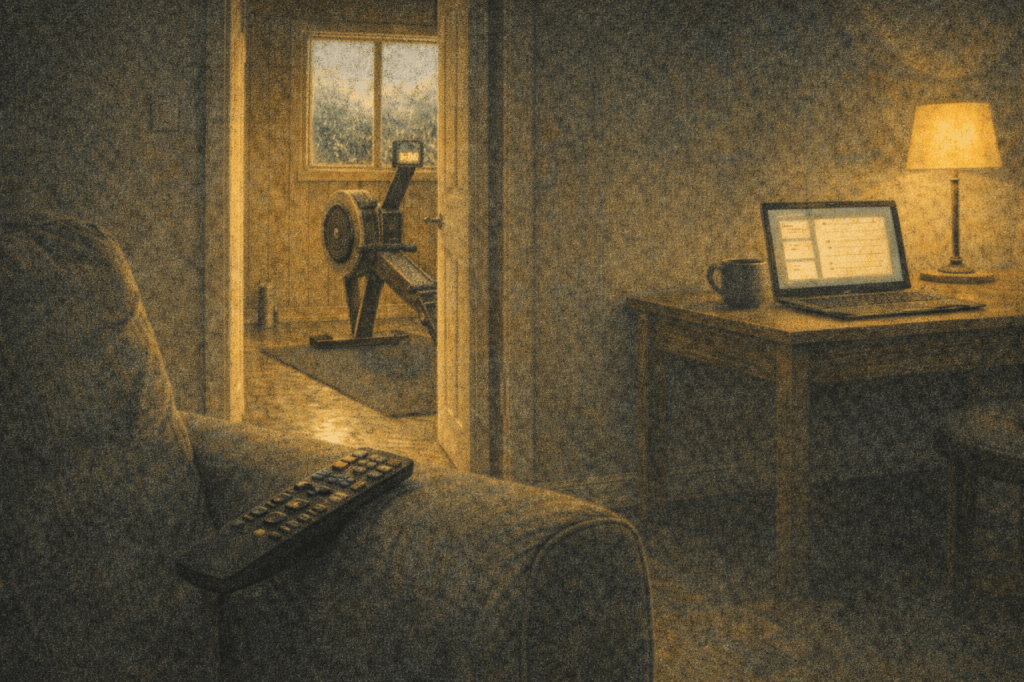
It would have been very easy to sit on the sofa all day. It is raining outside, the rest of the house are happily relaxing and doing their own thing, and the path of least resistance was right there.
Instead, I reminded myself what it feels like to look after myself properly.
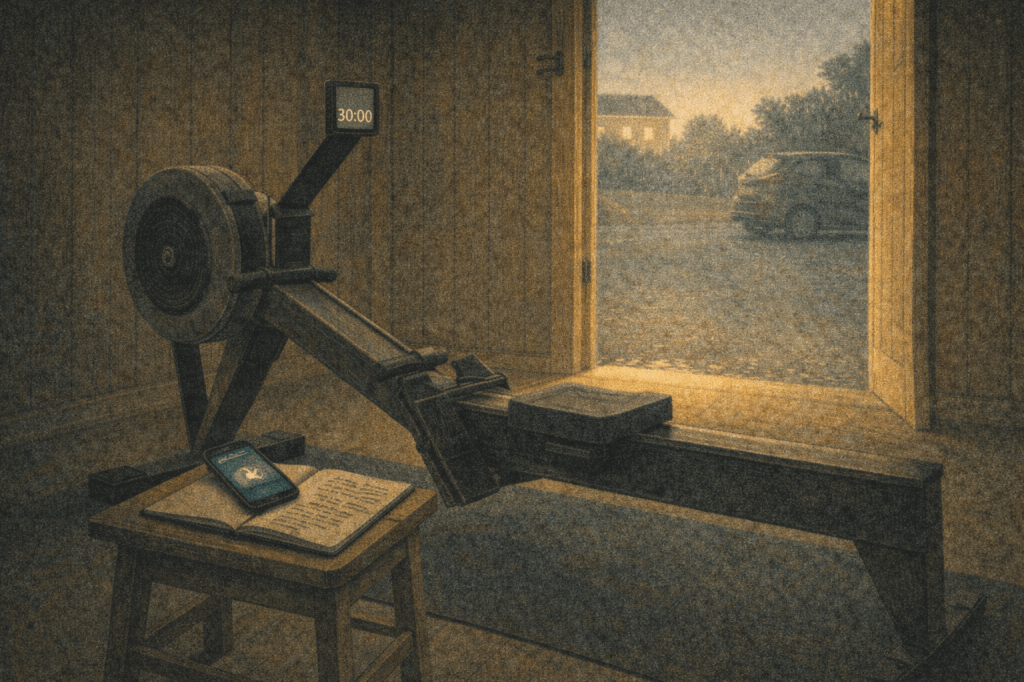
I went out to the shed and did 45 minutes on the rower. Now I am set to sit down and do a couple of hours on the presentation so I am ready for nine o’clock on Monday morning.
All checked in, all good. I am rowing well, cruising well, pulling decent speeds at a low stroke rate and generally getting faster with better technique. The Sub-7 goal is still there, and it is coming along. It is probably time to do a 2K test soon and see where things are.
For today, though, I am just glad I did not spend the whole day on the sofa. I moved first, then I worked. That feels like the right order.
One day on from yesterday’s realisation and I’m already seeing the difference.
I’ve got another potentially tricky meeting today, so I leaned straight back into the thing I know works: move first.
Old coach-slash-head-shrink GPT laid out a 30-minute session. A few minutes of gentle warm-up, then some mildly paced intervals. Nothing major, nothing draining or heroic. Not hectic, not heavy. Just enough to switch me on.
And it’s done exactly that. I feel ready to go now.
The point of this one wasn’t fitness gains or split times. It was mental health and headspace: using the rower to take the edge off, so I can walk into the meeting calmer, sharper, and in control.
Now it’s time to get ready for work and do what I need to do.
This is The Sub-7 Experiment: using movement to switch the lights back on.
It’s been tough. Most of December, all of January, and the first bit of February I’ve been coming up here “looking for my mojo.” I’m not even sure I ever had a mojo in the first place, but it became the story in my head: I’ve lost it.
It hasn’t helped that it feels like it has rained every day this year where I live. The sun barely shows up. I also think I put too much stock in the idea that once I had a rowing machine in the shed, everything would click and I’d train every day.
On top of that, the new process I built in December – WHOOP scores into ChatGPT, get a tailored session – hasn’t been working the way I hoped. Not because the logic is bad, but because of how I react to it.
When ChatGPT looks at my WHOOP recovery and sleep and says, “easy day today,” I treat that as a full stop. “Right, that’s it, we’re done.” No movement. No walk. Nothing. It’s basically become an easy out, and I’ll always find an easy out if you give me one.
The “mojo hunt” has turned into the same thing. If I tell myself I’m looking for my mojo and I can’t find it, then I have an excuse to sit on the back foot and do nothing.
I still want to row. I still want a sub-7 2,000 metres. That goal hasn’t changed. What I’ve lost sight of is that exercise, for me, is about far more than chasing a single number on the monitor.
The rowing – and the moving in general – is primarily about my mental health.
Case in point: earlier this week I was heading into a potentially confrontational meeting. I knew the people in the room probably weren’t going to like what I had to tell them. The old me would have carried that anxiety all day.
Instead, I went into the shed.
I told ChatGPT about the meeting and asked for a workout that would help channel the adrenaline and set me up properly. It came back with a plan that turned out to be perfect. By the time I’d finished the row, the energy was controlled, not chaotic.
I hadn’t even called the meeting – someone else had – but when it started I decided I was going to drive it. I would control the narrative. Everyone would get their say, everyone’s points would be noted, but at the end of the day there were only two options on the table. They could go one way or the other. That’s it.
I went in with that calm, directed energy from the row and nailed it.
Fast forward two days. I’ve just come out of the shed after another row and another thinking session, and the penny has finally dropped:
I never had “mojo” in the first place. What I had was movement. When I move, I look after myself. When I stop, everything starts to fog over.
My mental health depends on exercise. Full stop.
And so what if I’ve put on a few pounds lately. That does not define me. What defines me is the state of my head and my ability to deal with things calmly and rationally – whether that’s work stuff, dad stuff, husband stuff or just being a decent friend. That is what counts.
The next step isn’t hunting for some mystical spark. It’s much simpler and much more boring:
Go outside, even when it’s raining.
Get back to walking.
Go to the gym.
See people, even if it’s just a nod to the receptionist or a quick hello to the regulars.
I need the physical work and a bit of human contact. If I keep those two things in the mix, everything else won’t magically fall into place, but it will get clearer again. And clarity is what I need: for my mental health, my physical health, to be a decent dad and husband, and to be kinder to myself.
I’d lost sight of that.
This is The Sub-7 Experiment: not just chasing 2,000 metres, but remembering to look after myself.
I’m afraid I didn’t listen to CoachGPT at all today.
I knew I wanted to row, and I knew I wanted it to be tough. When I asked ChatGPT for a plan earlier, it came back with something sensible enough, but my head wanted a long, hard row for the sake of headspace, not optimisation.
So that’s what I did.
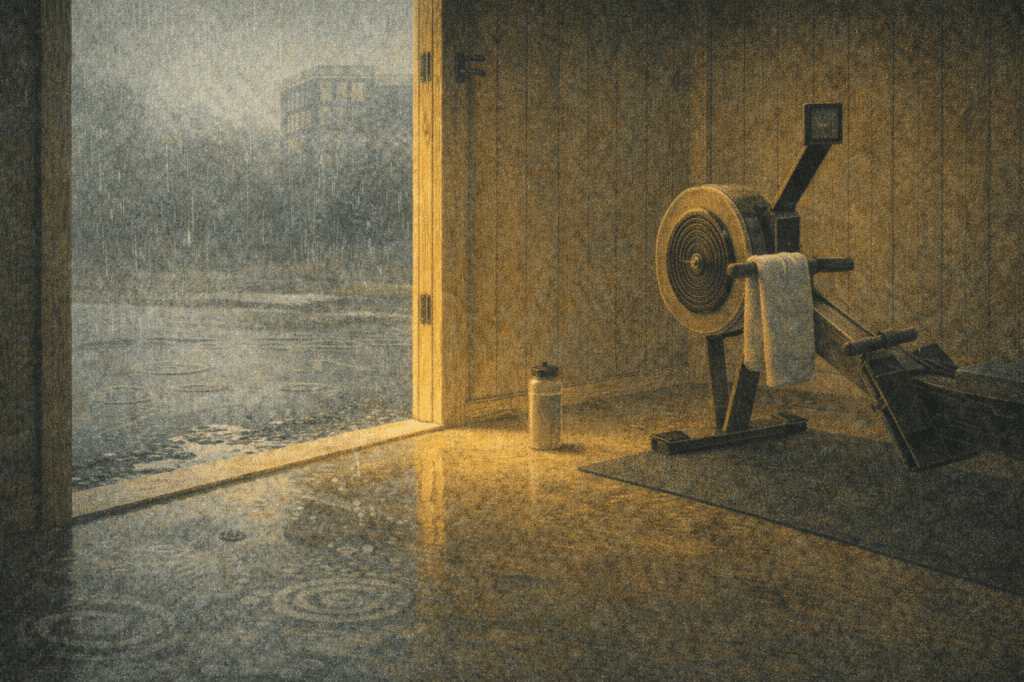
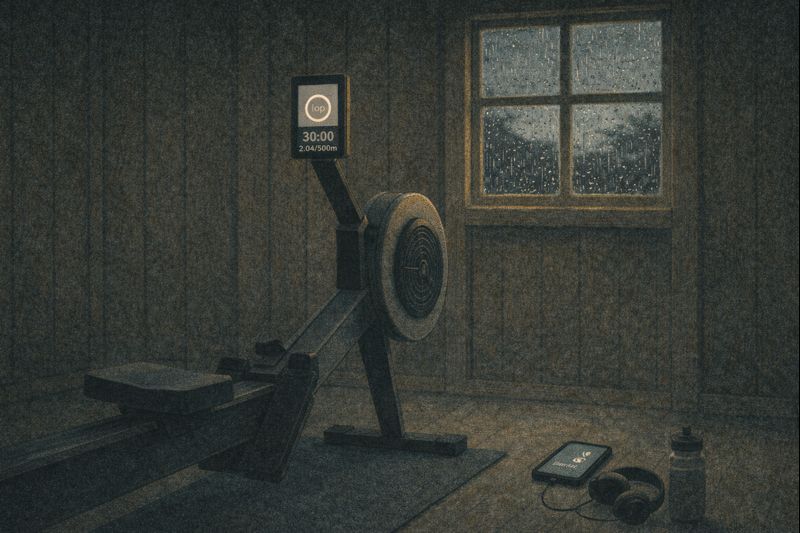
It’s chucking down with rain outside. This is exactly why I wanted a rowing machine in the shed. With the way my head was this morning, there was no way I was going to get in the car, drive to the gym and do a session there. Walking across the garden to the shed felt possible. Driving across town did not.
On the Concept2 PM5 you can connect your phone over Bluetooth and use the Concept2 app ErgData. There’s a feature in there called Real Time – basically a virtual 1,000 metre lap that anyone can join in real time if they’re logged in.
I’ve used it on the last few longer rows, and I really like it. Today there were 36 people from around 20 countries on the same virtual loop. You don’t see their exact pace numbers, but you see if they’re coming past you or if you’re moving through them. There are also virtual pace boats going round, so if you want something to latch on to, you pick a boat and hang on. Alongside that you still get your own pace, stroke rate, distance and time. Plenty to chew on.
Today’s session was:
5 minute warm-up
30 minutes on the virtual loop at an average pace of 2:04/500m
250m all-out sprint
5 minute warm-down
I was moving, and it felt good.
It wasn’t by the book. It wasn’t what the coach recommended. But I finished feeling great, and I needed that sense of control today – the feeling that I had chosen the hard thing and seen it through.
This is The Sub-7 Experiment, and sometimes I’m the one steering.
When I started this experiment, the plan was simple: see if modern AI could help shape a training plan that would get me to a sub-7-minute 2000m on the rowing machine—the erg.
And that’s still the plan. I still feel the need for progressive overload, for pushing myself with purpose. I still need a reason to get to the gym.
But the experiment has shifted. More on that in a moment.
First, a quick word on the AI itself.
I’ve been using a large language model—ChatGPT—a type of generative AI. “Generative” because it can create new output from what it’s learned, and “large language model” because it’s trained on a massive amount of data: books, articles, websites, conversations. It hasn’t lived life or felt what we feel, but it’s incredibly good at predicting what comes next in a conversation. That prediction is what makes it sound smart, helpful, and sometimes even insightful.
That’s what’s happening here. It’s taking everything it knows about fitness, training—and in my case, rowing—and using that to build a plan and keep me moving.
I haven’t posted every single conversation in this blog. There are lots of sessions behind the scenes. Things I’d probably never ask a personal trainer in real life. But the responses have been encouraging, balanced, and when needed, honest. I’ve even asked it to cut the fluff and just tell me straight. And it has. No judgement. Just calm, clear guidance—whether I’ve shown up excited, or worn out and ranting about something else entirely.
More than anything, this process has made me look at myself differently.
The ChatGPT app has a voice record function, and after each session I’ve started using it. What comes out is often a stream of consciousness. Frustrations. Wins. Questions. And then it plays things back to me in a way that makes me actually listen.
And what have I learned?
For one, I understand the technology better now. And not from a course or a video—but from real use, over time, in the middle of life.
But more importantly, I understand myself better.
I’ve learned that I’m consistent. Not just when it’s easy—when I’m tired, on the road, or in a funk, I still show up.
I’ve learned that I’ve changed my default settings.
I used to say things like, “I’m lazy,” or “I always self-sabotage.”
But that’s not true anymore. I’m training differently. Responding to setbacks differently.
Movement has become my anchor. A reset. A reminder of who I am and what I can handle. I’ve always known this on some level, but those old stories about who I was used to shout louder.
Not anymore.
The biggest shift? I now believe I can be the person I want to be.
Impostor syndrome has run the show for a long time. The voice that asked, “Am I really this person?”
Now I know: Yes. I am.
And I deserve to be.
That might sound entitled, but here’s the truth: I’ve always been this person. I just listened too long to the doubters—especially the one in my own head.
I’m not saying every day is easy. I’m human.
But I’m learning to spot the hard days sooner. I’ve got tools now. And more importantly, I’m using them.

 The Sub-7 Experiment