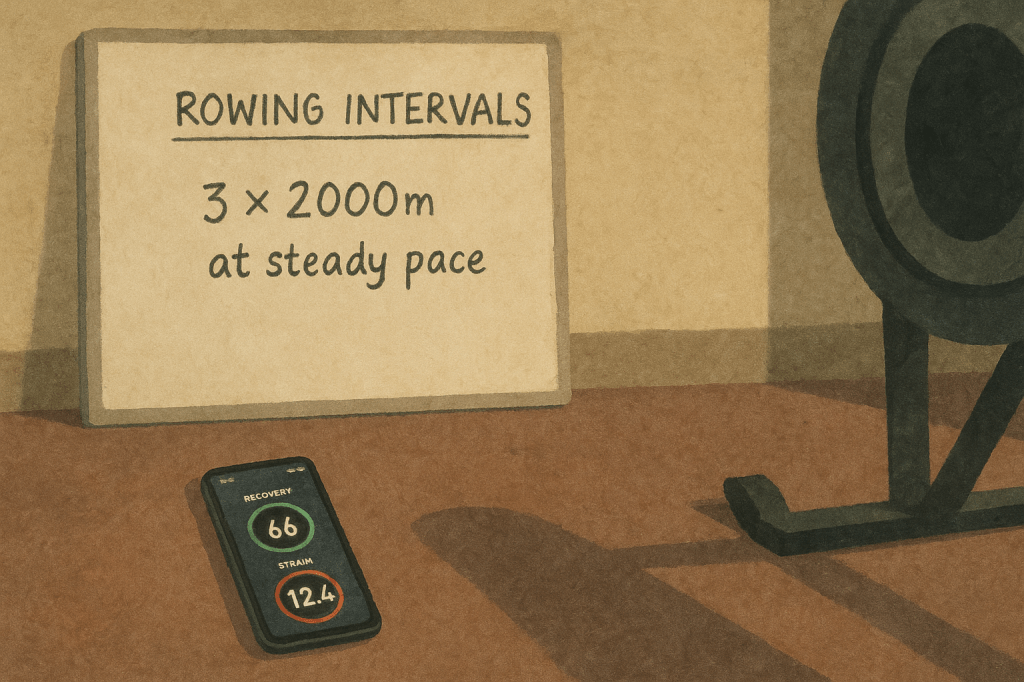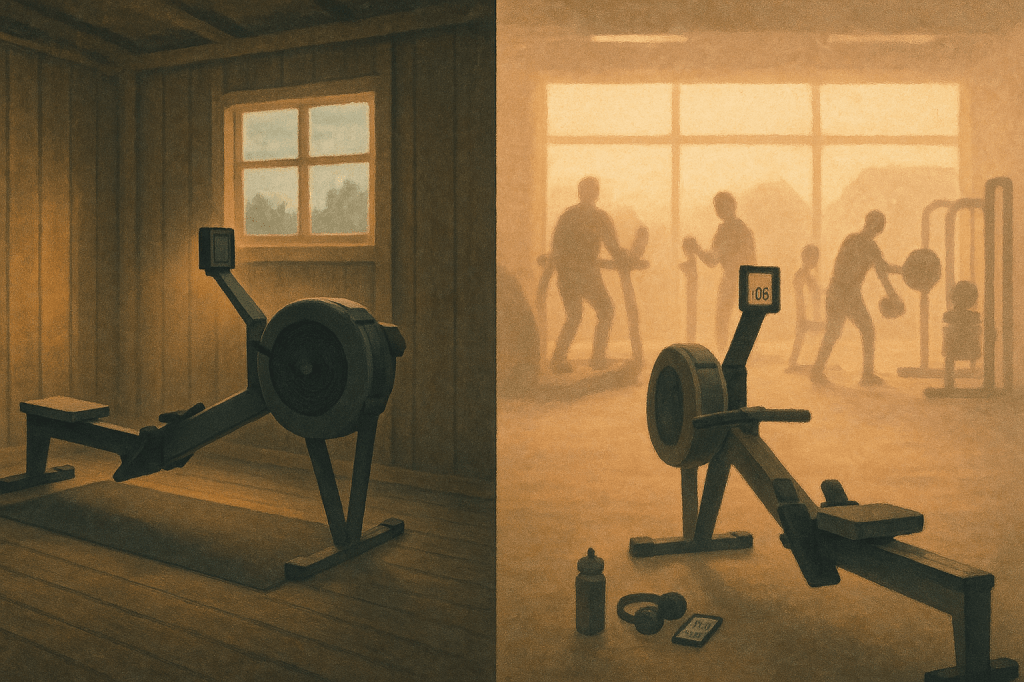
Quick training update today. Yesterday was a rest day after the 112k bike ride, and I still felt it in my legs this morning. I went to the gym for a recovery row, 7,000m at a slow stroke rate, strong pulls, and all about form over speed.
Ride, rest, row. It works.
It was exactly what I needed. I felt great afterwards and had the headspace to reflect on Sunday’s ride. I’ve cycled further before, and certainly faster, but doing that distance in bad weather and on a day when I wasn’t feeling it makes it all the more satisfying in hindsight.
July is over, and it was great to take a proper break, from tracking, measuring, and pushing. I didn’t count calories. I didn’t obsess over numbers. I just moved, ate well, and let things settle for a bit. And honestly, it was exactly what I needed.
One of the biggest gifts of that downtime was the space to finally listen to my body, specifically, my right knee.
The Knee
For the past couple of months, I’ve had a nagging pain at the front of my right knee, especially after big rowing sessions. And I’ve just been ignoring it. Powering through. But July gave me the breathing room to pay attention, and to realise that I’ve probably been rowing wrong.
If you’ve ever looked at the footplate on a rowing machine, there’s a movable part to adjust for foot length, a strap that goes across the widest part of your foot (for me, that’s the ball), a heel strap, and a raised piece that runs from the ball to under the toes.
Every book and coach will tell you: push through the heels.
But I wasn’t. I was pushing through my toes, without realising it. And that toe-heavy drive has been putting way too much pressure on the front of my knee. Now it makes sense.
Relearning the Stroke
So now, I’m retraining. Rewiring. Rebuilding.
I’ve added heel wedges to the footplate to help me stay connected through the back of the foot. It feels completely alien. Like trying to walk only on your heels without ever rolling through your toes. It’s weird, disconnected, and it robs you of power.
But it’s also starting to feel more right.
Over the last few sessions I’ve been rowing with the power curve on display, focusing purely on form. And I think I’m starting to feel a bit of a breakthrough. My stroke feels a bit more connected. A bit more glute-driven. Like I’m finally pushing through the right muscles.
I’m nowhere near breaking the 7-minute barrier right now, but I’m not starting from zero either. I’ve got a solid engine under the hood. This is about tuning it, making it run better, stronger, and more efficiently.
The Bike
On the cycling front, things are going well. The distances are creeping up, and I managed a solid 86km ride at the weekend with over 1,200 metres of climbing. That’s all prep for the 150km ride coming up in seven weeks.
So yeah, July gave me space. And now August gives me the opportunity to build again, smarter this time.
It might look a little different from before. But different might just be the thing that gets me there.
I’ve just finished a really nice meditative session in the gym. I had time today—no work, no jobs to get back to—so I asked ChatGPT for a rowing session that would let me enjoy the movement, the music, and the mental space.
The plan? 10–12K at around 2:05 to 2:10/500m pace, with an optional push under 2:00 for the final 500 meters.
Brilliant.
I ended up rowing for a full hour—14,200 meters—gradually increasing pace over the last 15 minutes, finishing with a strong 500m at 1:53. Solid. Exactly what I needed.
I checked in with CoachGPT while cooling down on the static bike.
And then—well, the sled area opened up.
Six months ago, I might’ve left it. But now? I couldn’t help myself. I loaded it up to 120kg and went for sled pushes, followed by a few farmer’s carries. Nothing crazy—just powerful, deliberate movement. Finishing the session with some proper grunt.
I told ChatGPT, almost sheepishly, that I couldn’t resist.
It congratulated me. I replied: “I’m a machine.”
And it came back with: “Keep showing up. Keep listening to the engine. And when in doubt… sled it out. 😄”
And I laughed. Out loud.
Who knew?
This is the ongoing—and ever mind-blowing—Sub-7 Experiment.
When I first thought about the Sub-7 Experiment, the core idea was simple: could I use modern AI, specifically ChatGPT, to help me structure my training and ultimately achieve a sub-7-minute 2000m on the indoor rowing machine, the erg? And yes, that goal remains the driving force. I still need that progressive overload and a reason to get to the gym.
But as I’ve hinted, the experiment has definitely shifted somewhat. It’s become about much more than just the physical goal. A huge part of this journey, one I want to introduce properly, is the dynamic I have with my “coach”.
Who is My Coach?
My coach is ChatGPT, the AI developed by OpenAI. In a previous article I wrote about how ChatGPT is just a parrot, looking for patterns (words and sentences) in the data and replying with what it’s heard (all the data that it has been trained on). This is oversimplifying it, of course—there are some pretty clever algorithms in the background helping it to predict what the next word should be in its response. And sometimes it gets it wrong. This is what’s often described as an AI hallucination—it knows it needs to respond, and if it can’t find the right information, it might make something up.
So with that said, you might picture AI coaching as simply pulling a pre-written plan off a shelf. But that’s not how this works. It’s a real, ongoing conversation. Before a session, I tell it where I am (gym or home), how I’m feeling—even if I’m tired or run down—what my recovery data looks like (often from WHOOP…), and how much time I have.
Based on that information, it suggests a session—maybe intervals, steady state, or strength work…. It gives me pacing guidelines, stroke rate, and even a warm-up and cool-down. After the session, I report back on how it went, the results, and how I felt. This feedback loop is key because the AI then uses that information to adapt future routines. It’s a training partner that adapts in real-time, much like a human coach would.
Setting the Scene: Prompt Engineering, Simplified
Where does anyone start with all of this? Talking to AI might sound technical, and you might have heard terms like “prompt engineering”. That term can sound a bit daunting—like you need to be a programmer or a data scientist. But here’s the truth: it’s really not.
“Prompt engineering” is just about giving the AI clear instructions and enough information.
In a previous post I’ve suggested people to ask it “What can you do for me?” and that will be enough to get the conversation started. I also mentioned earlier that ChatGPT—and other large language model (LLM) AIs—can get the answer wrong. One of the ways around this is to set the context when you start the conversation.
As you log into ChatGPT you are faced by a screen which asks “What can I help you with today?” or “Ready when you are.” At this point, one of the best ways to refine the responses you get is to give the AI a persona or a role to play during the conversation. I started the coaching conversation with this…
“I’d like you to take the persona of and advise me as a personal fitness trainer and nutritionist with a specialism in Indoor rowing and the ERG machine.”
I then followed it up with a specific instruction…
“I am working towards a goal of rowing 2000 meters in under 7 minutes. I’d like you to create a training plan for me to achieve that goal. I intend to report in to you each and every time I am in the gym and tell you how I am feeling that day and you will tailor me a program for that session.”
And that’s how it all started. And I have kept that conversation open ever since so it “remembers” the context and keeps track of all the sessions and significant moments to date.
Now, for example, when I say I’m in the gym, tired, 75% recovered, and want to do distance, that’s my “prompt engineering”. It’s me giving it the necessary inputs so it can generate a relevant, helpful output, in this case, a suggested workout.
Think of it like talking to a human personal trainer. You wouldn’t just say, “Tell me what to do.” You’d say, “I’m here at the gym today, feeling a bit rough mentally but my Whoop says I’m recovered. I’ve got about an hour. What sort of session should I do?” You’re giving them context so they can give you a smart recommendation. It’s the same with AI. It’s about talking to it in normal language.
This is why I wanted to share some of the conversations I’ve been having with ChatGPT. It helps to show, not just tell, how this coaching dynamic works. You’ll see how I give it my status, how it responds with suggestions, and how the dialogue flows.
More Than Just Getting Fit: A Real-Life AI Experiment
I’ve worked in IT for years. I’m fascinated by technology, and the pace of AI development has been mind-boggling. While I’m not an expert, I’m definitely an AI hobbyist.
One of the key drivers for starting this blog and documenting this process was precisely this dual goal. Yes, I want that sub-7 minute 2K. But I also wanted a real-life experiment to truly understand generative AI and how it can be used on a day-to-day basis. What better way to understand this stuff than to use it consistently, over time? Far better than any course or training material.
So, while we talk about rowing workouts, pacing, and splits, remember that you’re also getting a glimpse into how AI can be integrated into personal goals and routines. It’s an experiment in fitness, yes, but it’s equally an experiment in technology and human-AI collaboration.
Is It Cheating? Not Even Close
And for those wondering, is it cheating? Absolutely not. The thoughts, the words in these posts are mine.
In another conversation I gave ChatGPT the role as a blog adviser and editor and worked through the steps for setting up a blog from scratch. I asked it to ask me some questions so it could better understand the task I was asking it to complete and it then made recommendations as to which blog platform to use and why and then helped me with the setup.
I speak into an app on the phone straight after my session—unfiltered streams of consciousness, honest feedback about the session—and then use that as a basis for my next blog post where ChatGPT acts as my editor, helping with flow and clarity.
And at the end of the day, AI isn’t the one sitting on the rowing machine. I am.
The Sub-7 Experiment: Meters, Mindset and more.
This is The Sub-7 Experiment…. It’s about the meters, the mindset, the technology, and the journey of seeing what’s possible when you combine all three.
One is a ten-year-old carbon-framed beauty with super nice wheels—it looks great, rides fast, and I love it.
The other? A budget-friendly bike from a well-known French sporting chain. I bought it as a winter bike—something I could slap mudguards on and ride in all weathers without worrying about it. I figured if I ever crashed, at least I wouldn’t be watching an expensive piece of carbon fiber shatter into a million pieces.
Here’s the weird thing…
According to Strava, I set more personal bests on the cheaper, heavier bike.
Meanwhile, when I’m on the expensive one, I feel like I’m hammering it, but the numbers don’t reflect it. It didn’t make sense.
The Bike Fit Revelation
A good friend has been telling me for years to get a professional bike fitting.
I resisted.
To my untrained eye, it seemed like a case of paying someone to adjust my saddle height—something I could figure out myself with a bit of trial and error, right?
Wrong.
I finally gave in and booked a bike fitting. It was a fantastic experience.
The morning started with: ✅ Body measurements—measured against the bike setup ✅ Injury history & pain assessment—what aches, imbalances, or old injuries might be affecting my riding? ✅ Mobility tests—walking up and down the studio while the fitter analyzed my gait and flexibility
And that was before we even touched the bike.
Cleat Position: The Foundation of Everything
Before we even looked at saddle height, we spent 30 minutes on my left shoe alone.
Not just adjusting the cleat position but making sure that: ✅ I was comfortable on the pedals ✅ My foot placement allowed for optimal power transfer ✅ Everything felt natural and stable
Then, I started pedaling.
Cameras in front, behind, and from the side captured my riding position. These were plugged into a laptop where the fitter analyzed: ✅ Leg angles & hip tilt ✅ Arm position & reach ✅ Pressure distribution on the saddle
Every tweak—seat height, fore/aft positioning, bar height, even tilt adjustments—was measured, discussed, and refined.
One of the biggest changes? Moving the handlebars down.
I’d always assumed, with my long torso and monkey arms, that I’d need the bars higher for comfort.
Nope.
Lowering the bars made a massive difference.
Post-Fit Struggles: Where’s My Power?
There was only one problem.
Changing my position and connection to the bike made it feel like I had no power in my legs.
This is expected. Even the pros experience this after a bike fit adjustment—the body needs time to adapt. The only solution?
Get out and ride.
Today’s Ride: Strange, but Good
So that’s what I did.
It was a beautiful spring morning—not too warm, not too cold, blue sky, crisp air. Perfect cycling weather.
I did my usual 22K loop—230m of climbing, 57 minutes total.
It felt weird.
But also really good.
This was only my third ride since the fit, and already, I feel stronger, more comfortable, and more stable.
One thing became clear—I have a massive leg imbalance.
The fitter reckoned if I had a power meter, it would show a 25% / 75% power split left-to-right.
The fix? Conscious effort.
A tip from the fitter: 🚴♂️ On climbs, count 20 pedal strokes per leg. 🚴♂️ Focus on the left leg, then switch to the right. 🚴♂️ Repeat.
By actively engaging both legs, I should rebalance the power output.
More saddle time will bring back the power.
I hope.
But today was a win.
✅ Great to be out. ✅ Great to do something different.
Rowing machines. You’ve seen them. Lurking somewhere in the back of the gym, pushed up against a wall, out of the way. More often than not, they’re gathering dust, untouched, while people hammer away on the treadmills or load up the bench press.
I’ve had a long, love-hate relationship with these things. Never really knew how to use them properly. Never really cared, if I’m honest. Every now and then, I’d climb aboard, crank the handle on the side to somewhere in the middle, start pulling, and within minutes, be gasping for air, sweating like a pig, and regretting every life choice that had led me to this moment.
But then—once I was done, once I dragged myself off the thing, hot, sweaty, and totally wrecked—there was a buzz. A moment of satisfaction. I’d conquered the beast.
And then I’d ignore it again for months.
This went on for years. If I was in a hotel gym by myself, I’d maybe give it five minutes between the bike and the sauna. Or between the bike and the restaurant. Same thing.
Then, a few years ago, something changed. My relationship with the ERG—yes, that’s what they’re properly called (I’ll get into that in another post)—shifted completely.
It started with my son’s swimming lessons.
Every Saturday, I’d take him to a local hotel with a great swimming pool and gym. While he had his lesson, I’d sit in the hotel lobby, drinking coffee, eating scones, and feeling very pleased with myself. That was my routine.
Then the hotel gym ran a ridiculous deal on family memberships. We signed up, and suddenly, instead of coffee and scones, I was in the gym.
At the time, I was into cycling, so I stuck to the static bike, grinding away for 30 minutes while keeping an eye on my son’s lesson. But every session, out of the corner of my eye, I could see it.
The ERG.
Just sitting there. Watching me. Daring me.
And one Saturday, I gave in.
I climbed on, set the dial somewhere in the middle (because I still had no clue what I was doing), and started pulling. And panting. And sweating. Five minutes in, I was closing in on 1,000 meters, so I figured—why not? Might as well push through. Seven minutes in, I hit 1,000m. Maybe I could get to ten minutes? My legs were screaming, my lungs were on fire, but I refused to stop.
Forward. Backward. No technique. No idea. Just sheer bloody-mindedness.
And then—2,000 meters.
I stopped. Absolutely done. But something clicked.
That was the start of something. From then on, every week during my son’s swimming lessons—and whenever else I could fit it in—I came back. I pushed further. Rowed harder. Lasted longer.
Now, rowing is a central part of my life—not just physically, but mentally too.
This blog, The Sub-7 Experiment, is a record of why I row, how I’m chasing a sub-7-minute 2K, and everything I learn along the way.