Tag: Endurance Training

  • The Junction at 35K

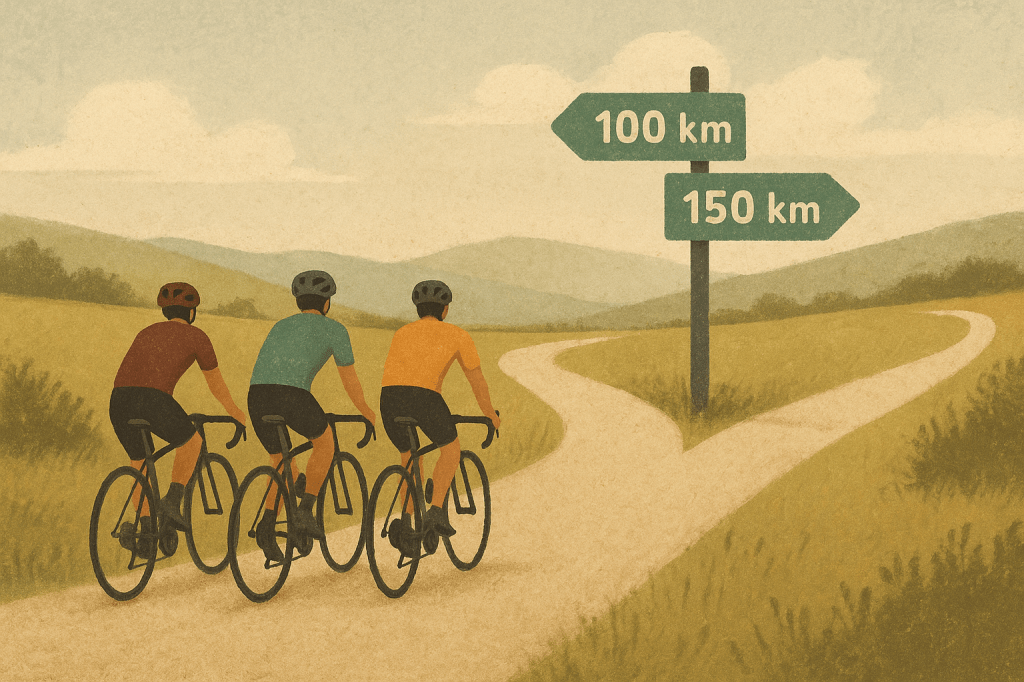
    In less than two days, I’ll be on the start line for the 150km sportive. There are two routes that day — 100km or 150km — and at the 35km mark, just after the first big climb, there’s a junction. Turn left and it’s the shorter route. Turn right and it’s the full thing. That choice feels like the whole ride in miniature: test the legs, listen to the head, and then decide whether I’ve got what it takes to go the distance.

    I’m excited, a bit nervous about riding in such a big group, but I know from experience that it thins out quickly enough. What sits with me more is whether the work I’ve done this year is the right kind of work. I haven’t ridden over 100k in three weeks, but the last one I did was 121k. The rowing and strength work mean I’m heavier now, but heavier in the right way: stronger, more resilient. I can leg press 150kg these days, not bad for someone who struggled with 70 when I started measuring this in March 2025. The endurance rows have kept the engine ticking too, even when the weather kept me indoors.

    The bike has been through its own transformation this year. Lighter wheels, better gearing, and most recently new gel pads and handlebar tape that have taken the sting out of the Irish roads. It’s not set up for rain, no mudguards, but this is Ireland, rain is part of the deal. Still, I’ll be riding with a piece of both my parents: the bike bought with a little money from Mum when she passed, and the saddle from Dad for my birthday. That matters more than any component choice.

    Success on the day is simple: finish strong without grinding myself into the ground, enjoy the company of my friends, and carry the memory with me. If the legs aren’t there and I have to turn left at the junction, then so be it. If something mechanical forces me to stop, then I’ll still have had a weekend away with good people. But if the legs are there, and the head is steady, then turning right — taking on the full 150 — will be the real win.

    This ride isn’t part of the Sub-7 Experiment, not really. Different training, different demands. But it is part of the bigger experiment: how to keep moving, how to choose things that are mine, how to remember that age hasn’t caught me yet. This is one of the rare things I do just for myself, away from family. And yet, finishing it well at 55 is also a reminder of what I bring back to them: proof that I can still do hard things, still choose adventure, still find joy in movement.

    The road will be long, but I won’t ride it alone.

    This is the Sub-7 Experiment and this weekend I am mostly riding a bike.
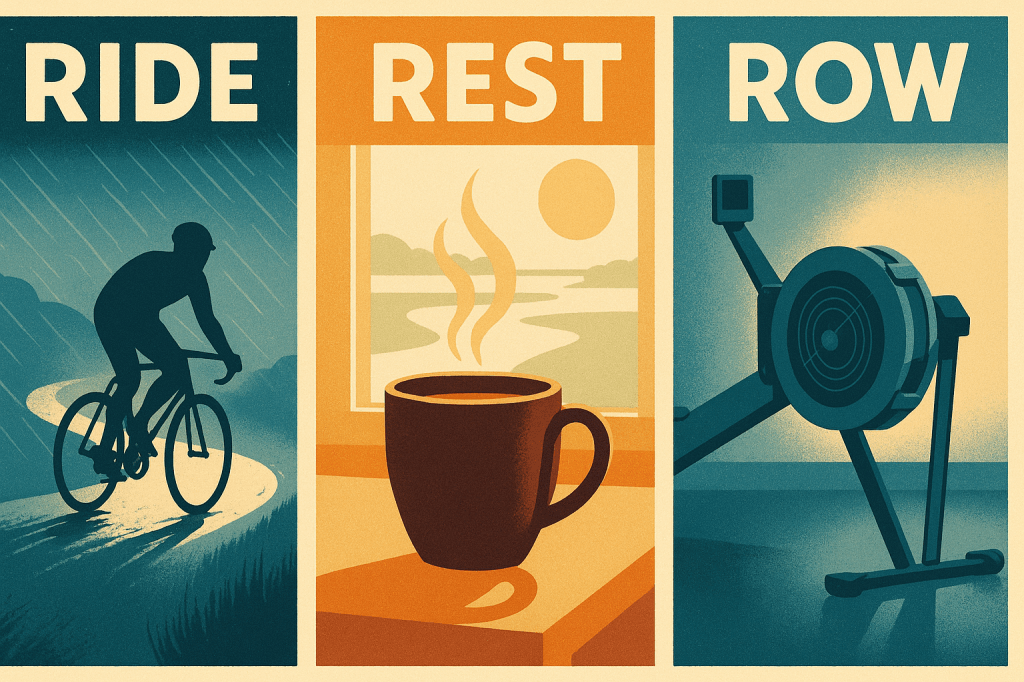
  • Ride, Rest, Row

    Quick training update today.
    Yesterday was a rest day after the 112k bike ride, and I still felt it in my legs this morning. I went to the gym for a recovery row, 7,000m at a slow stroke rate, strong pulls, and all about form over speed.

    Ride, rest, row. It works.

    It was exactly what I needed. I felt great afterwards and had the headspace to reflect on Sunday’s ride. I’ve cycled further before, and certainly faster, but doing that distance in bad weather and on a day when I wasn’t feeling it makes it all the more satisfying in hindsight.

    This is The Sub-7 Experiment.

  • Why I’m Chasing a Sub-7 2K

    I am inherently lazy but also reasonably competitive. Which makes no sense, but here we are.

    A couple of years ago, I completed the Wicklow 200, a cycling sportive that takes in 200km of some of the best scenery in Ireland in a single day. Their website calls it “Ireland’s premier cycling challenge.” And they’re not wrong.

    According to Strava, I covered 204.1km with 3,008 meters of climbing and a moving time of 9 hours, 57 minutes, and 52 seconds. A long, hard day in the saddle.

    Training for it was simple: a couple of one-hour rides during the week, longer ones at the weekend, gradually working up to 75% of the event distance before the big day.

    I’m not the fastest cyclist—I tend to diesel along. It’s enjoyable, but it takes ages.

    And this is where the laziness kicks in.

    I could get a really good workout on the ERG. A really, really good workout. The kind that felt like a couple of hours on the bike—without actually having to be on the bike.

    So I switched.

    The Slippery Slope of Excuses

    This worked great… while I was motivated.

    But I think I mentioned earlier—I’m inherently lazy. And before long, the excuses started creeping in.

    I’d be in bed the night before, full of good intentions. Then the morning would come, and my brain would instantly start talking me out of it.

    • I had a thing to do (I didn’t).
    • I didn’t have time (but still managed to sit in front of the TV).
    • It was too cold. I was too tired. My back hurt.

    Sound familiar?

    And then reality hit. My trousers started feeling tighter. I was puffing going up the stairs. I felt sluggish.

    Stepping on the scales told me the truth—I was 18 pounds heavier than I was 12 months earlier.

    We have a sun holiday booked later this year, and I want to feel better about myself before we go.

    Back to the Gym (and the Mind Games Begin)

    With that in mind, I dragged myself back to the gym a couple of times a week. To my surprise, I still had a reasonable level of fitness. I could still do 7,000 meters, but it took longer, hurt more, and wiped me out physically and mentally.

    And that’s when two thoughts hit me.

    First: This is good. Rowing = effort = calories burnt = a slimmer me = hopefully more self-esteem.
    Second: But what’s the actual point?

    There I was, grinding through 7,000 meters in the same old gym, staring out the same old window. For what?

    The Turning Point

    Then I read Not a Diet Book by James Smith.

    He’s a well-known fitness coach and entrepreneur who runs James Smith Academy, and his writing was refreshingly blunt and honest.

    He covered lifestyle, nutrition, training, and mindset, but two key takeaways stuck with me:

    1. Caloric deficit is king (energy expended must be greater than energy intake for fat loss).
    2. Progressive overload is the key to real progress.

    What is Progressive Overload?

    As I understand it, it means pushing a little harder each time to force your body to adapt.

    • Over time, your body gets used to the work it’s doing.
    • If you keep doing the same thing, it eventually stops making changes.
    • Unless you keep increasing the workload, progress slows down.

    That got me thinking.

    I love the buzz from a good, hard session. But I also get bored easily. And once I start seeing training as a chore, the excuses get louder.

    So, I needed to flip my thinking.

    • I need to choose to go to the gym.
    • I need to give my competitive self a target.
    • I need to train to beat 2,000 meters in less than seven minutes.

    And so, The Sub-7 Experiment began.