Tag: biking

  • Before You Buy the Bike

    In a previous post, Comfort is Speed, I talked about the process of bike fitting and some of the advantages and gains. But there is one particular gain that needed its own post.

    When bike manufacturers build bikes, they have to cater for people of all shapes and sizes. They have to decide on average component and frame sizes that will work for the largest number of people, while also keeping design and manufacturing costs under control.

    They are in business after all. They are there to make money.

    So bikes are sold, mainly, by frame size. Small, medium, large. 50cm, 52cm, 58cm and so on.

    Those frames come with a stem length and crank length that have been chosen by the design team based on their experience. When you buy a bike off the shelf, that is what you have to work with.

    Bike manufacturers also publish the frame geometry. That means the length of the various tubes on the frame, the angles at the junctions, and the measurements that give you a general idea of what the bike will be like to ride.

    Sizing charts are published too.

    To cater for the masses.

    When I bought my Giant and my Triban, I bought them both based on my height, inside leg measurement, and the sizing chart the manufacturer had published.

    We talked about rules of thumb in the previous article, and one of those rules when buying a new bike says that if you are halfway between two frame sizes, you should go for the smaller one. The logic is that it is easier to extend components than it is to shrink the frame once it is in your shed or garage.

    I was between sizes on the Triban, so I bought the large frame, not the XL.

    It turns out that for my height, I have fairly average length legs but great big long monkey arms and torso.

    And so it transpires that the frames of the bikes I own are too small for me. Yes, they are okay for leg length, but they are too short for my upper body. To get anywhere near the level of comfort I need, the stems have to be extended.

    After a few years of ownership, that is not a huge issue. You find it out, spend some money on a new stem after a bike fit, and move on.

    But what if the bike was brand new?

    What if you had just spent a considerable amount of cash on a new bike, only to find out straight away that it needed a new stem, different cranks, different pedals, or maybe even that you had bought the wrong size frame?

    I, for one, would feel a bit miffed.

    Cue the second type of bike fitting: the pre-purchase bike fit.

    I am in the very lucky position of being in the process of buying a new bike. A lot of research has gone into this purchase. I want something I can ride all day. Something I can ride fast if I want to. Maybe even something I can take away from the main road and down quieter tracks and trails.

    Most of all, I want it to be comfortable and able to deal with the poor surfaces on the roads near where I live and ride most often.

    My recent experience has shown me that most of the comfort comes from fit and dimensions. It has also shown me that I am not an average shape.

    So I booked another session with Bike Fit Barry. No sponsorship, no arrangement, just a very happy customer.

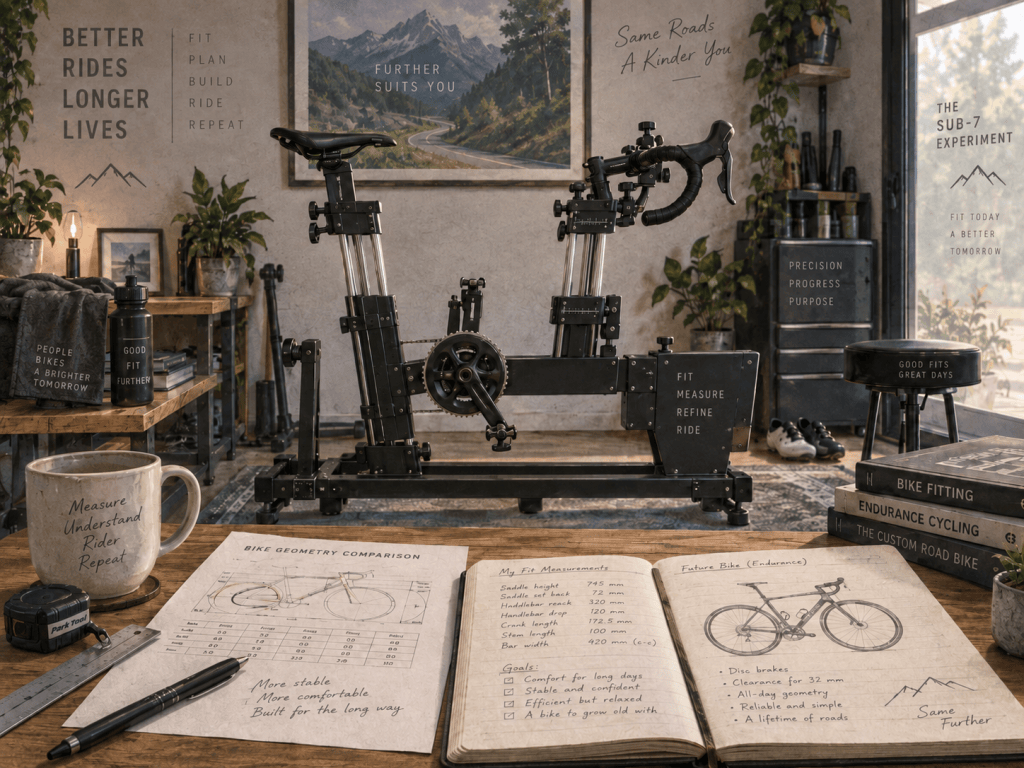
    For the new bike fitting session, Barry used a fitting jig. It mimics a bike, with handlebars, saddle, pedals and all the adjustable contact points. He had it set up when I arrived using the same dimensions from my Giant, based on the previous fitting session. That was the starting point.

    This time Barry also measured me properly, not just my height and inside leg. He measured hip to knee, knee to ankle, shoulder width, shoulder to elbow, and elbow to wrist. In other words, he was not just fitting a bike to “someone about my height.” He was building a picture of how I am actually put together.

    I had already narrowed the new bike decision down to one of two Mason bikes: the Bokeh and the Definition. I had been in touch with Mason and had booked a test ride on both bikes, each on a 58cm frame, because that is what the sizing chart suggested I needed.

    Barry had the geometry and frame details of the Mason Bokeh in his computer, and we went through the process of getting me set up in a comfortable position.

    Seat height. Stem length. Handlebar height and width. Crank length. Each change was documented until we found a comfortable fit.

    Barry even asked if I was going to buy new pedals for the bike. I said I hadn’t considered it. He told me about some Shimano pedals with a 4mm longer axle and said I should try them.

    He went outside to his own bike, took them off, and put them onto the fitting rig.

    The change was small but significant. It released pressure I had been feeling in my hips and lower back. These micro-adjustments can make a massive difference to the whole setup and feel.

    There were three big “oh wow” moments for me in this session.

    The first was the extra axle width on the pedals making such a difference to how my hips and back felt.

    The second was the shorter cranks. Normally, on a large or XL frame, the cranks will come from the factory at 170mm or maybe 172.5mm. For me, for the new bike and the way I am built, 165mm cranks are the way to go.

    The third “oh wow” moment was the big one.

    It turns out that the 60cm Mason Bokeh frame is the one I should go for.

    Because it is longer and taller than the 58cm frame the sizing chart pointed me towards, it accepts my long monkey arms and torso without me having to concertina myself into the available space between saddle and handlebars.

    This is huge.

    This new bike is my own personal indulgence for something I really love to do, and I can only imagine how disappointed I would have been if I had bought the wrong sized frame.

    Again.

    I am still going to ride the bike before I place the order, and that will happen in the next couple of weeks. But because of the bike fitting, I now know the exact measurements of the components I need.

    The beauty of the Mason model is that I can take everything we learned in the fitting session and pass it on to them, so they can build the bike specifically for me.

    It’s like going to Savile Row and having a bespoke suit made.

    If you are thinking of buying a new bike, and if you are going to spend your hard-earned cash, find a way to budget for a pre-purchase bike fit. Make sure you buy the right size frame, or even the right brand and model bike for what you actually want to use it for.

    Many bike fitters offer a follow-up session for when the new bike arrives, just to get it set up properly. Barry does, and I will be seeing him again in a couple of months when my new bike arrives.

    This is The Sub-7 Experiment.
  • Comfort Is Speed

    There seems to be a lot of discussion at the moment around bike fit.

    It could be that the cookies in my feed are just serving me bike fit content because I’ve been looking into it recently. Or it could be that more people are waking up to the fact that cycling does not have to be all about discomfort and pain. It should be about enjoyment and fun too.

    With that in mind, I thought I’d share a few thoughts of my own.

    There tends to be a thought that if you want to go fast, you slam your handlebars as low as possible to get as “aero” as possible. There is an equation that says you multiply your inside leg by 0.883, known as the LeMond method, and that will give you your saddle height. There is also the old “knee over pedal spindle” rule, where a line dropped from the front of your knee is supposed to line up neatly with the pedal axle.

    All of these things sound useful, and they can be useful as starting points, but they are not bike fit. They are rules of thumb. Bike fit is what happens when those rules meet an actual human body, with actual flexibility, actual history, actual injuries, and actual goals.

    A friend of mine had been championing bike fitting to me for years. I just thought I didn’t really need to spend €250 for someone to tell me how high my saddle needed to be. In typical fashion, I ignored the advice and went on my merry way thinking I knew best.

    I am lucky enough to have two bikes in my shed: a full carbon framed Giant and an aluminium framed Triban. Both great bikes, but both were making me sore across the lower back and shoulders, and I was getting pins and needles in my hands.

    All three are symptoms of a badly fitted bike.

    But in my head I still had the thought that pain and discomfort were just part of cycling, especially on 50km-plus rides. I thought I just needed to suck it up and get on with it.

    So I did some research. I found the inside leg equation and the knee-over-pedal-spindle advice and started changing things on both bikes to see how it went. I also bought some cushy handlebar tape and silicone inserts to try to stop the numb hands.

    The saddle height worked okay. The knee-over-spindle bit was harder to achieve by myself. That involved putting the bike on the trainer, making a plumb bob out of string and some washers I found in the shed, putting masking tape on my shoes, and drawing on the tape where I thought the pedal spindle was in relation to everything else.

    It wasn’t exactly scientific, but I managed to make some changes.

    Then I tried to make my handlebars as high as possible. I bought a headset extension and a comedy high-rise stem, specifically for the Triban. My thinking was simple: my lower back is sore because I’m leaning forward, so if I sit more upright it should ease the pressure on my back.

    It did.

    But it made my shoulders worse. And it made my back worse when I went any real distance.

    I even downloaded an app, stuck little white dots on my elbows, shoulders, hips and knees, set my phone up on my bike workshop stand and followed the instructions to see if I could get it any better.

    I didn’t.

    More frustration.

    More thinking: “Yeah, but this is cycling and cycling is uncomfortable.”

    Eventually, I booked an appointment with a bike fitter.

    Bike Fit Barry.

    I found him online and he would do both bikes in one session, so I loaded up the car and went to see what it was all about.

    The session started with a discussion about what symptoms I was experiencing, any medical history, and what I wanted to achieve. Was it comfort? Was it power? Was it speed?

    The answer was pretty much a combination of all three, but erring on the side of comfort. Yes, I like going fast, but I’m not racing from lamp post to lamp post any more. I want to be able to ride all day and enjoy it.

    After the discussion, Barry asked me to walk up and down without my shoes on so he could see my gait. Then he started asking about my medical history again. There was something he couldn’t quite put his finger on. Something he couldn’t suss out.

    Then I remembered.

    I had broken my left leg just above the ankle once, a long time ago.

    And that was it. That was why he couldn’t quite place why I was walking strangely. It didn’t feel strange to me, but it was enough to make a difference.

    Next step, literally, was to look at my cycling shoes. He quickly discovered they were too narrow for me. When he pointed it out, I said that was what cycling shoes were all about. Or so I thought. You cram your foot into a shoe, tighten it as much as possible, and that gives you proper power transfer to the pedals.

    No.

    He measured my feet, including width, and pulled out a pair of new wide-fitting cycling shoes. I put them on.

    So comfortable.

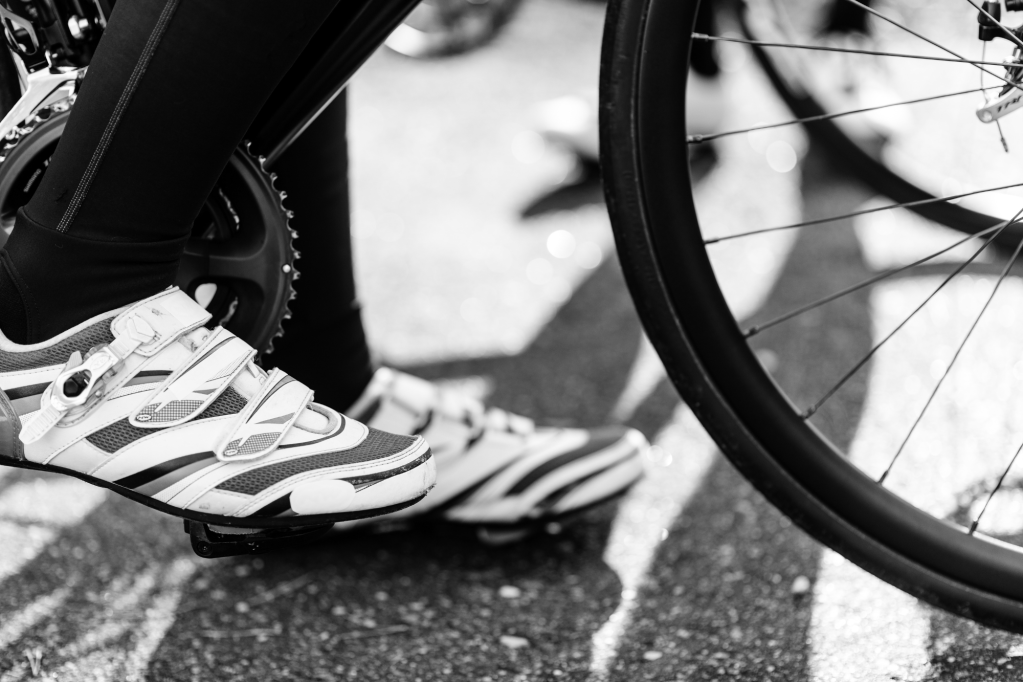
    The next phase was proper cleat alignment. The cleats are the physical connection between the shoes and the pedals. They can be positioned to move the foot forward or back in relation to the pedal spindle, slightly side to side, and also change the angle of the foot in relation to the direction of travel. All of that affects the position of the entire mechanical framework of the skeleton.

    I’ve only mentioned it briefly here, but the cleat placement and foot alignment took most of the time in the session and its quite possibly the most important part of the session and the overall fit.

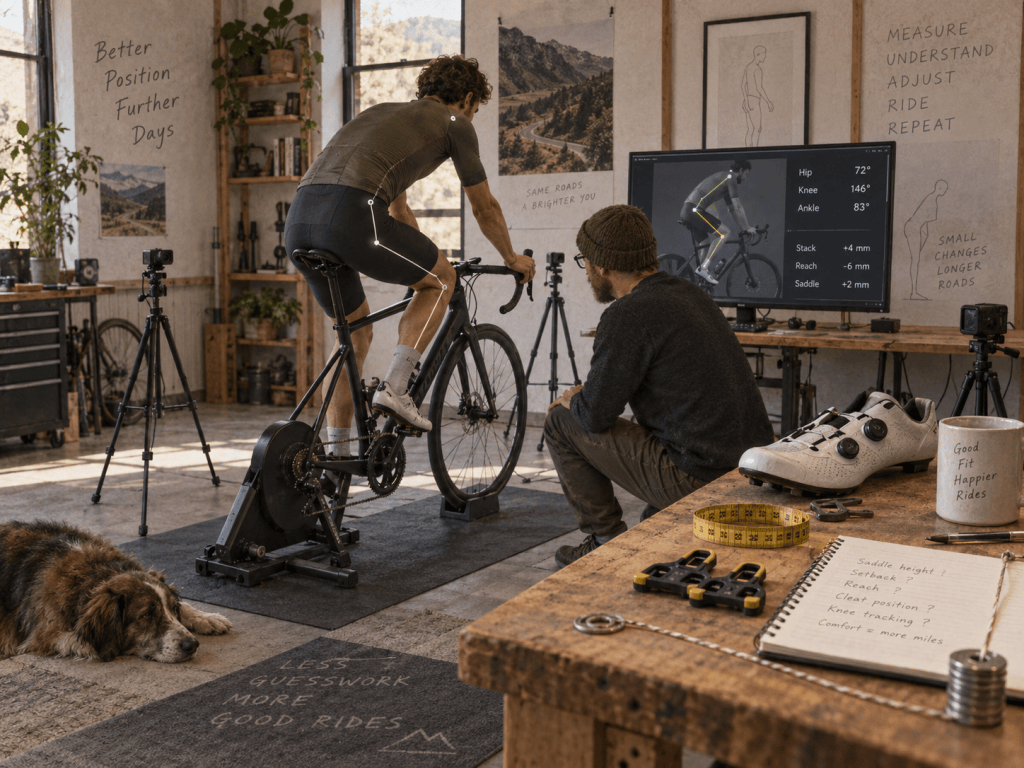
    Next, the bike was mounted onto the training setup in his studio and I started pedalling. Cameras at the front, rear and side recorded me riding. Snapshots of angles such as hip angle, knee angle at the top and bottom of the pedal stroke, elbow angle and shoulder angle were displayed on a screen. That gave Barry an idea of where I was in relation to the usual guidelines.

    Then, using his experience, his know-how and the conversation with me, he went about changing all the things that could be changed: seat height, saddle position fore and aft, saddle angle and handlebar height.

    This was by far the strangest thing and went against everything I had previously thought.

    He lowered the handlebars.

    It turns out I am quite supple and can bend at the waist fairly well. Because I had the handlebars up so high, I was holding myself up and pushing my shoulders up to fit my arms in, while my body was trying to bend lower.

    Sounds odd, but I was actually cycling hunched over. That was causing the sore shoulders, and I was putting so much pressure on my hands that the pins and needles were there all the time.

    By lowering the bars, the pressure was released.

    And the changes only need to be small. We are talking millimetres. Millimetres can make a big difference.

    We also talked about saddles. It was decided that my saddle was probably the wrong shape and I should investigate something else. Barry has a pressure pad he can place on the saddle to see where the weight quite literally sits. It showed more pressure on one side, which we put down to my twisted pelvis, but a new saddle looked like it might improve the comfort.

    After a while, we had one bike set up and it was time for the second one.

    This was the Triban with the comedy stem and riser. I hadn’t been able to find the original stem that came with the bike, so Barry tried to get the bars as low as possible. This bike didn’t need to be set up quite the same way as the Giant because it had different duties. I quite often put flat pedals on it and cycle with my son, so it didn’t need to be set up purely for distance.

    I took the bikes home and started riding the Giant far more than I had previously. It was easier to ride, more comfortable, and I started researching new saddles.

    After a while, I moved the stem down another couple of millimetres and that eased my shoulders even more. It was great. I found another saddle and booked a follow-up session with Barry to get it fitted properly.

    The bike had come alive.

    I rode it often, basically ignoring the Triban.

    A few months later, I thought I would try the Triban on a spin again, and it was uncomfortable. I had become used to riding the Giant with the lower handlebars, and I decided I should book in with Bike Fit Barry again.

    When I was there getting the new saddle fitted, I noticed that he had stems of different lengths on the wall in his studio. I asked if I could bring the Triban in and try different length stems. He said yes.

    That fitting took place, and now that bike is also comfortable to ride.

    So what is the outcome?

    I am absolutely now a proponent of having a proper bike fit with an experienced person, because it is way more nuanced than a few rules of thumb. Everyone is different, so everyone will have a different fit.

    People may think it is too expensive, but cyclists will happily spend hundreds of euro on new components to save a few grams here and a few grams there.

    The reality is that comfort is speed.

    If you can push power through your pedals without having to permanently brace yourself because of discomfort, you are going to get bigger gains than a few grams of weight will ever give you.

    And that leads into the next part of the story, because there is another kind of bike fit that I wish I had understood sooner.

    This is The Sub-7 Experiment.

  • Nearly Breaking Seven

    Last Sunday was the big cycling day, the 150km sportive, and what a day. It was tough, one of the hardest rides I’ve done, and yet one of the best.

    I’ve gone further before. A couple of years back I managed 205km in one day. But Sunday had its own sharp edge. The route was testing, the climbs were long, and the pace was relentless. What made the difference was the two friends I rode with. My cycling buddies. They’re both strong riders and very kind, and they led the way all day. The slipstream effect on a bike is huge, and they pulled me along when I needed it most.

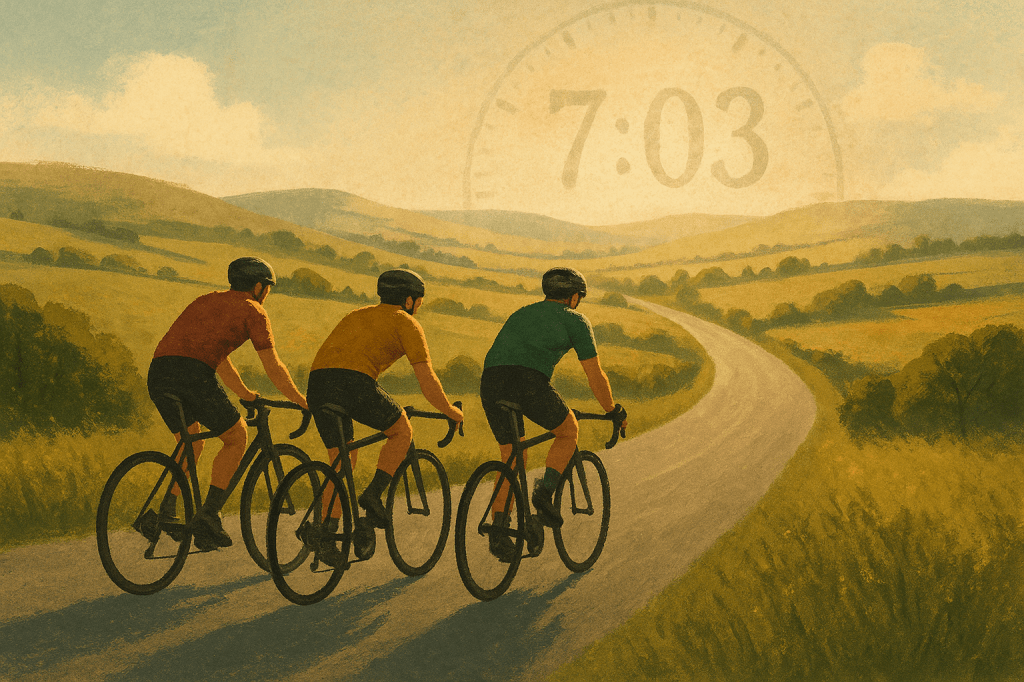
    The number seven keeps showing up, in rowing goals, in timings, now in cycling. I didn’t plan it that way, but perhaps it’s a reminder that some patterns are worth paying attention to. We set out aiming for seven and a half hours moving time. That would have been decent. Instead, we crossed the line at seven hours and three minutes, nearly breaking the seven-hour barrier. On my own I’d have finished, but nowhere near that time. With them, I came close to something I didn’t think was possible. For that, I’m grateful.

    The route itself was stunning. Rolling countryside, long open stretches, climbs that tested every muscle. I often watch the Tour de France, the Giro, or La Vuelta and think how incredible it would be to ride roads like that. That day felt like a taste of that. And we had the weather too, the last weekend of September in Ireland and not a drop of rain. Sun from start to finish, fresh in the morning, warm by afternoon. You couldn’t ask for better.

    This was more than just a ride. It was a reminder of the privilege of moving through the world under your own power, alongside good people, with good scenery around you. A reminder that shared effort magnifies achievement.

    This is The Sub-7 Experiment — and last Sunday, it was on two wheels

  • The Junction at 35K

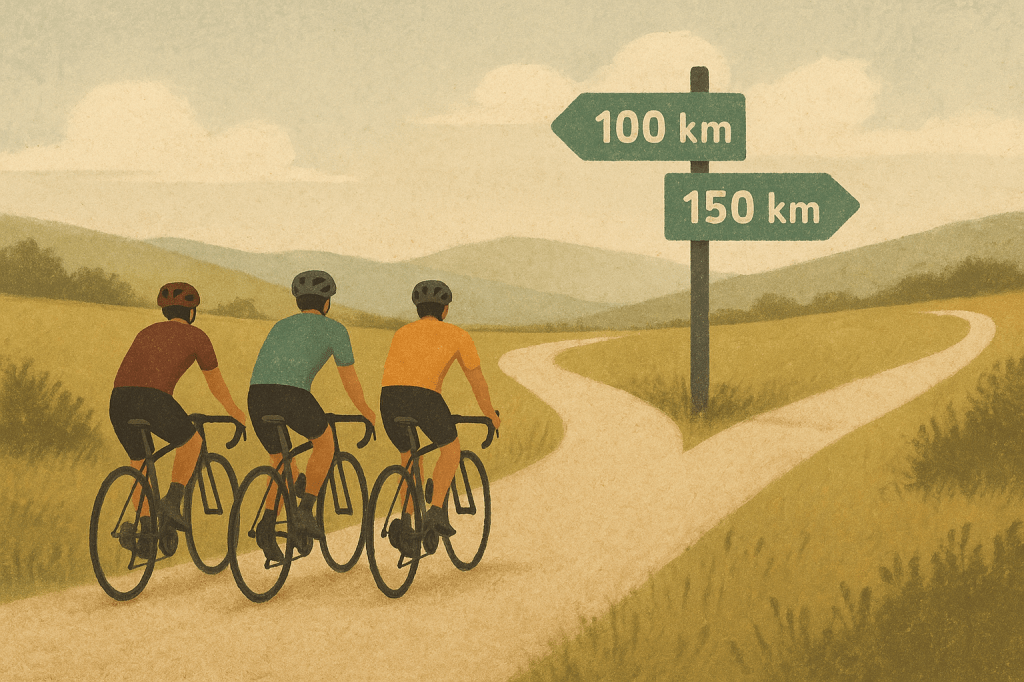
    In less than two days, I’ll be on the start line for the 150km sportive. There are two routes that day — 100km or 150km — and at the 35km mark, just after the first big climb, there’s a junction. Turn left and it’s the shorter route. Turn right and it’s the full thing. That choice feels like the whole ride in miniature: test the legs, listen to the head, and then decide whether I’ve got what it takes to go the distance.

    I’m excited, a bit nervous about riding in such a big group, but I know from experience that it thins out quickly enough. What sits with me more is whether the work I’ve done this year is the right kind of work. I haven’t ridden over 100k in three weeks, but the last one I did was 121k. The rowing and strength work mean I’m heavier now, but heavier in the right way: stronger, more resilient. I can leg press 150kg these days, not bad for someone who struggled with 70 when I started measuring this in March 2025. The endurance rows have kept the engine ticking too, even when the weather kept me indoors.

    The bike has been through its own transformation this year. Lighter wheels, better gearing, and most recently new gel pads and handlebar tape that have taken the sting out of the Irish roads. It’s not set up for rain, no mudguards, but this is Ireland, rain is part of the deal. Still, I’ll be riding with a piece of both my parents: the bike bought with a little money from Mum when she passed, and the saddle from Dad for my birthday. That matters more than any component choice.

    Success on the day is simple: finish strong without grinding myself into the ground, enjoy the company of my friends, and carry the memory with me. If the legs aren’t there and I have to turn left at the junction, then so be it. If something mechanical forces me to stop, then I’ll still have had a weekend away with good people. But if the legs are there, and the head is steady, then turning right — taking on the full 150 — will be the real win.

    This ride isn’t part of the Sub-7 Experiment, not really. Different training, different demands. But it is part of the bigger experiment: how to keep moving, how to choose things that are mine, how to remember that age hasn’t caught me yet. This is one of the rare things I do just for myself, away from family. And yet, finishing it well at 55 is also a reminder of what I bring back to them: proof that I can still do hard things, still choose adventure, still find joy in movement.

    The road will be long, but I won’t ride it alone.

    This is the Sub-7 Experiment and this weekend I am mostly riding a bike.

  • Three Weeks to Go: Testing the Legs, Testing the Head

    Big Day on the Bike

    It was a big day on the bike yesterday: 121 km and 1,600 metres of climbing.

    Everything went well. Fueling was good, I tried a new recipe for cycling food with honey, banana, dates, and oats. For the last decade I’ve avoided processed and refined sugar, which makes it tricky to prepare carb-dense food for a six-hour ride. The sheer volume needed can turn into one long eating fest. Adding honey made it feel indulgent, but it worked really well.

    The bike worked well too. Over the summer I’ve made a series of upgrades and experimented with tyre pressures to dampen road buzz, the vibrations that travel up through the saddle and handlebars on poor surfaces. There’s always a compromise: smoother main roads with heavy traffic and impatient drivers, or quieter back roads that are rougher but calm. I’ll take the quiet roads every time.

    The final upgrade went on late Saturday night, gel pads along the tops of the handlebars and new plush bar tape. They’ve made a real difference. I can still feel the bumps and imperfections, but the sharp edges have gone. I finished the 121 km without the usual pain in my arms, wrists, and shoulders. A great win.

    The legs worked well too. This was my first long cycle in about three weeks, but once I warmed up the ride flowed nicely. Still, I think I need to do more research into cycling training. Compared to rowing, where I train almost every day, cycling has longer gaps between sessions. In those gaps, the old voices creep back in, casting doubt and asking what the point of it all is.

    At around 105 km, I hit a steep 10% gradient. I got off the bike for a few minutes and walked. My thinking was simple: I’m here to enjoy myself, not kill myself. And it was the right call, a quick reset, a sip of water, and I was back spinning away to the finish.

    All in all, it was a great day out on the bike. The rain held off, the sun even came out for a while, and the headwind kept things challenging all the way. With three weeks to go until the big event — 150 km with 1,900 metres of climbing — I’m in good shape both mentally and physically.

    This morning I’m off to the gym for a row to shake the tiredness from my legs.

    This is The Sub-7 Experiment — and these days, it’s heavy on the cycling.

  • The Point Is Not Dribbling Into My Soup

    July was a break month. I called it “movement, not measurement” — no calorie counting, no chasing numbers, no obsessing over pace or distance. Instead, it was about moving because I wanted to, not because I had to. And it worked.

    There were plenty of walks, a few gym sessions, and a lot of time spent with family. Camping, holidays, and just enjoying being Dad. And yet, even with the lighter approach, July gave me one of the biggest breakthroughs of the summer: I realised my rowing form was wrong. For months I’d been driving off my toes instead of my heels, which explained the knee pain I’d been ignoring. With heel wedges and a focus on connection, I started the awkward process of re-learning how to row. It felt strange, disconnected, even underpowered, but it was a step in the right direction.

    August was tougher. Coming back, I was hit by frustration: sore knees, comfort eating, a few pounds up on the scale, and the voices in my head louder than they’d been in a long time. The ones that say, “What’s the point? Stop now.” But in the middle of that I found an answer: the point is not becoming an old man dribbling into my soup ruing the day i decided to stop moving. The point is staying strong, independent, and capable.

    So I kept going. Rebuilding form on the rower. Long, hilly rides on the bike — including a brutal 112 km in rain, wind, and navigational mishaps that turned into a bigger ride than planned. No coffee stops, soaked to the skin, but proud I stuck it out. That cup of tea at the end tasted like a medal.

    By the end of the month, structure was back. Gym sessions, meditation rows when my head was scattered, and one big endurance block: two × 45 minute blocks on the rower with a 20-minute bike in between. Over 21 km rowed in total, despite being under the weather. Proof that the base fitness is still there.

    So here we are at the start of September. July gave me the space to reset. August gave me the chance to face setbacks head-on and still move forward. Now it’s time to sharpen things again — with a 120 km ride on the horizon and the 150 km event at the end of the month. And beyond that, the Sub-7 Experiment continues.

    This is The Sub-7 Experiment.

  • Dialing in the Ride

    I’m lucky enough to own two bicycles.

    One is a ten-year-old carbon-framed beauty with super nice wheels—it looks great, rides fast, and I love it.

    The other? A budget-friendly bike from a well-known French sporting chain. I bought it as a winter bike—something I could slap mudguards on and ride in all weathers without worrying about it. I figured if I ever crashed, at least I wouldn’t be watching an expensive piece of carbon fiber shatter into a million pieces.

    Here’s the weird thing…

    According to Strava, I set more personal bests on the cheaper, heavier bike.

    Meanwhile, when I’m on the expensive one, I feel like I’m hammering it, but the numbers don’t reflect it. It didn’t make sense.


    The Bike Fit Revelation

    A good friend has been telling me for years to get a professional bike fitting.

    I resisted.

    To my untrained eye, it seemed like a case of paying someone to adjust my saddle height—something I could figure out myself with a bit of trial and error, right?

    Wrong.

    I finally gave in and booked a bike fitting. It was a fantastic experience.

    The morning started with:
    ✅ Body measurements—measured against the bike setup
    ✅ Injury history & pain assessment—what aches, imbalances, or old injuries might be affecting my riding?
    ✅ Mobility tests—walking up and down the studio while the fitter analyzed my gait and flexibility

    And that was before we even touched the bike.


    Cleat Position: The Foundation of Everything

    Before we even looked at saddle height, we spent 30 minutes on my left shoe alone.

    Not just adjusting the cleat position but making sure that:
    ✅ I was comfortable on the pedals
    ✅ My foot placement allowed for optimal power transfer
    ✅ Everything felt natural and stable

    Then, I started pedaling.

    Cameras in front, behind, and from the side captured my riding position. These were plugged into a laptop where the fitter analyzed:
    ✅ Leg angles & hip tilt
    ✅ Arm position & reach
    ✅ Pressure distribution on the saddle

    Every tweak—seat height, fore/aft positioning, bar height, even tilt adjustments—was measured, discussed, and refined.

    One of the biggest changes? Moving the handlebars down.

    I’d always assumed, with my long torso and monkey arms, that I’d need the bars higher for comfort.

    Nope.

    Lowering the bars made a massive difference.


    Post-Fit Struggles: Where’s My Power?

    There was only one problem.

    Changing my position and connection to the bike made it feel like I had no power in my legs.

    This is expected. Even the pros experience this after a bike fit adjustment—the body needs time to adapt. The only solution?

    Get out and ride.


    Today’s Ride: Strange, but Good

    So that’s what I did.

    It was a beautiful spring morning—not too warm, not too cold, blue sky, crisp air. Perfect cycling weather.

    I did my usual 22K loop—230m of climbing, 57 minutes total.

    It felt weird.

    But also really good.

    This was only my third ride since the fit, and already, I feel stronger, more comfortable, and more stable.

    One thing became clear—I have a massive leg imbalance.

    The fitter reckoned if I had a power meter, it would show a 25% / 75% power split left-to-right.

    The fix? Conscious effort.

    A tip from the fitter:
    🚴‍♂️ On climbs, count 20 pedal strokes per leg.
    🚴‍♂️ Focus on the left leg, then switch to the right.
    🚴‍♂️ Repeat.

    By actively engaging both legs, I should rebalance the power output.

    More saddle time will bring back the power.

    I hope.

    But today was a win.

    ✅ Great to be out.
    ✅ Great to do something different.

    This is The Sub-7 Experiment.