In a previous post, Comfort is Speed, I talked about the process of bike fitting and some of the advantages and gains. But there is one particular gain that needed its own post.
When bike manufacturers build bikes, they have to cater for people of all shapes and sizes. They have to decide on average component and frame sizes that will work for the largest number of people, while also keeping design and manufacturing costs under control.
They are in business after all. They are there to make money.
So bikes are sold, mainly, by frame size. Small, medium, large. 50cm, 52cm, 58cm and so on.
Those frames come with a stem length and crank length that have been chosen by the design team based on their experience. When you buy a bike off the shelf, that is what you have to work with.
Bike manufacturers also publish the frame geometry. That means the length of the various tubes on the frame, the angles at the junctions, and the measurements that give you a general idea of what the bike will be like to ride.
Sizing charts are published too.
To cater for the masses.
When I bought my Giant and my Triban, I bought them both based on my height, inside leg measurement, and the sizing chart the manufacturer had published.
We talked about rules of thumb in the previous article, and one of those rules when buying a new bike says that if you are halfway between two frame sizes, you should go for the smaller one. The logic is that it is easier to extend components than it is to shrink the frame once it is in your shed or garage.
I was between sizes on the Triban, so I bought the large frame, not the XL.
It turns out that for my height, I have fairly average length legs but great big long monkey arms and torso.
And so it transpires that the frames of the bikes I own are too small for me. Yes, they are okay for leg length, but they are too short for my upper body. To get anywhere near the level of comfort I need, the stems have to be extended.
After a few years of ownership, that is not a huge issue. You find it out, spend some money on a new stem after a bike fit, and move on.
But what if the bike was brand new?
What if you had just spent a considerable amount of cash on a new bike, only to find out straight away that it needed a new stem, different cranks, different pedals, or maybe even that you had bought the wrong size frame?
I, for one, would feel a bit miffed.
Cue the second type of bike fitting: the pre-purchase bike fit.
I am in the very lucky position of being in the process of buying a new bike. A lot of research has gone into this purchase. I want something I can ride all day. Something I can ride fast if I want to. Maybe even something I can take away from the main road and down quieter tracks and trails.
Most of all, I want it to be comfortable and able to deal with the poor surfaces on the roads near where I live and ride most often.
My recent experience has shown me that most of the comfort comes from fit and dimensions. It has also shown me that I am not an average shape.
So I booked another session with Bike Fit Barry. No sponsorship, no arrangement, just a very happy customer.
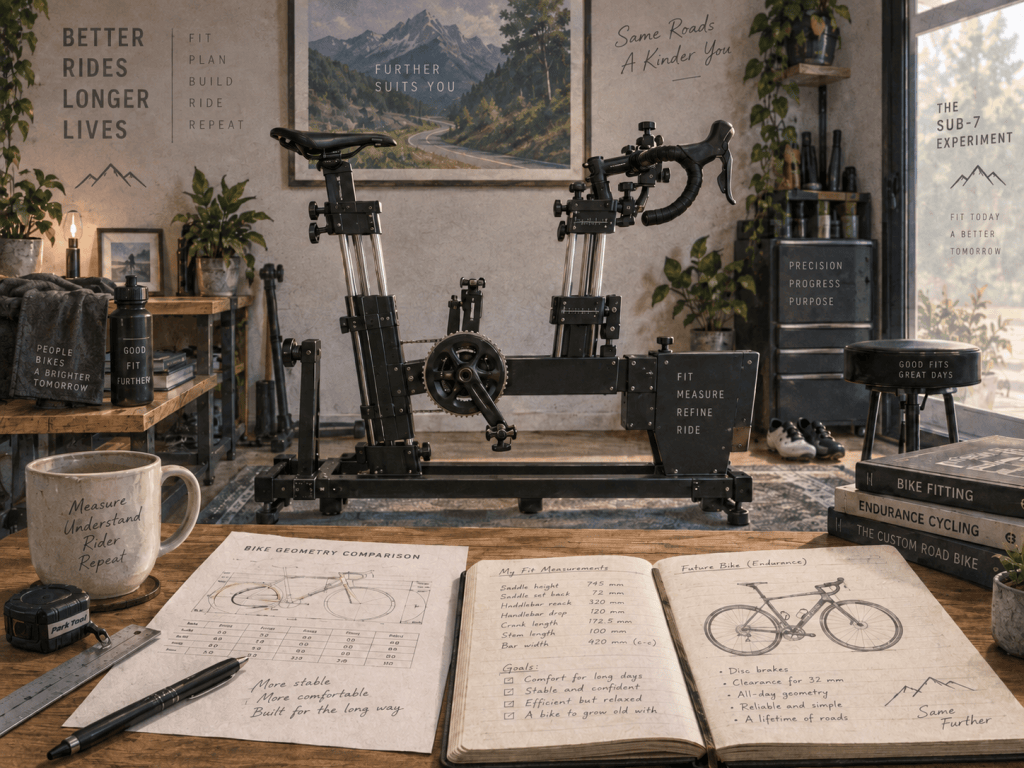
For the new bike fitting session, Barry used a fitting jig. It mimics a bike, with handlebars, saddle, pedals and all the adjustable contact points. He had it set up when I arrived using the same dimensions from my Giant, based on the previous fitting session. That was the starting point.
This time Barry also measured me properly, not just my height and inside leg. He measured hip to knee, knee to ankle, shoulder width, shoulder to elbow, and elbow to wrist. In other words, he was not just fitting a bike to “someone about my height.” He was building a picture of how I am actually put together.
I had already narrowed the new bike decision down to one of two Mason bikes: the Bokeh and the Definition. I had been in touch with Mason and had booked a test ride on both bikes, each on a 58cm frame, because that is what the sizing chart suggested I needed.
Barry had the geometry and frame details of the Mason Bokeh in his computer, and we went through the process of getting me set up in a comfortable position.
Seat height. Stem length. Handlebar height and width. Crank length. Each change was documented until we found a comfortable fit.
Barry even asked if I was going to buy new pedals for the bike. I said I hadn’t considered it. He told me about some Shimano pedals with a 4mm longer axle and said I should try them.
He went outside to his own bike, took them off, and put them onto the fitting rig.
The change was small but significant. It released pressure I had been feeling in my hips and lower back. These micro-adjustments can make a massive difference to the whole setup and feel.
There were three big “oh wow” moments for me in this session.
The first was the extra axle width on the pedals making such a difference to how my hips and back felt.
The second was the shorter cranks. Normally, on a large or XL frame, the cranks will come from the factory at 170mm or maybe 172.5mm. For me, for the new bike and the way I am built, 165mm cranks are the way to go.
The third “oh wow” moment was the big one.
It turns out that the 60cm Mason Bokeh frame is the one I should go for.
Because it is longer and taller than the 58cm frame the sizing chart pointed me towards, it accepts my long monkey arms and torso without me having to concertina myself into the available space between saddle and handlebars.
This is huge.
This new bike is my own personal indulgence for something I really love to do, and I can only imagine how disappointed I would have been if I had bought the wrong sized frame.
Again.
I am still going to ride the bike before I place the order, and that will happen in the next couple of weeks. But because of the bike fitting, I now know the exact measurements of the components I need.
The beauty of the Mason model is that I can take everything we learned in the fitting session and pass it on to them, so they can build the bike specifically for me.
It’s like going to Savile Row and having a bespoke suit made.
If you are thinking of buying a new bike, and if you are going to spend your hard-earned cash, find a way to budget for a pre-purchase bike fit. Make sure you buy the right size frame, or even the right brand and model bike for what you actually want to use it for.
Many bike fitters offer a follow-up session for when the new bike arrives, just to get it set up properly. Barry does, and I will be seeing him again in a couple of months when my new bike arrives.
This is The Sub-7 Experiment.

