Tag: Bike fitting

  • Before You Buy the Bike

    In a previous post, Comfort is Speed, I talked about the process of bike fitting and some of the advantages and gains. But there is one particular gain that needed its own post.

    When bike manufacturers build bikes, they have to cater for people of all shapes and sizes. They have to decide on average component and frame sizes that will work for the largest number of people, while also keeping design and manufacturing costs under control.

    They are in business after all. They are there to make money.

    So bikes are sold, mainly, by frame size. Small, medium, large. 50cm, 52cm, 58cm and so on.

    Those frames come with a stem length and crank length that have been chosen by the design team based on their experience. When you buy a bike off the shelf, that is what you have to work with.

    Bike manufacturers also publish the frame geometry. That means the length of the various tubes on the frame, the angles at the junctions, and the measurements that give you a general idea of what the bike will be like to ride.

    Sizing charts are published too.

    To cater for the masses.

    When I bought my Giant and my Triban, I bought them both based on my height, inside leg measurement, and the sizing chart the manufacturer had published.

    We talked about rules of thumb in the previous article, and one of those rules when buying a new bike says that if you are halfway between two frame sizes, you should go for the smaller one. The logic is that it is easier to extend components than it is to shrink the frame once it is in your shed or garage.

    I was between sizes on the Triban, so I bought the large frame, not the XL.

    It turns out that for my height, I have fairly average length legs but great big long monkey arms and torso.

    And so it transpires that the frames of the bikes I own are too small for me. Yes, they are okay for leg length, but they are too short for my upper body. To get anywhere near the level of comfort I need, the stems have to be extended.

    After a few years of ownership, that is not a huge issue. You find it out, spend some money on a new stem after a bike fit, and move on.

    But what if the bike was brand new?

    What if you had just spent a considerable amount of cash on a new bike, only to find out straight away that it needed a new stem, different cranks, different pedals, or maybe even that you had bought the wrong size frame?

    I, for one, would feel a bit miffed.

    Cue the second type of bike fitting: the pre-purchase bike fit.

    I am in the very lucky position of being in the process of buying a new bike. A lot of research has gone into this purchase. I want something I can ride all day. Something I can ride fast if I want to. Maybe even something I can take away from the main road and down quieter tracks and trails.

    Most of all, I want it to be comfortable and able to deal with the poor surfaces on the roads near where I live and ride most often.

    My recent experience has shown me that most of the comfort comes from fit and dimensions. It has also shown me that I am not an average shape.

    So I booked another session with Bike Fit Barry. No sponsorship, no arrangement, just a very happy customer.

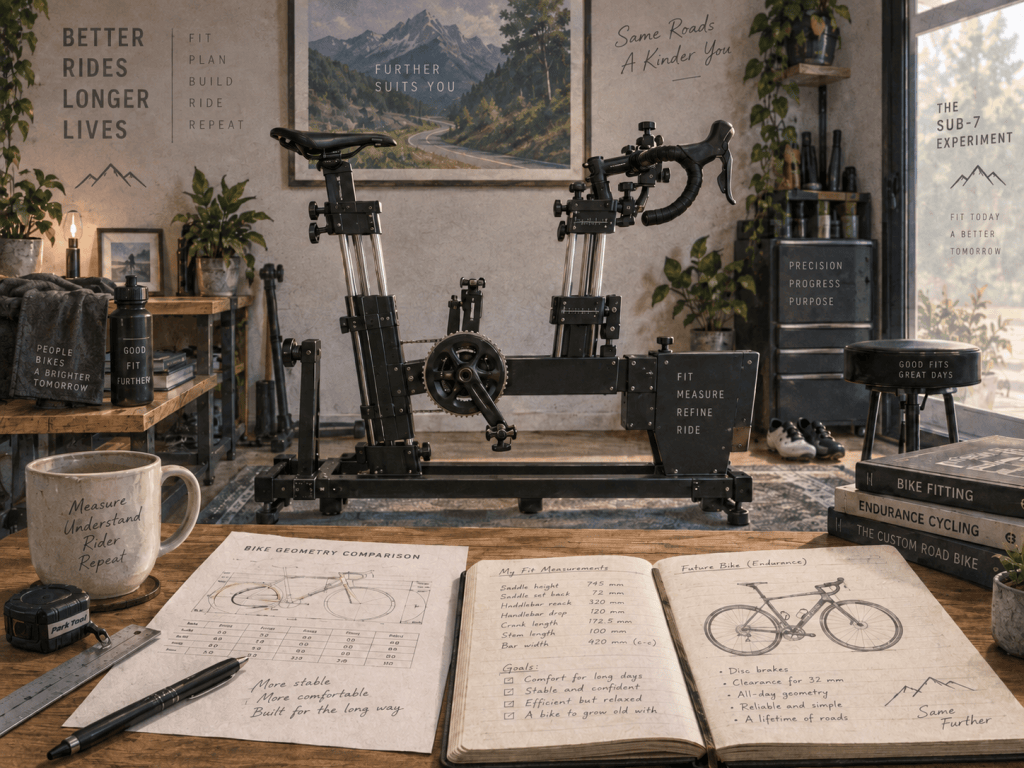
    For the new bike fitting session, Barry used a fitting jig. It mimics a bike, with handlebars, saddle, pedals and all the adjustable contact points. He had it set up when I arrived using the same dimensions from my Giant, based on the previous fitting session. That was the starting point.

    This time Barry also measured me properly, not just my height and inside leg. He measured hip to knee, knee to ankle, shoulder width, shoulder to elbow, and elbow to wrist. In other words, he was not just fitting a bike to “someone about my height.” He was building a picture of how I am actually put together.

    I had already narrowed the new bike decision down to one of two Mason bikes: the Bokeh and the Definition. I had been in touch with Mason and had booked a test ride on both bikes, each on a 58cm frame, because that is what the sizing chart suggested I needed.

    Barry had the geometry and frame details of the Mason Bokeh in his computer, and we went through the process of getting me set up in a comfortable position.

    Seat height. Stem length. Handlebar height and width. Crank length. Each change was documented until we found a comfortable fit.

    Barry even asked if I was going to buy new pedals for the bike. I said I hadn’t considered it. He told me about some Shimano pedals with a 4mm longer axle and said I should try them.

    He went outside to his own bike, took them off, and put them onto the fitting rig.

    The change was small but significant. It released pressure I had been feeling in my hips and lower back. These micro-adjustments can make a massive difference to the whole setup and feel.

    There were three big “oh wow” moments for me in this session.

    The first was the extra axle width on the pedals making such a difference to how my hips and back felt.

    The second was the shorter cranks. Normally, on a large or XL frame, the cranks will come from the factory at 170mm or maybe 172.5mm. For me, for the new bike and the way I am built, 165mm cranks are the way to go.

    The third “oh wow” moment was the big one.

    It turns out that the 60cm Mason Bokeh frame is the one I should go for.

    Because it is longer and taller than the 58cm frame the sizing chart pointed me towards, it accepts my long monkey arms and torso without me having to concertina myself into the available space between saddle and handlebars.

    This is huge.

    This new bike is my own personal indulgence for something I really love to do, and I can only imagine how disappointed I would have been if I had bought the wrong sized frame.

    Again.

    I am still going to ride the bike before I place the order, and that will happen in the next couple of weeks. But because of the bike fitting, I now know the exact measurements of the components I need.

    The beauty of the Mason model is that I can take everything we learned in the fitting session and pass it on to them, so they can build the bike specifically for me.

    It’s like going to Savile Row and having a bespoke suit made.

    If you are thinking of buying a new bike, and if you are going to spend your hard-earned cash, find a way to budget for a pre-purchase bike fit. Make sure you buy the right size frame, or even the right brand and model bike for what you actually want to use it for.

    Many bike fitters offer a follow-up session for when the new bike arrives, just to get it set up properly. Barry does, and I will be seeing him again in a couple of months when my new bike arrives.

    This is The Sub-7 Experiment.
  • Comfort Is Speed

    There seems to be a lot of discussion at the moment around bike fit.

    It could be that the cookies in my feed are just serving me bike fit content because I’ve been looking into it recently. Or it could be that more people are waking up to the fact that cycling does not have to be all about discomfort and pain. It should be about enjoyment and fun too.

    With that in mind, I thought I’d share a few thoughts of my own.

    There tends to be a thought that if you want to go fast, you slam your handlebars as low as possible to get as “aero” as possible. There is an equation that says you multiply your inside leg by 0.883, known as the LeMond method, and that will give you your saddle height. There is also the old “knee over pedal spindle” rule, where a line dropped from the front of your knee is supposed to line up neatly with the pedal axle.

    All of these things sound useful, and they can be useful as starting points, but they are not bike fit. They are rules of thumb. Bike fit is what happens when those rules meet an actual human body, with actual flexibility, actual history, actual injuries, and actual goals.

    A friend of mine had been championing bike fitting to me for years. I just thought I didn’t really need to spend €250 for someone to tell me how high my saddle needed to be. In typical fashion, I ignored the advice and went on my merry way thinking I knew best.

    I am lucky enough to have two bikes in my shed: a full carbon framed Giant and an aluminium framed Triban. Both great bikes, but both were making me sore across the lower back and shoulders, and I was getting pins and needles in my hands.

    All three are symptoms of a badly fitted bike.

    But in my head I still had the thought that pain and discomfort were just part of cycling, especially on 50km-plus rides. I thought I just needed to suck it up and get on with it.

    So I did some research. I found the inside leg equation and the knee-over-pedal-spindle advice and started changing things on both bikes to see how it went. I also bought some cushy handlebar tape and silicone inserts to try to stop the numb hands.

    The saddle height worked okay. The knee-over-spindle bit was harder to achieve by myself. That involved putting the bike on the trainer, making a plumb bob out of string and some washers I found in the shed, putting masking tape on my shoes, and drawing on the tape where I thought the pedal spindle was in relation to everything else.

    It wasn’t exactly scientific, but I managed to make some changes.

    Then I tried to make my handlebars as high as possible. I bought a headset extension and a comedy high-rise stem, specifically for the Triban. My thinking was simple: my lower back is sore because I’m leaning forward, so if I sit more upright it should ease the pressure on my back.

    It did.

    But it made my shoulders worse. And it made my back worse when I went any real distance.

    I even downloaded an app, stuck little white dots on my elbows, shoulders, hips and knees, set my phone up on my bike workshop stand and followed the instructions to see if I could get it any better.

    I didn’t.

    More frustration.

    More thinking: “Yeah, but this is cycling and cycling is uncomfortable.”

    Eventually, I booked an appointment with a bike fitter.

    Bike Fit Barry.

    I found him online and he would do both bikes in one session, so I loaded up the car and went to see what it was all about.

    The session started with a discussion about what symptoms I was experiencing, any medical history, and what I wanted to achieve. Was it comfort? Was it power? Was it speed?

    The answer was pretty much a combination of all three, but erring on the side of comfort. Yes, I like going fast, but I’m not racing from lamp post to lamp post any more. I want to be able to ride all day and enjoy it.

    After the discussion, Barry asked me to walk up and down without my shoes on so he could see my gait. Then he started asking about my medical history again. There was something he couldn’t quite put his finger on. Something he couldn’t suss out.

    Then I remembered.

    I had broken my left leg just above the ankle once, a long time ago.

    And that was it. That was why he couldn’t quite place why I was walking strangely. It didn’t feel strange to me, but it was enough to make a difference.

    Next step, literally, was to look at my cycling shoes. He quickly discovered they were too narrow for me. When he pointed it out, I said that was what cycling shoes were all about. Or so I thought. You cram your foot into a shoe, tighten it as much as possible, and that gives you proper power transfer to the pedals.

    No.

    He measured my feet, including width, and pulled out a pair of new wide-fitting cycling shoes. I put them on.

    So comfortable.

    The next phase was proper cleat alignment. The cleats are the physical connection between the shoes and the pedals. They can be positioned to move the foot forward or back in relation to the pedal spindle, slightly side to side, and also change the angle of the foot in relation to the direction of travel. All of that affects the position of the entire mechanical framework of the skeleton.

    I’ve only mentioned it briefly here, but the cleat placement and foot alignment took most of the time in the session and its quite possibly the most important part of the session and the overall fit.

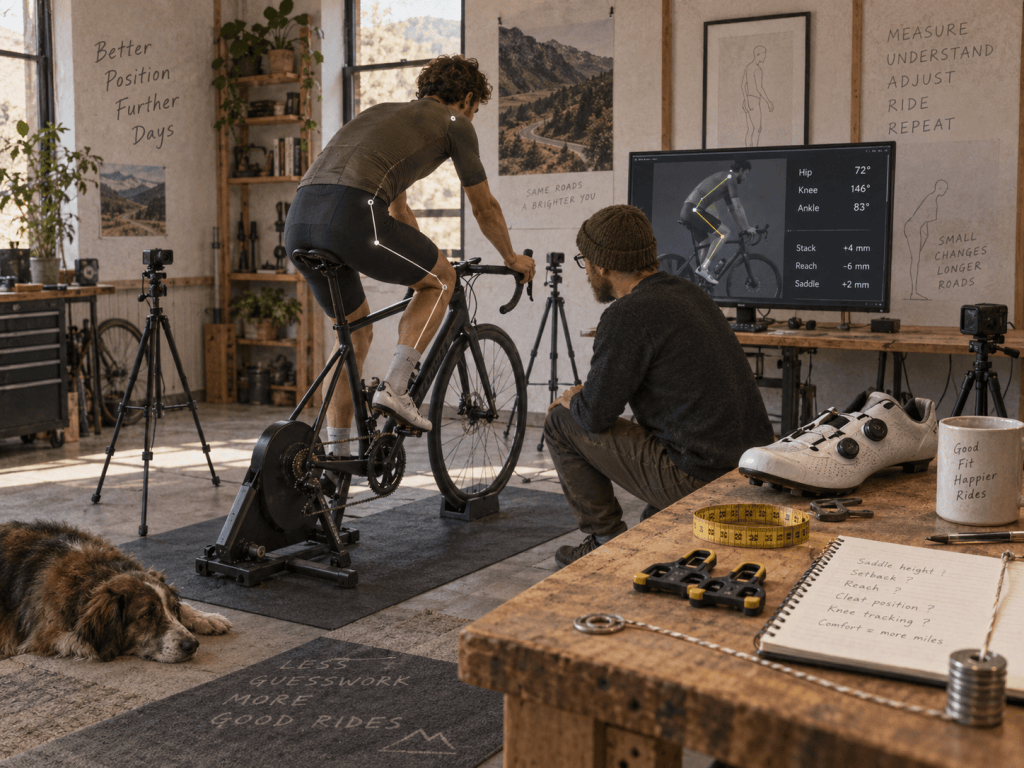
    Next, the bike was mounted onto the training setup in his studio and I started pedalling. Cameras at the front, rear and side recorded me riding. Snapshots of angles such as hip angle, knee angle at the top and bottom of the pedal stroke, elbow angle and shoulder angle were displayed on a screen. That gave Barry an idea of where I was in relation to the usual guidelines.

    Then, using his experience, his know-how and the conversation with me, he went about changing all the things that could be changed: seat height, saddle position fore and aft, saddle angle and handlebar height.

    This was by far the strangest thing and went against everything I had previously thought.

    He lowered the handlebars.

    It turns out I am quite supple and can bend at the waist fairly well. Because I had the handlebars up so high, I was holding myself up and pushing my shoulders up to fit my arms in, while my body was trying to bend lower.

    Sounds odd, but I was actually cycling hunched over. That was causing the sore shoulders, and I was putting so much pressure on my hands that the pins and needles were there all the time.

    By lowering the bars, the pressure was released.

    And the changes only need to be small. We are talking millimetres. Millimetres can make a big difference.

    We also talked about saddles. It was decided that my saddle was probably the wrong shape and I should investigate something else. Barry has a pressure pad he can place on the saddle to see where the weight quite literally sits. It showed more pressure on one side, which we put down to my twisted pelvis, but a new saddle looked like it might improve the comfort.

    After a while, we had one bike set up and it was time for the second one.

    This was the Triban with the comedy stem and riser. I hadn’t been able to find the original stem that came with the bike, so Barry tried to get the bars as low as possible. This bike didn’t need to be set up quite the same way as the Giant because it had different duties. I quite often put flat pedals on it and cycle with my son, so it didn’t need to be set up purely for distance.

    I took the bikes home and started riding the Giant far more than I had previously. It was easier to ride, more comfortable, and I started researching new saddles.

    After a while, I moved the stem down another couple of millimetres and that eased my shoulders even more. It was great. I found another saddle and booked a follow-up session with Barry to get it fitted properly.

    The bike had come alive.

    I rode it often, basically ignoring the Triban.

    A few months later, I thought I would try the Triban on a spin again, and it was uncomfortable. I had become used to riding the Giant with the lower handlebars, and I decided I should book in with Bike Fit Barry again.

    When I was there getting the new saddle fitted, I noticed that he had stems of different lengths on the wall in his studio. I asked if I could bring the Triban in and try different length stems. He said yes.

    That fitting took place, and now that bike is also comfortable to ride.

    So what is the outcome?

    I am absolutely now a proponent of having a proper bike fit with an experienced person, because it is way more nuanced than a few rules of thumb. Everyone is different, so everyone will have a different fit.

    People may think it is too expensive, but cyclists will happily spend hundreds of euro on new components to save a few grams here and a few grams there.

    The reality is that comfort is speed.

    If you can push power through your pedals without having to permanently brace yourself because of discomfort, you are going to get bigger gains than a few grams of weight will ever give you.

    And that leads into the next part of the story, because there is another kind of bike fit that I wish I had understood sooner.

    This is The Sub-7 Experiment.

  • Reflection, Riding, and Reassessing What Matters

    It’s been a while since I’ve written anything.

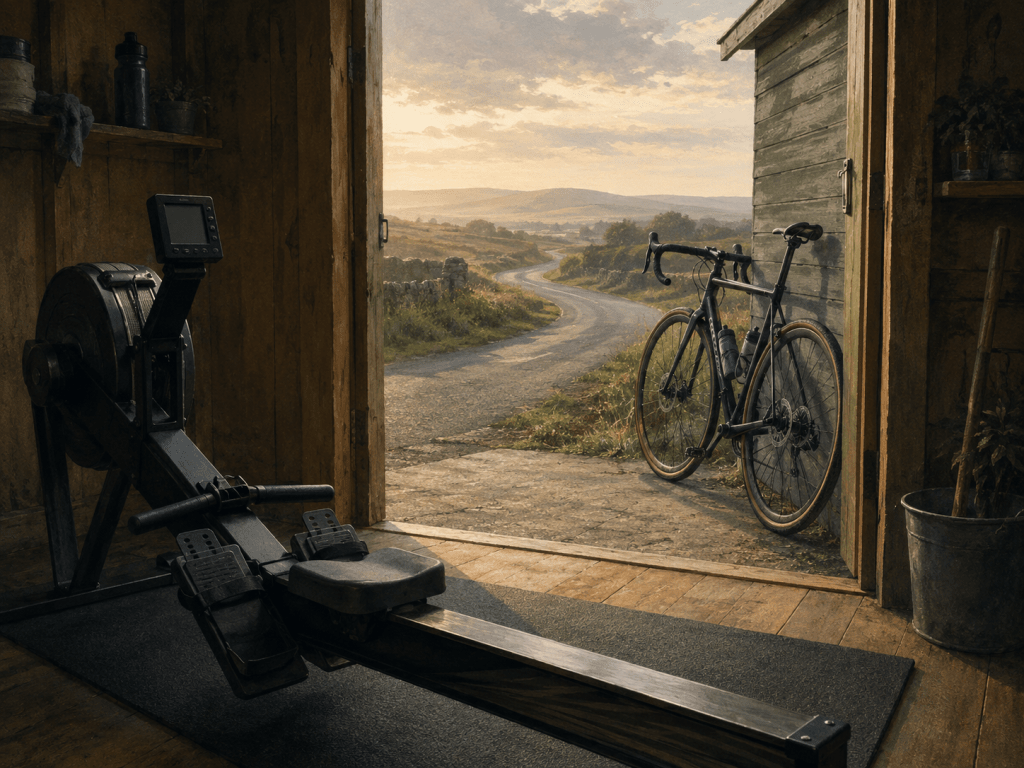
    The “new” rower in the shed is not so new now. It has been there for six months, and the new routine of rowing, then heading straight back into the house to start work or whatever the day brings, has meant I haven’t been giving myself any time to reflect on the workout afterwards. No reflection has meant nothing to post.

    Rowing is still important to me, and so is the wider exercise regime as a whole. But I think I’ve been missing that reflection piece. I also wrote in a previous article that I’ve missed the gym visits too. So it feels like time to reassess what matters.

    Exercise matters. Having an exercise goal matters. Reflection matters too. And so does being around like-minded people. My gym membership has lapsed, and I think it is time to renew it.

    In other news, I’ve been cycling a bit more.

    This Sunday I’m riding the Tour de South Coast, a 100km sportive that covers some roads I’ve used before in training. I don’t know anyone else who is doing it, but there will be a couple of hundred cyclists out on the day, and I’m looking forward to it.

    I’ve also been back to see Bike Fit Barry, who has once again sprinkled a bit of magic over the setup on the Triban. On top of that, I’ve decided to make it even more comfortable. I’ve taken the mudguards off completely and fitted some big 35mm tyres, which means I can run lower pressures and take a lot of the buzz out of the road surface.

    A quick 15km test ride yesterday showed they are doing exactly what I hoped.

    I spent a lot of last year tweaking the Giant to try to get more comfort out of it, but the truth is that the early carbon technology makes it so stiff that it just takes too much out of me over longer distances. I’m keen to see how the newly fettled, balloon-tyre-equipped Triban gets on over the 100km on Sunday.

    In Coach ChatGPT news, I’m still consulting with it and still completing the workouts it gives me after I upload my daily WHOOP scores. I’m getting stronger and faster on the rower, and my technique is getting better too. I can really feel the progress.

    The aim is still to get to a sub-7-minute 2,000m row.

    This is The Sub-7 Experiment. We continue.