After the long, hot, dry summer we’ve had, this weekend has been properly rainy. I was hoping to get out on the bike, especially with the Dingle Peninsula trip coming up in two weekends’ time. It’s only 120km, but I wanted to get a bit of practice in this weekend, maybe 60km or so, just to keep the legs used to longer rides.
That didn’t happen.
Instead, I’ve just come off the rower. Actually, I’m still sitting on it as I write this, recovering.
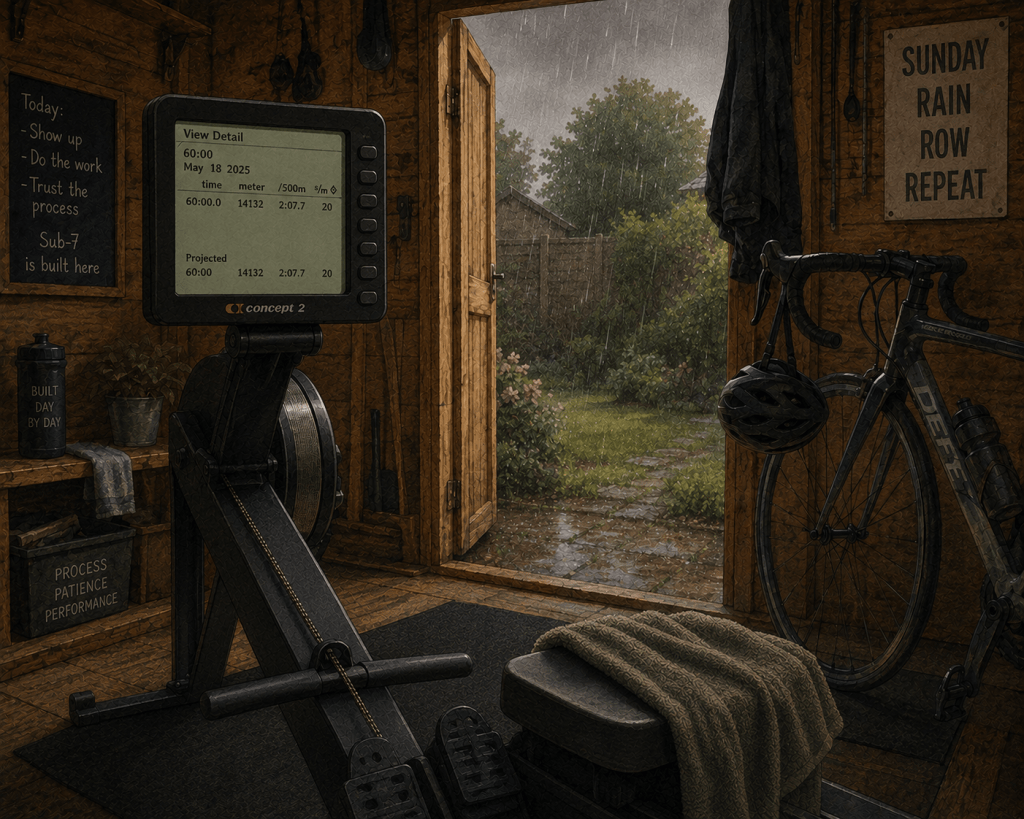
The session was three 20-minute blocks, giving me an hour in total. Gradual progression, getting faster as it went on. Nothing frantic, just steady work.
The thing that amazes me is that I did the full 60 minutes, just over 14km, at an average pace of 2:09/500m.
Thinking about it, that’s pretty mind-blowing. There was a time when I could only sustain that pace for short bursts. Not 30 minutes. Not even close. More like 30 seconds.
And here I am now, averaging it for a whole hour.
So yes, there is definitely progress happening. Sometimes it’s hard to see when you’re in the middle of it, but numbers like that make it pretty clear. The aerobic base is there. The cruising speed is improving. The work is paying off.
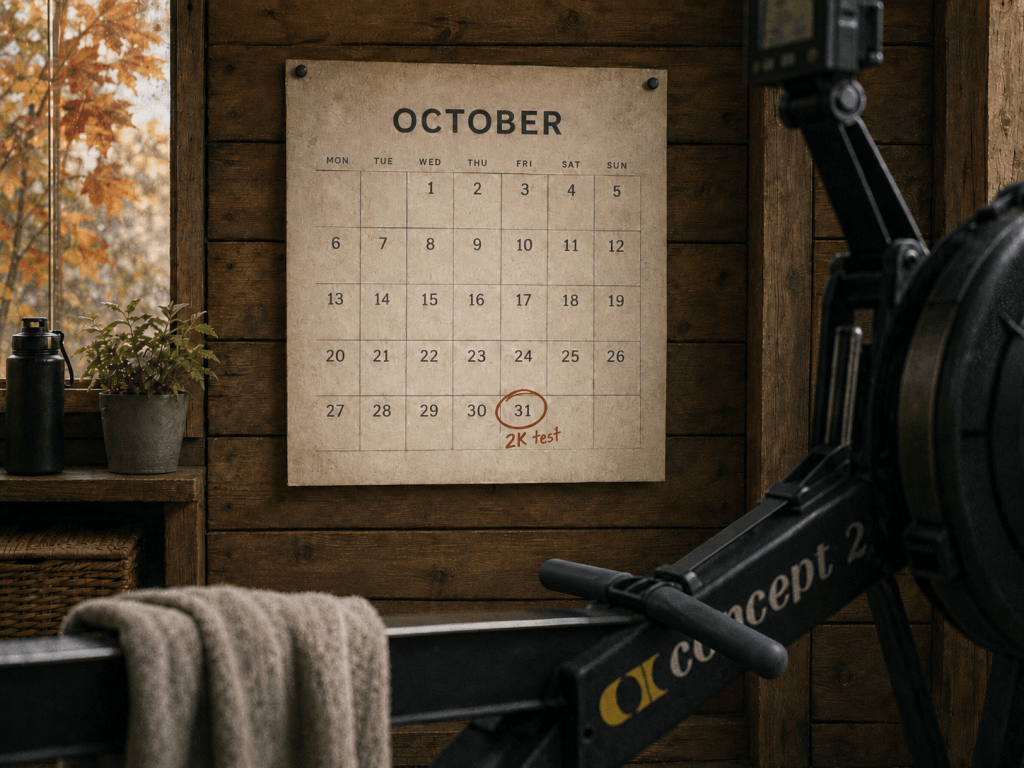
Cycling around Dingle is coming in a couple of weeks. The 2K test is still the target for the end of October.
I mentioned recently that ChatGPT seems to remember what it wants to remember, and that sometimes you have to specifically tell it what to forget.
It turns out you probably have to specifically tell it what to remember too.
So that is what I did.
I told Coach ChatGPT to remember this: we are aiming for a sub-7-minute 2,000m row. I also told it that I want to aim for a 2K test at the end of October, and to adjust the training plans accordingly.
And I have to admit, the last three sessions suggest that it has listened.
The workouts are getting progressively harder. They feel more focused, more purposeful, and more aligned with the actual goal. That is what we need.
I don’t know if I’ll be ready for the full sub-7 attempt by the end of October. That might still be too soon. But if I can beat my previous best of 7:20, I’ll be happy with that. That would be real progress and a proper marker for where I am.
Today was a good one.
I did a 6 × 500m interval set, getting faster and faster as the session went on. Every rep was under 1:57/500m, and the last one was around 1:49.
Controlled. Powerful. Technique felt good.
That is the bit that matters most. Not just the pace, but the fact that it felt managed. No mad thrashing around. No hanging on for dear life. Just proper work, done properly.
Not because nothing has been going on, but because the things to write have largely been the same:
“Nice workout. Got the job done. Nothing much to report.”
And it has all been a bit samey.
That has got me asking questions. Why does it feel the same? Where is the push coming from? Am I still properly engaged in the Sub-7 Experiment?
So I’ve been trying to make sense of it, and here are a few thoughts that might explain it.
Firstly, let’s look at the process.
For ages, the process has been the same. Take screenshots from WHOOP, put them into ChatGPT, ask for a workout, ChatGPT gives me the workout, I do it, then I report back.
That process worked for a while, but I’ve decided to ditch WHOOP.
I have cancelled my WHOOP subscription and no longer wear the device. It has done its job, and I am grateful for it. It gave me the impetus I needed when I started training three years ago, and it helped me get back into the idea of looking after myself. At that point, it was the best tool for the job.
When I started focusing on the rowing, I would set the app going to record the session and then work until I hit the suggested strain in the app itself. That suggested strain feature was brilliant because it stopped me bursting myself every time I got on the machine, wildly going for it until I collapsed.
No pain, no gain, right?
Well, not strictly true.
Too much pain becomes “give up and never go back,” at least that’s what my head was telling me. But with the WHOOP strain monitor giving me a suggested amount of work to aim for, it gave me structure without stupidity. Brilliant.
But now there is so much data in there that I have become swamped by it, and I’m not really using most of it. Yes, I would check recovery and sleep, but to be honest I am well used to my body showing signs of fatigue after a workout now. I don’t need an app to tell me every morning.
Recovery is also quite subjective, based on WHOOP’s algorithms. Sleep quality is the same. I was there. I know how the sleep went.
As for the rest of it, there is so much data now that I don’t know what to do with it, other than remove it from my life and make things simpler.
So no more checking WHOOP first thing in the morning. No more screenshots of WHOOP, ErgData and Strava into ChatGPT after every workout just to capture all the details.
I’ve gone back to using my old Polar chest strap and heart rate monitor, connecting that directly to the Concept2 rowing monitor and letting ErgData capture the session and feed it into Strava. When I’m in the gym, the same strap sends heart rate directly into my phone and the Strava app.
I am still asking ChatGPT to give me the workout each time, and I am still uploading the results from ErgData afterwards. Occasionally I’ll upload Strava too if ChatGPT asks for it. So the coaching process is still there, but the data sources are simpler and there is a lot less noise around it.
Good.
Data sources simplified. App integrations simplified.
Let’s go.
Except nothing really happened.
The workouts were fine, but they were also a bit easy.
So I had a chat with ChatGPT itself.
One of the things about ChatGPT is that it has a memory feature. Depending on the subscription you have, it can remember things from your conversations across different chats. That can be a good thing, but it turns out it can also be a bit of a problem.
It’s good because, as a user, you don’t have to keep reminding it about everything that has happened. I have a persistent conversation inside ChatGPT that is all about Sub-7 coaching, along with many other subjects.
I had some surgery on my leg last October, and at the time I asked ChatGPT, within the Sub-7 coaching conversation, for a recovery plan to get me back up to speed. It remembered that.
I also tweaked my back in the gym a short while ago, using bad form to lift some plates off a machine I was using. Again, I told ChatGPT about it and asked for recovery steps. It remembered that too.
So when I asked it to remind me what the Sub-7 Experiment was about, it told me the long-term plan: to build a training programme that will enable me to row 2,000 metres in under 7 minutes.
That was the right answer.
But then I challenged it. I asked why I felt as though there was no real progress at the moment and why everything felt very samey. It came back and said I was still recovering from the tweaked back and the leg surgery.
And immediately, there it was.
It had remembered that I’d had those issues, but it had not properly remembered that I had also told it I was back in one piece and able to continue with the full-on progress towards Sub-7.
It seems the memory function in ChatGPT remembers what it thinks is important, not necessarily what the user thinks is important, unless the user specifically says: “Remember this.”
So I told it to remember that I am back on form and back into the full Sub-7 programme, and that it should stop treating me like a piece of glass.
And since then, starting last Sunday, the workouts have been much more on plan.
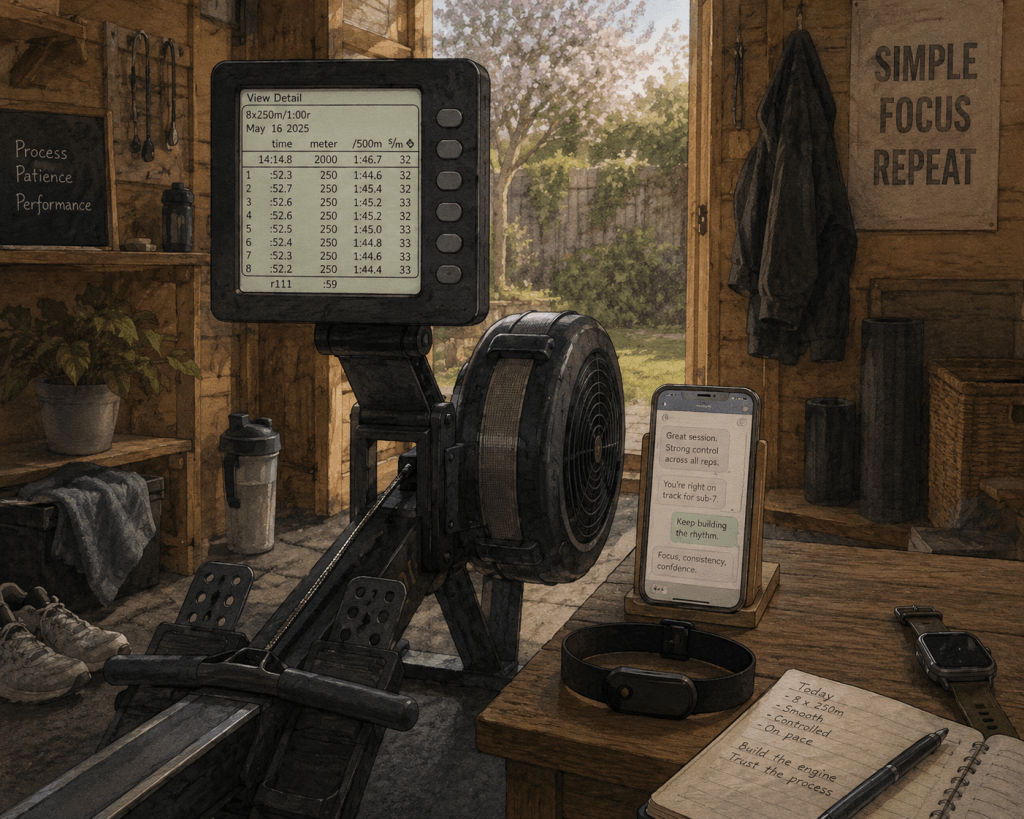
Sunday’s workout was a 10-minute warm-up, then 8 × 250m sprints with 90 seconds rest between each one, designed to simulate 2,000 metres at or around Sub-7 pace.
And my goodness, it was a strong session.
Properly controlled pacing. Good technique. No mad thrashing around. And most importantly, there were signs of real progress.
Yes, there were rest periods between each 250m sprint, but if I add up the actual times of those 250m sections, it comes out as a 7 minute 7 second 2,000m.
All I need to do now is join those 250m sections together.
That is definitely going to need extra strength work in the gym and more power runs on the rower, but I am making progress.