It’s Friday.
It’s been a long week.
My WHOOP says 49% recovery.
My brain says, “you’re behind.”
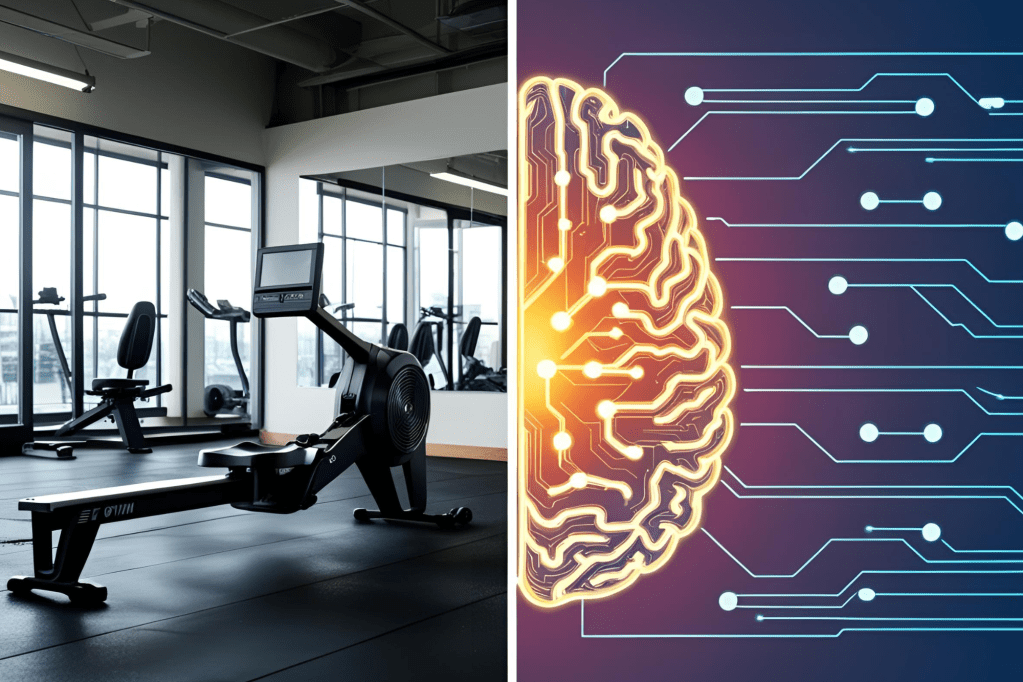
So I asked ChatGPT for a smart session—and it delivered:
500m rowing intervals, sled pushes, farmer’s carries.
Solid, focused work.
And I enjoyed it. I really did.
But there’s something gnawing at me—and I need to write it down.
I haven’t done the core work I said I would.
Holiday’s coming up in a few weeks.
And the truth is… when I look down, I still see the belly.
The tyre.
The thing I was hoping would be gone by now.
I’ve been consistent. I’ve been disciplined.
I’m rowing faster. Pulling harder. Lifting heavier.
I’m wearing trousers I couldn’t fit into a while back.
My shirts hug in the right places again.
I know I’m fitter. I know I’m stronger. I feel it every session.
But… I don’t see it. Not in the way I’d hoped.
And it’s messing with my head.
I think part of it is stress. Work’s intense right now.
And I feel like I’m slipping into old habits—being hard on myself.
Impatient. Frustrated.
Beating myself up when I should be backing myself up.
I kind of thought this other work—this training, this structure—would sort everything out.
That I’d look down one day and think, “There he is. That’s the guy I was aiming for.”
But instead, I look down and think, “Still the same.”
The truth?
That’s not true.
It’s not the same.
I’m not the same.
But body image is a funny thing.
It lags behind the progress.
It rewrites the story.
And sometimes… it just lies.
A Thought from the Shower
This morning, standing under the water, something hit me:
Is this the part of the experiment where a human coach would make a difference?
Would a real-life coach have pointed to the mat and said, “Go. Now. Do the core work.”
And would I have done it—just because someone was watching?
It’s easy to ignore words on a screen. Even when those words are spot on.
But the whole point of the Sub-7 Experiment is to see if I can close that gap.
The AI can suggest the work.
But I still have to choose to do it.
This isn’t failure.
It’s a data point.
A moment in the experiment where the mental friction is more important than the reps.
And here’s the realisation:
Consistency is easy when it’s comfortable.
The real test is doing the things I’d rather avoid.
It’s Friday. The sky is blue.
The sun is shining.
My people are healthy. I’m healthy.
I’m making real progress—even if I can’t always see it in the mirror.
This is still the Sub-7 Experiment.
And it’s about much more than rowing.


 The Sub-7 Experiment