It is a few days into this phase of remembering what it feels like to look after myself, and it is actually pretty good.
It is Sunday today. I got up, had some breakfast and watched a bit of telly. I have a presentation first thing tomorrow morning, so I knew I had to do some work today as well.
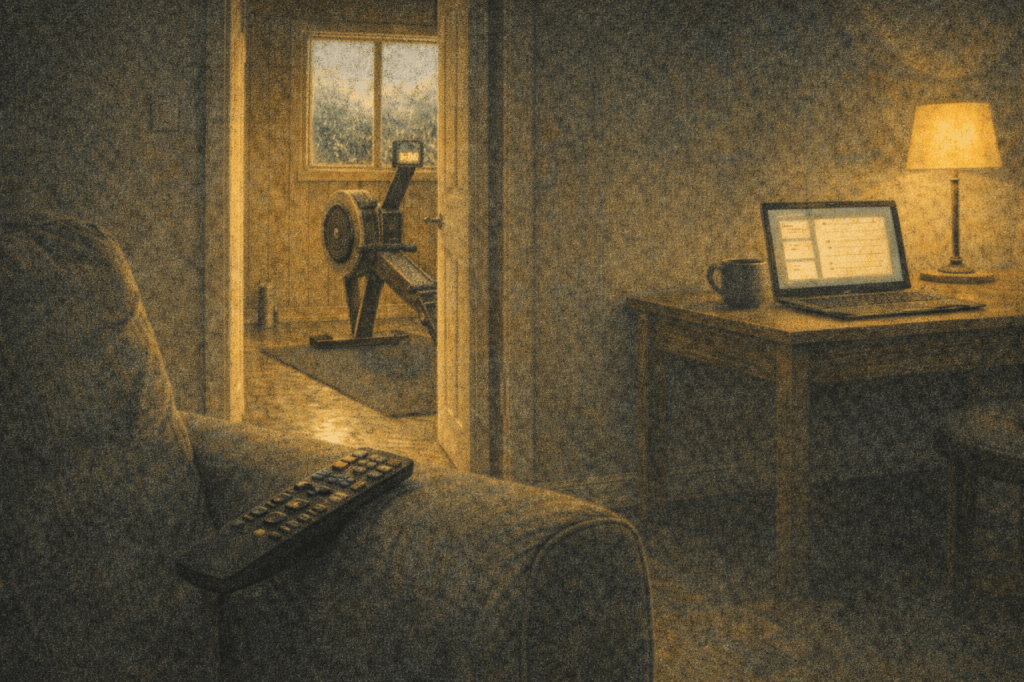
It would have been very easy to sit on the sofa all day. It is raining outside, the rest of the house are happily relaxing and doing their own thing, and the path of least resistance was right there.
Instead, I reminded myself what it feels like to look after myself properly.
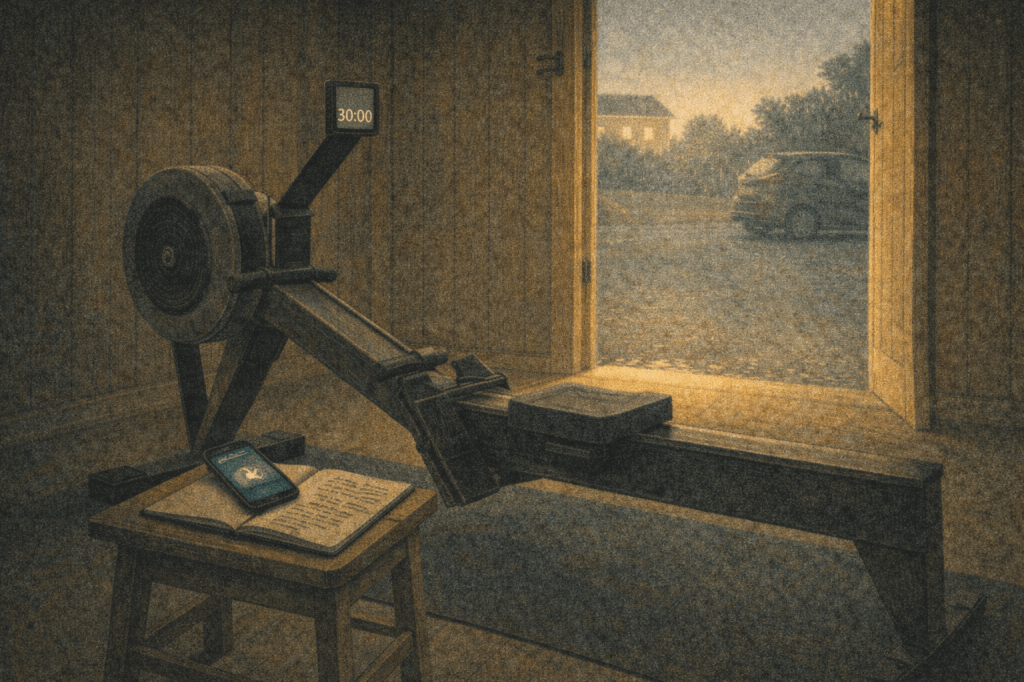
I went out to the shed and did 45 minutes on the rower. Now I am set to sit down and do a couple of hours on the presentation so I am ready for nine o’clock on Monday morning.
All checked in, all good. I am rowing well, cruising well, pulling decent speeds at a low stroke rate and generally getting faster with better technique. The Sub-7 goal is still there, and it is coming along. It is probably time to do a 2K test soon and see where things are.
For today, though, I am just glad I did not spend the whole day on the sofa. I moved first, then I worked. That feels like the right order.
Choose to be happy. Choose to be sad. Choose to feel sorry for yourself. Choose to eat your own bodyweight in cheese and crisps and crackers. Choose to turn up. Choose to be a good dad. Choose to go to the gym and come out feeling brilliant, like I did today.
Today was the first time I’ve chosen to go to the gym in a long time. I haven’t been at all this year.
Instead, I’ve been blaming other people. Blaming the New Year’s resolution crowd for “clogging up” the gym. Why am I so anti-them? They’re trying to make a change. I’ve been in their shoes, and not that long ago either. Twelve months ago, twenty-four months ago, I was them.
If anything, I should be in there alongside them. As someone who has been where they are, I could help if they needed it. Instead, I chose to use them as my excuse not to go.
I also chose to decide to be sad because of the time of year. It’s winter, Christmas is gone, the sun barely shows up, so I leaned into it. Chose the slump. Chose to sit on my hands.
What a choice, when there’s only one go at this life.
At some point you have to choose to live it. Choose to get off your arse and do something about it.
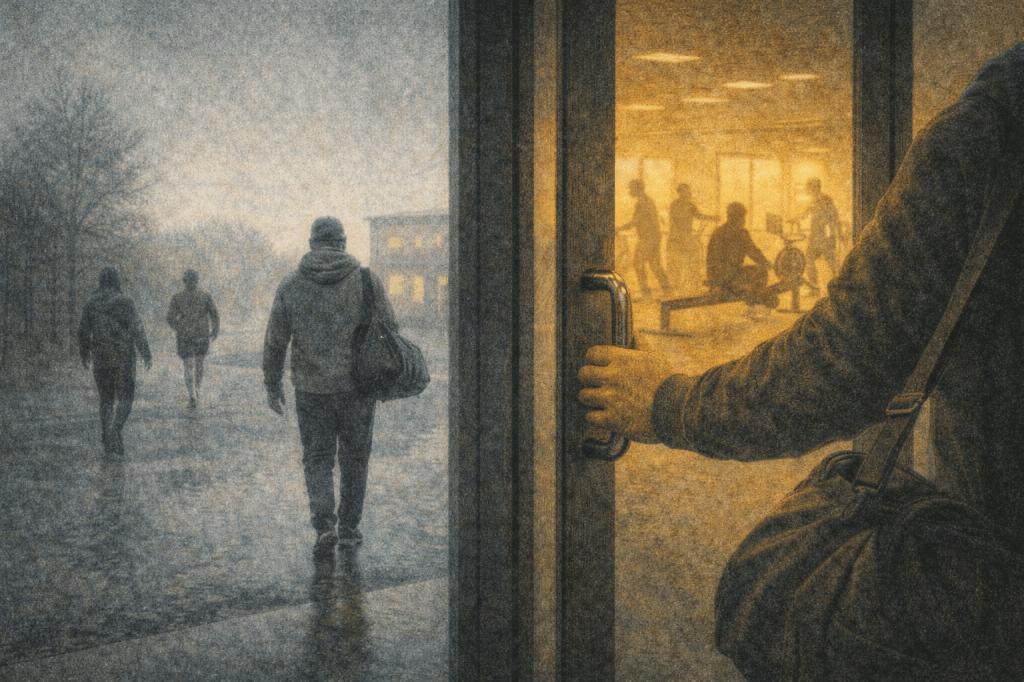
Today, I chose to go to the gym.
I’ve been rowing in the shed on my new rower, and I’m still delighted I’ve got it. But I’ve missed the contact with people. I’ve missed being in a place that’s full of like-minded folk, all there to put some effort in and feel better for it. The buzz. The energy.
So today I choose differently.
I choose to live. I choose to be the best version of me that I can be. And I choose to start doing that again today.
One day on from yesterday’s realisation and I’m already seeing the difference.
I’ve got another potentially tricky meeting today, so I leaned straight back into the thing I know works: move first.
Old coach-slash-head-shrink GPT laid out a 30-minute session. A few minutes of gentle warm-up, then some mildly paced intervals. Nothing major, nothing draining or heroic. Not hectic, not heavy. Just enough to switch me on.
And it’s done exactly that. I feel ready to go now.
The point of this one wasn’t fitness gains or split times. It was mental health and headspace: using the rower to take the edge off, so I can walk into the meeting calmer, sharper, and in control.
Now it’s time to get ready for work and do what I need to do.
This is The Sub-7 Experiment: using movement to switch the lights back on.
It’s been tough. Most of December, all of January, and the first bit of February I’ve been coming up here “looking for my mojo.” I’m not even sure I ever had a mojo in the first place, but it became the story in my head: I’ve lost it.
It hasn’t helped that it feels like it has rained every day this year where I live. The sun barely shows up. I also think I put too much stock in the idea that once I had a rowing machine in the shed, everything would click and I’d train every day.
On top of that, the new process I built in December – WHOOP scores into ChatGPT, get a tailored session – hasn’t been working the way I hoped. Not because the logic is bad, but because of how I react to it.
When ChatGPT looks at my WHOOP recovery and sleep and says, “easy day today,” I treat that as a full stop. “Right, that’s it, we’re done.” No movement. No walk. Nothing. It’s basically become an easy out, and I’ll always find an easy out if you give me one.
The “mojo hunt” has turned into the same thing. If I tell myself I’m looking for my mojo and I can’t find it, then I have an excuse to sit on the back foot and do nothing.
I still want to row. I still want a sub-7 2,000 metres. That goal hasn’t changed. What I’ve lost sight of is that exercise, for me, is about far more than chasing a single number on the monitor.
The rowing – and the moving in general – is primarily about my mental health.
Case in point: earlier this week I was heading into a potentially confrontational meeting. I knew the people in the room probably weren’t going to like what I had to tell them. The old me would have carried that anxiety all day.
Instead, I went into the shed.
I told ChatGPT about the meeting and asked for a workout that would help channel the adrenaline and set me up properly. It came back with a plan that turned out to be perfect. By the time I’d finished the row, the energy was controlled, not chaotic.
I hadn’t even called the meeting – someone else had – but when it started I decided I was going to drive it. I would control the narrative. Everyone would get their say, everyone’s points would be noted, but at the end of the day there were only two options on the table. They could go one way or the other. That’s it.
I went in with that calm, directed energy from the row and nailed it.
Fast forward two days. I’ve just come out of the shed after another row and another thinking session, and the penny has finally dropped:
I never had “mojo” in the first place. What I had was movement. When I move, I look after myself. When I stop, everything starts to fog over.
My mental health depends on exercise. Full stop.
And so what if I’ve put on a few pounds lately. That does not define me. What defines me is the state of my head and my ability to deal with things calmly and rationally – whether that’s work stuff, dad stuff, husband stuff or just being a decent friend. That is what counts.
The next step isn’t hunting for some mystical spark. It’s much simpler and much more boring:
Go outside, even when it’s raining.
Get back to walking.
Go to the gym.
See people, even if it’s just a nod to the receptionist or a quick hello to the regulars.
I need the physical work and a bit of human contact. If I keep those two things in the mix, everything else won’t magically fall into place, but it will get clearer again. And clarity is what I need: for my mental health, my physical health, to be a decent dad and husband, and to be kinder to myself.
I’d lost sight of that.
This is The Sub-7 Experiment: not just chasing 2,000 metres, but remembering to look after myself.
I still think the process itself will work, but I need to change the order in which I do things.
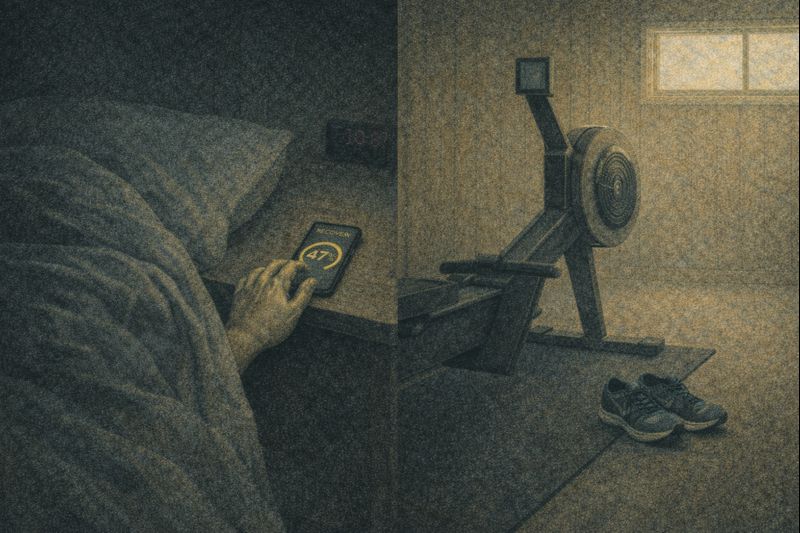
Right now it goes like this: I wake up, reach for the phone, input my WHOOP scores, see what ChatGPT recommends for the day’s session and then… nothing. No enthusiasm, no drive, just “I don’t want to do that.” Then I get out of bed and start the day.
And that day has no exercise in it.
The realisation this morning is that I need to go back to the old routine. The one that actually worked.
Wake up. Get out of bed. Do the breakfast stuff. Make a packed lunch for my son. Put the gym gear on. Get to the gym or out to the rower. And only then ask ChatGPT for the fitness plan.
The crucial part is doing all of that without giving myself time to think my way out of it. No lying in bed, staring at a plan on a screen until I talk myself into doing nothing. At the moment that happens about a nanosecond after I see the suggested session.
So the change is simple: move the decision point from under the duvet to when I am already in my kit, standing next to the machine.
This is The Sub-7 Experiment: wrestling with routine.
OK, that was a good session. I didn’t think it was going to be.
My recovery, according to WHOOP, was down in the yellow at around 47%. Not terrible, not great. CoachGPT’s prescription for today was simple enough on paper: three 6-minute intervals at a pace between 2:02 and 2:05/500m, with a stroke rate of 22–24.
I looked at it and thought, what’s the point? It didn’t sound like there was going to be much effort involved.
Turned out I was wrong.
I did my warm-up and then got into the first 6 minutes. Holding 2:02 at 22 strokes per minute is actually a fair bit of work. It ties straight back to what we were talking about the other day: lower stroke rate means you have to put more power into each stroke.
By the end of the first 6 minutes I was puffing. I took the 2-minute rest, started the second 6-minute block, and I was definitely working by the end of that one too.
The third set was the most interesting. I couldn’t find a rhythm at all to start with. I was either rowing too fast or too slow. Pace drifting, stroke rate drifting. It took me nearly half of that final 6-minute interval to settle into the groove of 22 strokes a minute at around 2:02/500m.
Once I locked it in, it felt solid, but it was a much more intense session than it looked on paper.
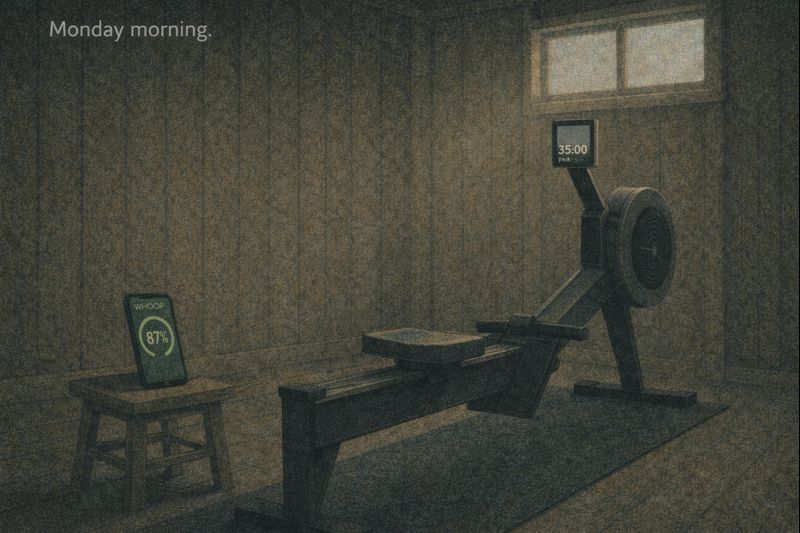
WHOOP was green when I woke up, and green means go. So I went.
I did a short warm-up, then 35 minutes on the rower at an average pace of about 2:04/500m, which worked out to roughly 8,500 metres. With the warm-up and cool-down, it comes in around 11k for the day.
Nothing dramatic, no heroics. Just a solid, steady session and another brick in the wall.
When I finish my sessions, I take screenshots of the WHOOP data and the ErgData app and feed them back into Coach ChatGPT. Today I noticed something new. It didn’t just say “good job.” It started to ask for specific changes in the data.
My pace was where it had asked for it, if not a little quicker. What it picked up on was my stroke rate. It pointed out that I was moving a bit fast and that it would like to see the same pace but with a lower stroke rate.
That probably doesn’t make much sense unless you are used to the action of rowing.
Inside the rower is a flywheel that gives you the resistance on each stroke. On the recovery part of the stroke, that flywheel slows down, and how much it slows depends on the damper setting. The higher the damper, the more the flywheel slows, and the harder you have to work on each stroke to get it spinning again. To keep a 2:04 pace at a higher stroke rate, say 26–28 strokes per minute, you can “get away with” less power per stroke. To hold the same 2:04 at 22–24 strokes per minute, each stroke has to do more work.
In simple terms, CoachGPT is asking me to slow the stroke rate down and put more power into each stroke. Get stronger, not just spin faster.
I hadn’t really seen it nudge me like that before. That is good. It means the coach is starting to care about how I make the split, not just the number on the screen.
It felt like the first real, proper work towards the Sub-7 project for a long time. I did six 500 metre intervals, sitting pretty consistently around 1:52/500m. It felt like work – in a good way. Hard enough that I had to concentrate, not so hard that I was falling apart.
After that I dropped the intensity and spent 15 minutes just cruising around the virtual loop, spinning the legs and letting the heart rate come down.
Nothing dramatic to report. No breakthroughs. Just solid work.
We’re on the right route. I think we always have been – it’s just that some phases feel easier than others.
I’m afraid I didn’t listen to CoachGPT at all today.
I knew I wanted to row, and I knew I wanted it to be tough. When I asked ChatGPT for a plan earlier, it came back with something sensible enough, but my head wanted a long, hard row for the sake of headspace, not optimisation.
So that’s what I did.
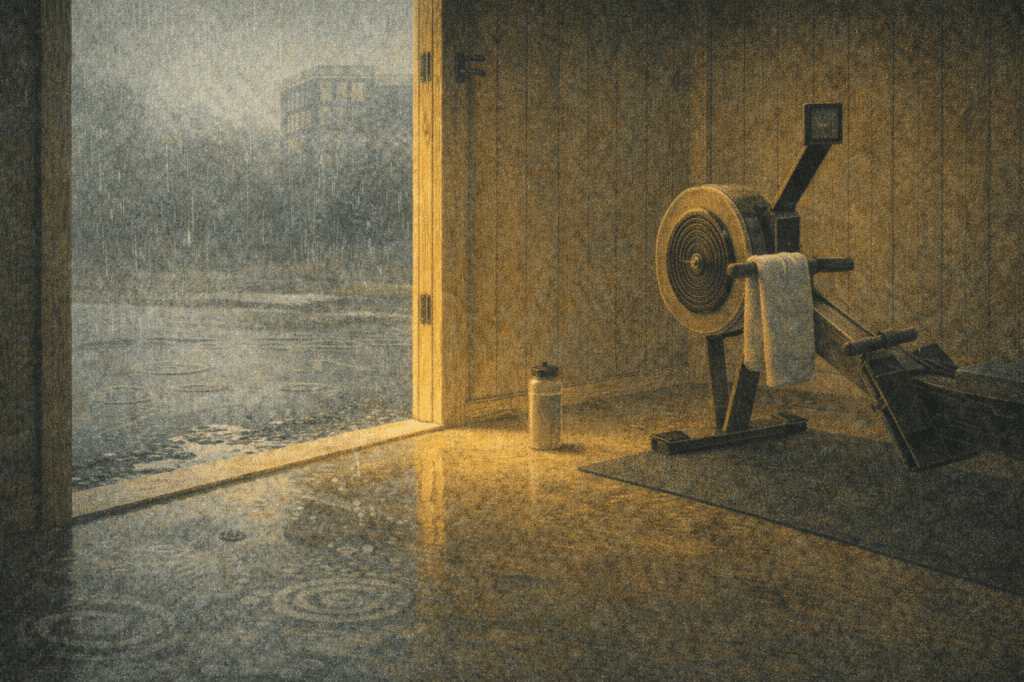
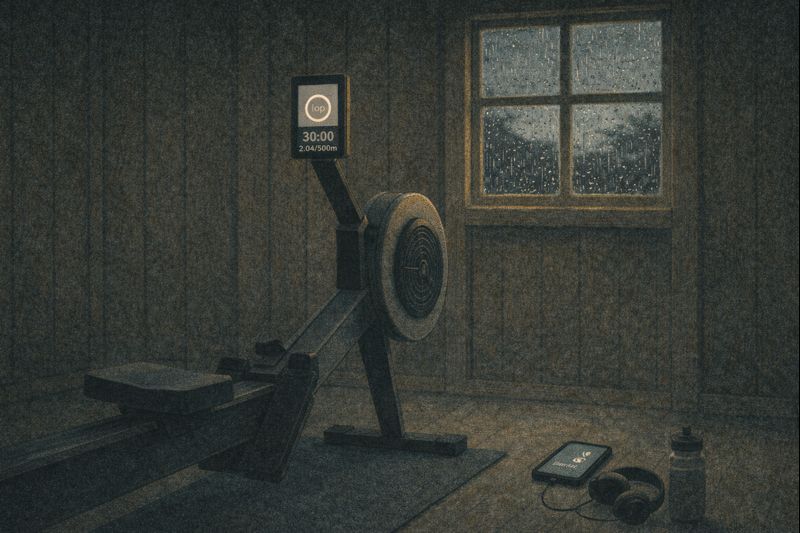
It’s chucking down with rain outside. This is exactly why I wanted a rowing machine in the shed. With the way my head was this morning, there was no way I was going to get in the car, drive to the gym and do a session there. Walking across the garden to the shed felt possible. Driving across town did not.
On the Concept2 PM5 you can connect your phone over Bluetooth and use the Concept2 app ErgData. There’s a feature in there called Real Time – basically a virtual 1,000 metre lap that anyone can join in real time if they’re logged in.
I’ve used it on the last few longer rows, and I really like it. Today there were 36 people from around 20 countries on the same virtual loop. You don’t see their exact pace numbers, but you see if they’re coming past you or if you’re moving through them. There are also virtual pace boats going round, so if you want something to latch on to, you pick a boat and hang on. Alongside that you still get your own pace, stroke rate, distance and time. Plenty to chew on.
Today’s session was:
5 minute warm-up
30 minutes on the virtual loop at an average pace of 2:04/500m
250m all-out sprint
5 minute warm-down
I was moving, and it felt good.
It wasn’t by the book. It wasn’t what the coach recommended. But I finished feeling great, and I needed that sense of control today – the feeling that I had chosen the hard thing and seen it through.
This is The Sub-7 Experiment, and sometimes I’m the one steering.
I thought that having a rowing machine in the shed would mean I’d use it every day. That was the plan in my head: step out the back door, sit on the erg, job done.
What’s actually happened with this new training regime is almost the opposite.
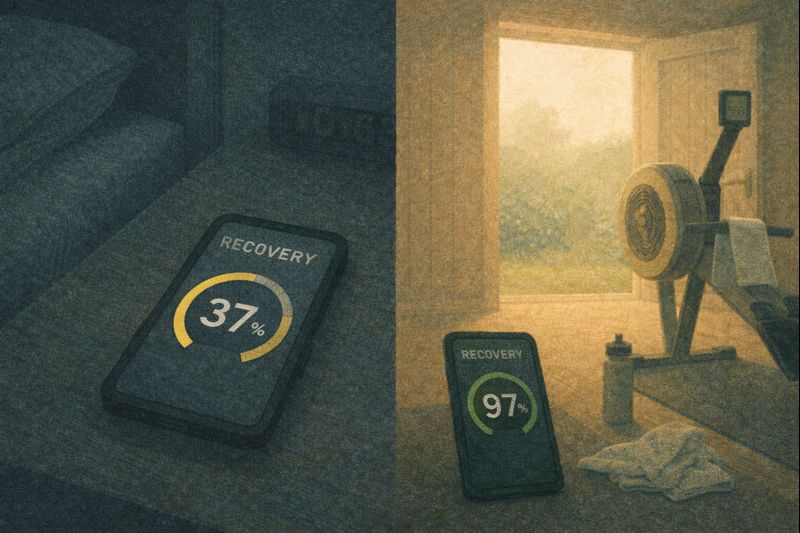
Since I started feeding my WHOOP scores into Coach ChatGPT, there have been more recovery days than I expected. Yesterday was a perfect example. I woke up fully intending to do a decent session in the shed, or maybe even go to the gym. But my recovery score, according to Whoop, was 37%, and the advice from Coach ChatGPT was simple: take a recovery day.
It felt wrong.
In my head, I wanted to train. But this is the deal I’ve made with myself: if I’m going to use data and a coach, I have to actually listen. So I did. I gave myself the day off. My total strain for the day was only 4.4. Not much happened physically.
Then came this morning.
Recovery was 97%, the highest it’s been in a long time. Suddenly yesterday’s “non-session” made a lot more sense.
With that green light, today’s plan was a decent workout on the rower in the shed: three 8-minute intervals with 2 minutes rest between them, each one slightly faster than the last. Warm-up first, cooldown after. It felt like a well-judged session, enough to make me work, not enough to bury me.
I’ll admit, I’ve been wondering if I’ve made this whole thing too complicated. Copying WHOOP numbers into ChatGPT. Using the new app on the rower to program intervals, target pace, target stroke rate. It’s a few more moving parts than just “sit down and hammer it.”
But I think this is just what happens with any new process. At first it feels clunky and over-engineered. Then you learn it, repeat it, and it becomes habit. Muscle memory. Copy, paste, adjust, row.
Today was a good workout and a good lesson: sometimes the smart move is not to train, so that when you do train, you can actually go to work.
This is The Sub-7 Experiment, and I’m still figuring it out.

 The Sub-7 Experiment