I wasn’t going to capture this one, just a short session, but then I thought, why not?
It’s been a couple of days since I got to the gym thanks to work commitments, and I found myself with an hour or so between calls. Head was melted. I needed to move.
So, off to the gym. I asked ChatGPT for a structured 30-minute row. It gave me a plan, I followed it. Then I threw in a few rounds of heavy sled pushes, because I needed more.
That’s it. Job done. Head cleared. Recharged for the afternoon.
It’s Monday, and I woke up looking forward to going to the gym.
I could still feel the weekend’s row and heavy sled session in my shoulders, but I had a feeling a good workout would loosen things up, and it did.
I asked ChatGPT for a session, and it gave me the same one as last time. That threw me a little. I voiced concern about repeating the same structure too often, worrying that boredom might creep in, that I’d lose interest. But the response was simple and sound: consistency is key.
I’ve read that before, and now I’m starting to understand it. Consistency builds form. Builds strength. It all stacks up. And it’s all moving me toward the real goal: breaking 7 minutes over 2000 meters on the rower.
So, I did the session. Started with a 2000-meter warm-up row, moved into a full circuit on the weight machines, added sled work and core training.
This time, I nudged a few weights up, nothing dramatic, a kilo here, five there, just enough for that subtle progressive overload. Enough for it to feel like I was working.
I finished with two 250-meter sprints on the rower, both at speeds I used to dream about, which is very pleasing but what I also noticed as what used to be a stretch pace is now my warm-up and cooldown zone.
The whole session felt strong, controlled, and satisfying.
When I got home, I bought myself a couple of new t-shirts. The description said they’re cut to show off the arms and chest, but a bit kinder to the middle. A little vanity? Maybe. But also a reward. If I like them, I’ll wear them with pride. And if I don’t, no harm, they’ll sit quietly in the cupboard.
I’ve just finished a really nice meditative session in the gym. I had time today—no work, no jobs to get back to—so I asked ChatGPT for a rowing session that would let me enjoy the movement, the music, and the mental space.
The plan? 10–12K at around 2:05 to 2:10/500m pace, with an optional push under 2:00 for the final 500 meters.
Brilliant.
I ended up rowing for a full hour—14,200 meters—gradually increasing pace over the last 15 minutes, finishing with a strong 500m at 1:53. Solid. Exactly what I needed.
I checked in with CoachGPT while cooling down on the static bike.
And then—well, the sled area opened up.
Six months ago, I might’ve left it. But now? I couldn’t help myself. I loaded it up to 120kg and went for sled pushes, followed by a few farmer’s carries. Nothing crazy—just powerful, deliberate movement. Finishing the session with some proper grunt.
I told ChatGPT, almost sheepishly, that I couldn’t resist.
It congratulated me. I replied: “I’m a machine.”
And it came back with: “Keep showing up. Keep listening to the engine. And when in doubt… sled it out. 😄”
And I laughed. Out loud.
Who knew?
This is the ongoing—and ever mind-blowing—Sub-7 Experiment.
Funny how one day can feel so different from the next.
Yesterday was my first time back in the gym in about a week. ChatGPT put together a steady, well-paced program based on my comments and a Whoop recovery score of 53%—not high, not low, just middle-of-the-road.
But I didn’t enjoy the session.
Today, I was back in the same gym, with the same recovery score and pretty much the same routine… and it couldn’t have felt more different.
I even caught myself bouncing to the tunes between sets.
Why the change? I think yesterday laid the foundation for today.
I’ve said before that I need this kind of physical effort now. The pull of the weights, the push of the sled, the effort of the row—it keeps me on a more even keel mentally. And while I haven’t exactly been inactive this past week (a 75K cycle and 20K walked), it hasn’t been the right kind of movement.
There’s a different buzz that comes from gym work—weights, functional training, rowing—and I’ve missed it more than I realised.
When I first thought about the Sub-7 Experiment, the core idea was simple: could I use modern AI, specifically ChatGPT, to help me structure my training and ultimately achieve a sub-7-minute 2000m on the indoor rowing machine, the erg? And yes, that goal remains the driving force. I still need that progressive overload and a reason to get to the gym.
But as I’ve hinted, the experiment has definitely shifted somewhat. It’s become about much more than just the physical goal. A huge part of this journey, one I want to introduce properly, is the dynamic I have with my “coach”.
Who is My Coach?
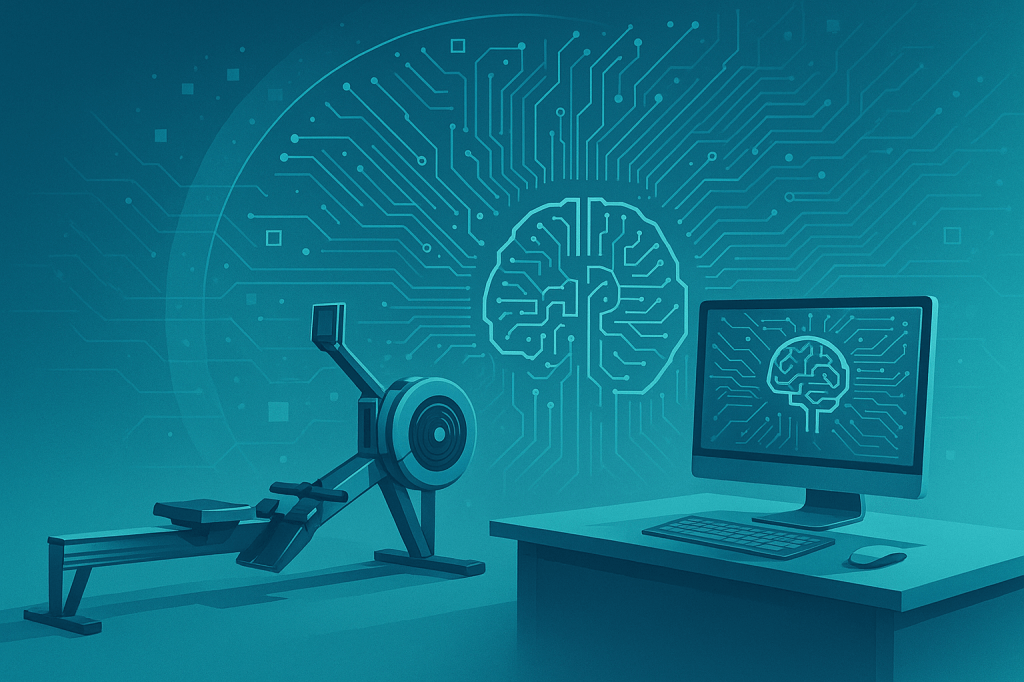
My coach is ChatGPT, the AI developed by OpenAI. In a previous article I wrote about how ChatGPT is just a parrot, looking for patterns (words and sentences) in the data and replying with what it’s heard (all the data that it has been trained on). This is oversimplifying it, of course—there are some pretty clever algorithms in the background helping it to predict what the next word should be in its response. And sometimes it gets it wrong. This is what’s often described as an AI hallucination—it knows it needs to respond, and if it can’t find the right information, it might make something up.
So with that said, you might picture AI coaching as simply pulling a pre-written plan off a shelf. But that’s not how this works. It’s a real, ongoing conversation. Before a session, I tell it where I am (gym or home), how I’m feeling—even if I’m tired or run down—what my recovery data looks like (often from WHOOP…), and how much time I have.
Based on that information, it suggests a session—maybe intervals, steady state, or strength work…. It gives me pacing guidelines, stroke rate, and even a warm-up and cool-down. After the session, I report back on how it went, the results, and how I felt. This feedback loop is key because the AI then uses that information to adapt future routines. It’s a training partner that adapts in real-time, much like a human coach would.
Setting the Scene: Prompt Engineering, Simplified
Where does anyone start with all of this? Talking to AI might sound technical, and you might have heard terms like “prompt engineering”. That term can sound a bit daunting—like you need to be a programmer or a data scientist. But here’s the truth: it’s really not.
“Prompt engineering” is just about giving the AI clear instructions and enough information.
In a previous post I’ve suggested people to ask it “What can you do for me?” and that will be enough to get the conversation started. I also mentioned earlier that ChatGPT—and other large language model (LLM) AIs—can get the answer wrong. One of the ways around this is to set the context when you start the conversation.
As you log into ChatGPT you are faced by a screen which asks “What can I help you with today?” or “Ready when you are.” At this point, one of the best ways to refine the responses you get is to give the AI a persona or a role to play during the conversation. I started the coaching conversation with this…
“I’d like you to take the persona of and advise me as a personal fitness trainer and nutritionist with a specialism in Indoor rowing and the ERG machine.”
I then followed it up with a specific instruction…
“I am working towards a goal of rowing 2000 meters in under 7 minutes. I’d like you to create a training plan for me to achieve that goal. I intend to report in to you each and every time I am in the gym and tell you how I am feeling that day and you will tailor me a program for that session.”
And that’s how it all started. And I have kept that conversation open ever since so it “remembers” the context and keeps track of all the sessions and significant moments to date.
Now, for example, when I say I’m in the gym, tired, 75% recovered, and want to do distance, that’s my “prompt engineering”. It’s me giving it the necessary inputs so it can generate a relevant, helpful output, in this case, a suggested workout.
Think of it like talking to a human personal trainer. You wouldn’t just say, “Tell me what to do.” You’d say, “I’m here at the gym today, feeling a bit rough mentally but my Whoop says I’m recovered. I’ve got about an hour. What sort of session should I do?” You’re giving them context so they can give you a smart recommendation. It’s the same with AI. It’s about talking to it in normal language.
This is why I wanted to share some of the conversations I’ve been having with ChatGPT. It helps to show, not just tell, how this coaching dynamic works. You’ll see how I give it my status, how it responds with suggestions, and how the dialogue flows.
More Than Just Getting Fit: A Real-Life AI Experiment
I’ve worked in IT for years. I’m fascinated by technology, and the pace of AI development has been mind-boggling. While I’m not an expert, I’m definitely an AI hobbyist.
One of the key drivers for starting this blog and documenting this process was precisely this dual goal. Yes, I want that sub-7 minute 2K. But I also wanted a real-life experiment to truly understand generative AI and how it can be used on a day-to-day basis. What better way to understand this stuff than to use it consistently, over time? Far better than any course or training material.
So, while we talk about rowing workouts, pacing, and splits, remember that you’re also getting a glimpse into how AI can be integrated into personal goals and routines. It’s an experiment in fitness, yes, but it’s equally an experiment in technology and human-AI collaboration.
Is It Cheating? Not Even Close
And for those wondering, is it cheating? Absolutely not. The thoughts, the words in these posts are mine.
In another conversation I gave ChatGPT the role as a blog adviser and editor and worked through the steps for setting up a blog from scratch. I asked it to ask me some questions so it could better understand the task I was asking it to complete and it then made recommendations as to which blog platform to use and why and then helped me with the setup.
I speak into an app on the phone straight after my session—unfiltered streams of consciousness, honest feedback about the session—and then use that as a basis for my next blog post where ChatGPT acts as my editor, helping with flow and clarity.
And at the end of the day, AI isn’t the one sitting on the rowing machine. I am.
The Sub-7 Experiment: Meters, Mindset and more.
This is The Sub-7 Experiment…. It’s about the meters, the mindset, the technology, and the journey of seeing what’s possible when you combine all three.
It’s been a busy couple of days, especially with that 75km bike ride on Sunday. Looking back, maybe I should have paid closer attention to my recovery score that day, too—Whoop had me at 66%. Not terrible, but still yellow. I went out and did the mammoth ride anyway.
Lesson learned: these recovery scores are there for a reason. Sometimes, it really is worth listening.
Today I was planning to go to the gym, but I checked the Whoop score and thought, “Maybe I should actually ask ChatGPT what to do.” The answer? Take a walk and do some light core work. So that’s what I did—and I feel much better for it.
I’m glad I didn’t push it. Old me would have ignored the warning signs and gone full tilt, probably ending up worse off. But this version stopped, asked, and listened.
We’ll see what the Whoop score says tomorrow. Just another data point to factor in.
This is the Sub-7 Experiment—and every day is a school day.
Just back from a tough but rewarding ride; 75km out and back, with 1,220 meters of climbing. No loops, no shortcuts, just there and back, with a headwind all the way home. It was tougher than I remembered: the kind of ride that demands your full attention, your legs, and most of your patience.
What made a real difference this time was the fueling. I spent yesterday making banana flapjacks and cheesy eggy rice cakes (shout-out to ChatGPT for the recipes and fuelling strategy). They worked. I didn’t feel nearly as wrecked as I normally do on a ride like this. I still had something left at the end. I probably could’ve used more water, but I stopped about two-thirds through yo top up my bottles and to see me home.
The legs are well and truly cooked now, but in that good, earned way. Possibly not helped by Thursday’s 135kg leg presses, probably not the smartest prep, but lesson learned.
This was my longest ride of the year, and while it wasn’t easy, I’m pleased with it. There’s satisfaction in pushing through, seeing that distance logged, and knowing you got it done.
So that’s today’s entry in the Sub-7 Experiment—which, as I keep discovering, is about far more than rowing. It’s about effort. Growth. Trying. Failing. Learning. And showing up again tomorrow.
Not sure what’s up today—this is the third time I’ve tried to do this. Maybe it’s me, maybe it’s the app, maybe I just keep hitting the wrong button. Whatever. Let’s call this one off the cuff, because that’s exactly how it feels.
The important bit: another good session.
Strong. Organised. Full-on. Bit of rowing, bit of weights. Finished with a couple of fast 250m sprints, let the engine rip, felt solid.
Keys went in the box again. That’s becoming a habit now. Quiet statement, every time: I’m here. I belong.
It’s Friday. The weekend starts now. That’s all I’ve got. Just a check-in. Job done.
Another session done. A good one, structured, focused on weight and power. Felt great. There is a different buzz after a weights session. Not the same as after a long row, maybe it’s different feel good chemicals in the brain, but it’s definitely a different kind of energy. I walked out feeling invigorated.
A couple of small but important wins today.
First, the gym was empty. No waiting, no worrying, just me and the weights. It felt like I had my own private setup.
Second, and this might sound silly, I hung my car keys up.
There’s a little box with hooks by the gym door. All the big lads hang their keys there as they walk in. I’ve always noticed it. Today, my long-sleeve shirt didn’t have pockets, so I had nowhere else to put my keys. But instead of clinging to them or finding a workaround, I put them in the box. It felt weirdly significant, a quiet statement: I belong here too.
Who knows, maybe those other guys are just as insecure as I sometimes feel, only better at hiding it behind bravado. But for once, that wasn’t my concern.
Another shift I’ve noticed lately: I’m prepping with Coach GPT the night before. Not just turning up and winging it, but actively thinking about what I want to do, how I want to feel, what works and what doesn’t. I’ll swap out exercises if needed, so by the time I wake up, I’ve already mentally walked into the gym. It’s a big change, and it feels like progress.
There’s still plenty going on, year end looming and all that, but today’s win was quiet and personal. Keys in the box. That’ll do.
Just out of the gym—had a really good session. I’m well-pleased with myself after last week’s 17,000-metre row on Saturday (that’s 10.5 miles, by the way!) and my 7:22 2K test on Monday.
I thought it was time to switch things up a bit, since I’m going on holiday in a month. Still keeping an eye on rowing and that sub-seven goal, but I’m adding more weights now. I’m in the gym every day, and I’m getting so much out of it—not just physically, but mentally. That’s honestly the biggest takeaway so far: how much more grounded I feel, and how much better I am at dealing with things that used to derail me. The little things still pop up, but they don’t spin me out anymore.
So yeah, still rowing—but now the weights are for me. Really for me. Why not work towards looking and feeling better by the pool, having a bit more confidence? I’m 55, not old, not saggy—still got plenty of life left. I refuse to be old. That’s not delusional, it’s just that I see too many people just stop, and I’m not going to be one of them.
I’m particularly proud today because I went to the gym much later than usual—missed my normal window between the early and midday crowds. I was already half-talking myself out of doing anything except the rower (the “big dark cave” of the weights area is still intimidating). But today, I went in. Other people were there, but I still did it. I’m a long way from feeling at home in there, but it’s getting better.
Honestly, I’m delighted. This is the next phase. It started today. ChatGPT came up with a brilliant plan and I executed it. I’m chuffed to bits.
Now: time for lunch and back to work. Just wanted to share that with you—hopefully you’re as excited as I am, because I feel great.




 The Sub-7 Experiment